What happened in Seoul after martial law was declared in South Korea?


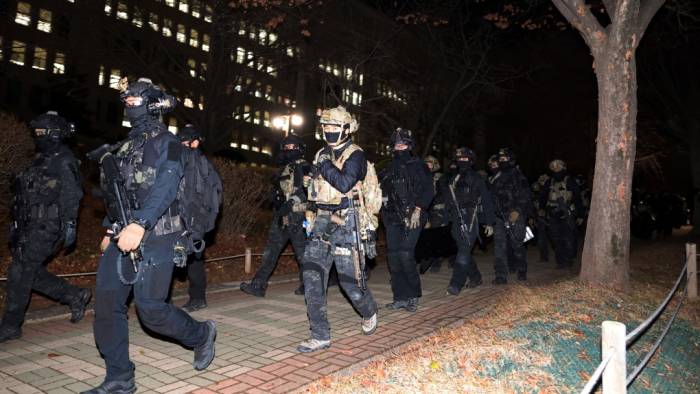
South Korean martial law soldiers leave the National Assembly in Seoul, South Korea, Wednesday, Dec. 4, 2024. (The Canadian Press/AP-Yonhap, Kim Ju-sung)
In an unprecedented move, South Korean President Yoon Suk-yeol declared martial law earlier today , plunging the nation into political and social uncertainty. The announcement triggered immediate mobilization of military forces into Seoul, where eyewitnesses reported convoys of military equipment moving through the capital's streets. This development marks a dramatic escalation in the ongoing tensions between the administration and opposition forces, signaling potential long-term ramifications for South Korea's democracy, economy, and social stability, News.az reports.
The declaration of martial law quickly resulted in heightened security measures, including the blocking of access to the National Assembly. Law enforcement authorities barred entry to members of parliament (MPs) and the general public, a move that sparked protests outside the assembly building. Clashes between demonstrators and security forces erupted near the main entrance, underscoring the volatile nature of the situation.Despite the military cordon, approximately 190 MPs managed to enter the parliament building, joined by Speaker Kim Jin-pyo. In a decisive session, they voted to revoke the martial law imposed by President Yoon. Reports from South Korean media indicate that military personnel stationed in and around the assembly began to withdraw following the vote, though no official announcement has been made regarding the cessation of martial law.
The political unrest has already sent shockwaves through South Korea's economy. The Korean won experienced a significant drop in value against the US dollar, reflecting investor anxiety over the country's uncertain future. Meanwhile, Bloomberg reported a marked decline in the stock prices of major South Korean companies. To mitigate the fallout, the government has pledged to deploy all available measures to stabilize financial markets, although the efficacy of these interventions remains to be seen.
While the use of martial law to suppress opposition is not unprecedented in South Korea, it evokes memories of authoritarian regimes that governed the country during its less democratic past. Leaders who employed such measures are now viewed as controversial figures in South Korean history, often remembered for their dictatorial tendencies.
President Yoon’s actions are drawing comparisons to these former leaders, raising questions about his intent and the state of democracy in South Korea. Critics argue that his aggressive stance against the opposition—which he has labeled as North Korean sympathizers—represents an alarming departure from democratic norms. This episode could mark a turning point in Yoon's presidency, aligning him with a legacy of leaders who prioritized consolidation of power over democratic governance.
The immediate consequence of today’s events is likely to be a surge in public discontent. Protests and demonstrations demanding President Yoon’s resignation or impeachment are expected to spread nationwide. The opposition, which Yoon accused of collaborating with North Korea, stands to gain significant political capital from these developments. By framing Yoon’s actions as an assault on democratic principles, opposition leaders may galvanize broader public support, further weakening the administration's position.
This upheaval also raises questions about the balance of power within South Korea’s political system. The swift vote by parliament to overturn martial law demonstrates institutional resistance to authoritarianism. However, the deployment of military forces in the capital sets a dangerous precedent, potentially undermining the public's trust in democratic processes and governance.
South Korea’s reputation as a stable democracy and a global economic powerhouse is at stake. Prolonged instability could deter foreign investment, disrupt supply chains, and diminish South Korea’s influence on the international stage. The depreciation of the won and falling stock prices underscore the immediate risks to economic stability, while long-term uncertainty could impact trade relations and partnerships.
International allies, including the United States, are likely to monitor these developments closely. As a key ally in the Indo-Pacific region, South Korea’s stability is of strategic importance. Any erosion of democratic norms or prolonged political turmoil may strain alliances and complicate collective efforts to counter regional threats, particularly from North Korea.
The next 24 hours will be critical in shaping the trajectory of this crisis. If protests escalate and public pressure mounts, President Yoon may face calls to resign or agree to a negotiated resolution with opposition leaders. However, should the administration double down on its current course, South Korea risks entering a prolonged period of unrest, further polarizing its society.
President Yoon’s decision to invoke martial law may have been driven by a desire to consolidate power and silence dissent, but it appears to have backfired, amplifying the very opposition he sought to suppress. Moving forward, restoring public trust and ensuring political stability will require transparent governance, respect for democratic principles, and meaningful dialogue with all stakeholders.
As South Korea faces this pivotal moment, the nation’s ability to navigate the crisis peacefully will determine not only its domestic trajectory but also its standing in the global community. Whether President Yoon emerges as a defender of order or is remembered as a divisive figure remains to be seen, but the consequences of today’s events will undoubtedly reverberate for years to come.


Similar news