Fifty years later: How the Green March reshaped Morocco’s future


.png)
Editor’s note: Faig Mahmudov is a journalist based in Azerbaijan. The views expressed are the author’s own and do not necessarily reflect those of News.Az.
This year marks the 50th anniversary of Morocco’s Green March, one of the most influential and symbolic events in the modern history of the kingdom. On November 6, 1975, hundreds of thousands of Moroccans responded to the call of King Hassan II and marched peacefully toward what was then Spanish Sahara.
Their march was not meant to wage war, but to demonstrate the unity and determination of the Moroccan people and to pressure Spain to negotiate the handover of the territory. Five decades later, the Green March remains a central part of Morocco’s national identity and a defining event in its policy toward the Southern Provinces.
The Green March took place during a period of global decolonization. Spain had controlled the territory since the early 20th century, but by the 1960s the United Nations was urging colonial powers to grant self-determination to the territories they governed. Morocco argued that the Sahara had historical ties of allegiance to the Moroccan throne, and in 1974 the issue was sent to the International Court of Justice.
In October 1975, the Court issued an advisory opinion that acknowledged certain historical links but reaffirmed the principle of self-determination. Morocco interpreted the ruling as support for negotiations with Spain rather than for an independence referendum under Spanish control.
Source: Diplomacy and Commerce
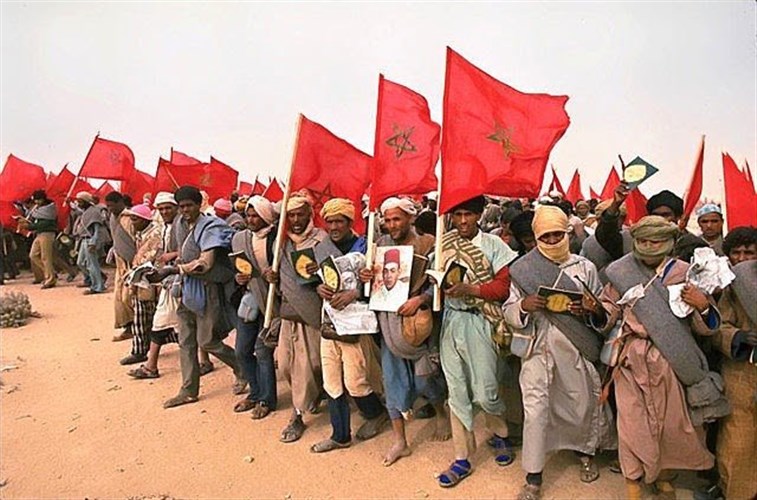
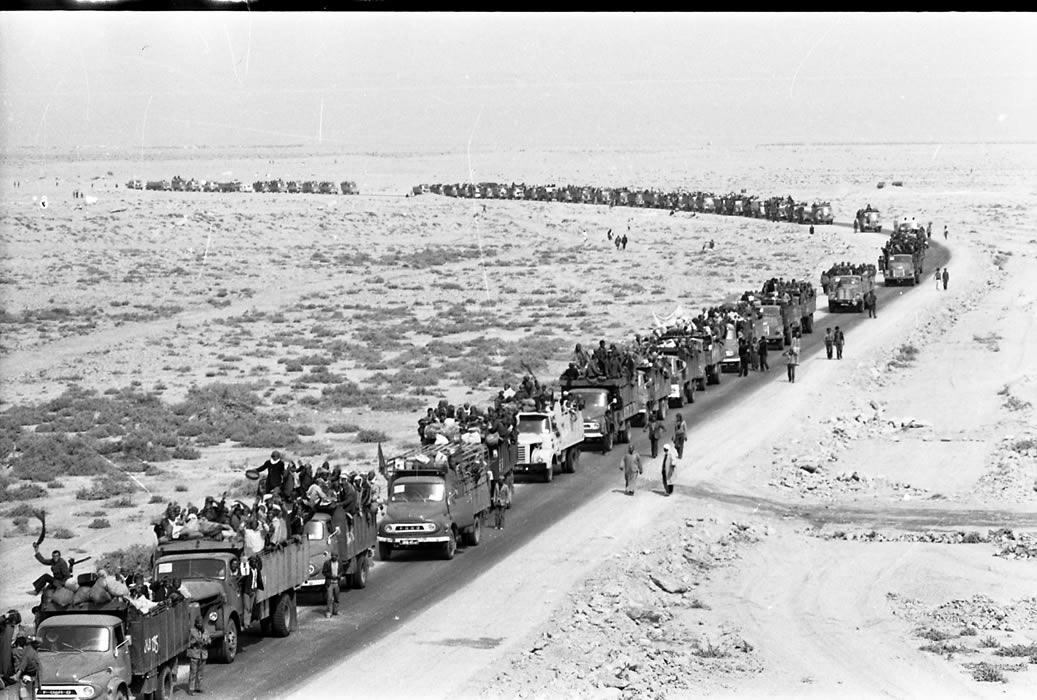
In this context, King Hassan II announced the Green March. On November 6, 1975, more than 350,000 unarmed Moroccans, carrying national flags, Qur’ans, and pictures of the king, advanced toward the border. The operation was organized with extraordinary precision and required large-scale national coordination involving transport, food supplies, medical teams, and communications. The presence of such an enormous civilian force placed immense pressure on Spain, which was already politically weakened due to the imminent death of General Franco.
Shortly after the march began, Spain entered negotiations, and in November 1975 the Madrid Accords were signed. The agreement transferred administrative control of the territory to Morocco and Mauritania. Mauritania later withdrew in 1979, and Morocco extended its administration to the entire region previously under joint control.
However, the Polisario Front, supported by Algeria and advocating independence, rejected the accords. This led to years of armed conflict between Morocco and the Polisario Front until a United Nations–brokered ceasefire came into effect in 1991. The UN mission MINURSO was established to monitor the ceasefire and support a long-term political solution.

Source: Maroc-Patriotique
Despite the unresolved international dispute, the Green March has become a powerful symbol within Morocco. Each year on November 6, it is commemorated with national ceremonies, cultural events, and an annual royal speech outlining Morocco’s priorities for the Southern Provinces.
The Green March represents loyalty to the monarchy, national unity, and the idea of peaceful mobilization for national goals. Its 50th anniversary in 2025 is expected to be one of the most significant commemorations in recent memory.
Over the past two decades, Morocco has launched major development programs in the Southern Provinces. Significant investments have been made in road networks, ports, airports, hospitals, schools, universities, desalination plants, and renewable energy infrastructure. The Tiznit–Dakhla expressway and the Dakhla Atlantic Port are two flagship projects intended to integrate the region more deeply into both national and African trade routes. Laayoune and Dakhla have undergone rapid urban growth, emerging as regional economic centers with expanding tourism, services, fisheries, and green energy industries.
Diplomatically, Morocco continues to promote its autonomy plan, introduced in 2007, which proposes self-governance for the region under Moroccan sovereignty. In recent years, several countries have publicly supported this plan or opened consulates in Laayoune and Dakhla. These actions are seen by Morocco as signs of growing international recognition of its approach.
At the same time, the political process under the United Nations continues to face challenges, and relations between Morocco and Algeria remain heavily influenced by the dispute.

Source: Hespress
The security situation has generally remained stable since the 1991 ceasefire, although occasional tensions still arise. Morocco’s defensive sand berm, built during the 1980s, marks the separation between areas under Moroccan control and zones where the Polisario Front previously operated. The region’s stability is considered essential to broader North African and Sahelian security, making the political resolution of the conflict an ongoing priority for international diplomacy.
As Morocco approaches the 50th anniversary of the Green March, the event serves both as a moment of national celebration and as a time for reflection. It highlights the enduring power of peaceful mobilization, the long-term complexity of territorial disputes, and the significant transformation the Southern Provinces have undergone. The 50th anniversary will be used by Morocco to reaffirm national unity, showcase development achievements, and present a forward-looking vision for the region. Half a century later, the Green March remains not only a defining historical event but also a living symbol of Morocco’s political, social, and strategic trajectory.
(If you possess specialized knowledge and wish to contribute, please reach out to us at opinions@news.az).


Similar news