India and Russia unite against China’s Belt and Road Initiative


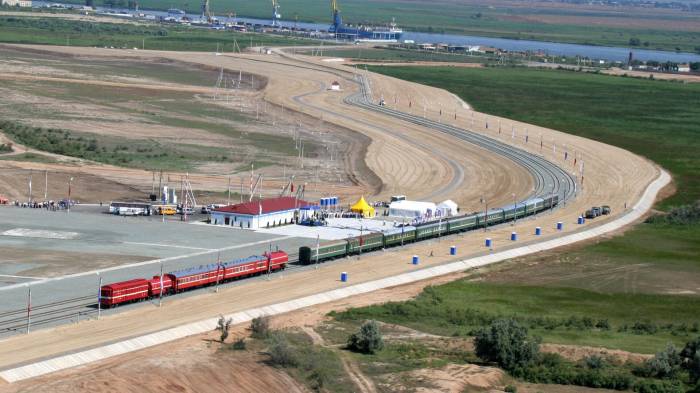
Photo: Sputnik
Editor's note: Moses Becker is a special commentator on political issues for News.Az, a PhD in political science and an expert on interethnic and interreligious relations. The article expresses the personal opinion of the author and may not coincide with the view of News.Az.
It is often said that the new is merely the well-forgotten old. During the Middle Ages, Europe relied on several major trade routes, many of which connected northern and southern states. One notable example was the Varangians-to-Greeks trade route, which linked Scandinavia to Byzantium and traversed the lands of the Eastern Slavs. This route had several branches, one of which extended from Veliky Novgorod southeastward along the Volga River to the Caspian Sea. Although no sophisticated canal systems or hydraulic structures existed at the time, even then, people sought ways to develop trade, exchange goods, and share ideas.On December 23, 2024, a milestone event occurred: Russian Transport Minister Roman Starovoit and Azerbaijani Minister of Digital Development and Transport Rashad Nabiyev signed an intergovernmental agreement to cooperate on developing transit freight transportation along the "North-South" International Transport Corridor (ITC). This ambitious project is poised to become an alternative to China's "Belt and Road Initiative." The "North-South" corridor begins at the port of St. Petersburg and extends to Mumbai on India’s western coast, fulfilling a long-standing vision of connecting Russia to the southern seas.
India, a primary rival of China in Southeast Asia, was chosen as a key partner, reflecting Russia’s efforts to carve out greater economic and geopolitical independence. The planned corridor spans approximately 7,200 kilometers. In September 2000, Russia, Iran, and India signed an agreement in St. Petersburg to implement the project, which later welcomed participants such as Oman, Azerbaijan, Armenia, Belarus, Kazakhstan, Syria, Türkiye, Tajikistan, and Kyrgyzstan.
The ITC "North-South" encompasses maritime routes from Mumbai to Iran's Chabahar and Bandar Abbas ports, along with rail networks passing through Russia, Azerbaijan, and Iran. The project also includes Caspian Sea maritime transport, modernization of adjacent river routes, and the development of new highways across Armenia, Azerbaijan, Kazakhstan, Turkmenistan, Iran, and Russia.
In July 2022, the first commercial shipments along the corridor were dispatched. Around the Caspian Sea, the corridor operates via three routes: the Trans-Caspian route, using Russian and Iranian ports; the western route, through Azerbaijan; and the eastern route, via Kazakhstan, Uzbekistan, and Turkmenistan. In 2023, an agreement was signed to construct a railway connecting Rasht and Astara in Iran, set to launch in 2025, completing the corridor's western section. However, the land routes are currently constrained by limited rail capacity in Iran, Kazakhstan, and Turkmenistan, as well as insufficient road infrastructure in Russia and Kazakhstan.
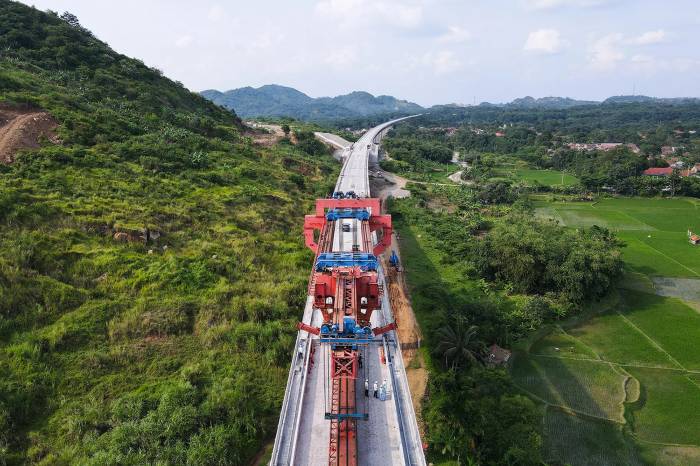
The construction of a BRI-funded railway in Purwakarta, Indonesia. Photo: Xu Qin/Xinhua/Getty Images
The maritime routes face challenges such as inadequate port capacity, the lack of rail access to Iranian ports, and the aging Caspian fleet. Components of the "North-South" ITC include international corridors like Finland-St. Petersburg-Moscow with branches to Astrakhan and Novorossiysk, and Berlin-Warsaw-Minsk-Moscow-Nizhny Novgorod-Yekaterinburg. The existing infrastructure of the Volga and Don rivers, including the Volga-Baltic and Volga-Don canals, as well as ports in the Astrakhan region and Dagestan, play crucial roles.
The corridor spans vast regions, covering much of Russia and neighboring European countries, the Caspian basin, the Persian Gulf, and parts of Central, South, and Southeast Asia. Its key advantages include significantly reduced transport distances—by half or more—resulting in lower container shipping costs from Germany and Finland to India.
To fully realize the corridor’s potential, Russia must modernize the Astrakhan transport hub, expand port capacities, and address related infrastructure needs, creating new jobs in the process. The project will also establish a new intermodal route through Russia to Iran. Collaborative efforts with Azerbaijan and Iran aim to establish direct overland connections along the Caspian’s western shore, including the construction of the Qazvin-Astara railway (connecting Iranian and Azerbaijani segments). The railway's projected capacity is 10 million tons annually, with a potential increase to 15 million tons.
An alternative railway project under the "North-South" ITC envisions a route along the Caspian’s eastern shore (Gorgan-Etrek-Bereket-Uzen, etc.). This new line reduces the eastern route by 600 kilometers.
Russia remains committed to actively engaging with international organizations and bilateral partnerships to develop optimal routes that attract additional freight traffic to its transportation network. From a geopolitical perspective, successfully filling the corridor with freight flows will strengthen transit potential in the Caspian
region.
Furthermore, the project will drive transport infrastructure development in Russia's southeastern regions, including Volgograd, Astrakhan, Kalmykia, Dagestan, and Stavropol Krai—areas that lag in containerization and warehouse facilities. Building container terminals and repair facilities will boost employment and improve livelihoods across all participating nations, not just in Russia.
(If you possess specialized knowledge and wish to contribute, please reach out to us at opinions@news.az).


Similar news