Middle East in a kaleidoscope of events


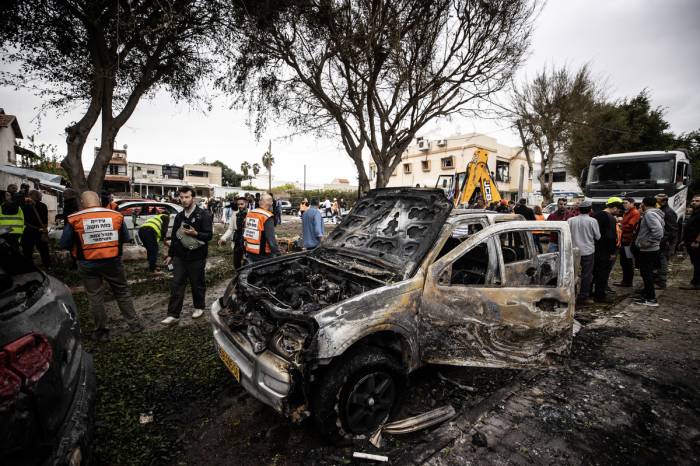
A view of destroyed vehicles after rockets are fired from southern Lebanon in Petah Tikva neighborhood of Israel on November 24, 2024. [Mostafa Alkharouf – Anadolu Agency]
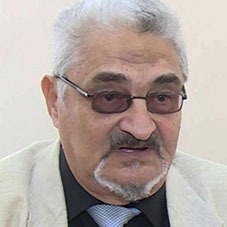
Editor's note: Moses Becker is a special commentator on political issues for News.az, a PhD in political science and an expert on interethnic and interreligious relations. The article expresses the personal opinion of the author and may not coincide with the view of News.Az.
Recently, particularly after Donald Trump's resounding victory in the U.S. presidential election on November 5, 2024, we have witnessed an acceleration of events in both Eastern Europe and the Middle East, a region close to us. It appears as though someone is trying to make up for lost time, pushing the world ever closer to global confrontation. In a sudden turn of events, the International Criminal Court (ICC) issued arrest warrants for Israeli Prime Minister Benjamin Netanyahu and former Defense Minister Yoav Gallant. This move is clearly a provocation by the liberal elite, which continues to struggle to come to terms with its defeat in the United States and several European nations.In this context, it is also notable that a similar attempt is being made to prosecute Marine Le Pen, a prominent French politician, leader of the National Rally party, and a member of the National Assembly. Donald Trump himself faced a comparable smear campaign, but all efforts by the "liberals" only served to increase his popularity. The same outcome is likely in France. As for Prime Minister Netanyahu, amidst the anti-Semitic hysteria funded by certain countries, his popularity is rising not only in Israel but also abroad. Currently, Hungarian Prime Minister Viktor Orbán and Argentine President Javier Milei have openly expressed their support for the Israeli leader, inviting him to pay official visits to their countries.
Donald Trump, following his inauguration on January 20, 2025, has promised to impose sanctions on the prosecutor and members of the ICC. It is plausible that several states may withdraw from the ICC altogether, potentially marking the beginning of its decline.
Simultaneously, the outgoing administration of President Joe Biden is making desperate efforts to broker a ceasefire between the State of Israel and the heavily battered Hezbollah, which has effectively dragged Lebanon into a senseless and devastating war. U.S. Special Envoy Amos Hochstein has been tirelessly shuttling between Washington, Jerusalem, and Beirut, creating the impression that a ceasefire agreement is imminent. For example, Israeli sources believe that an agreement could be reached within a few days. According to the Ynet portal, the primary terms of the agreement have already been finalized, with only minor, albeit significant, disagreements remaining. One such sticking point is Israel's rejection of French involvement in the agreement and its enforcement mechanism. This stems from Israel’s conviction that the French judge at the ICC, who supported the arrest warrant for Prime Minister Netanyahu and former Defense Minister Gallant, could not have acted without the approval of French President Emmanuel Macron.
The proposed agreement reportedly includes a 60-day ceasefire, during which the Israel Defense Forces (IDF) would withdraw from southern Lebanon, and Hezbollah would retreat 30 kilometers north of the Litani River. Concurrently, the Lebanese army and the UN peacekeeping force, UNIFIL, would bolster their presence along the border, while a new U.S.-led security mechanism would ensure that Hezbollah and Israel do not cross into southern Lebanon.
However, questions regarding the agreement’s implementation remain unresolved. Israel insists on maintaining the freedom to act against any Hezbollah activities in southern Lebanon. It is likely that the Lebanese side will object to such a demand.
This dynamic situation underscores the fragile and complex state of the Middle East, where each development carries profound implications for regional and global stability.
It is evident that Lebanon’s government, for the most part, secretly hopes to rid itself of Hezbollah as a political force with Israel’s assistance. However, a military solution to deal with the Shiite group is not being considered, as Lebanon’s armed forces are incapable of handling such a challenge. The outgoing U.S. administration seems intent on preserving Hezbollah, inadvertently playing into Iran’s hands. This is underscored by Iranian Supreme Leader Ali Khamenei urging Hezbollah’s leader, Naim Qassem, to agree to a ceasefire with Israel, while promising continued comprehensive support for the organization.
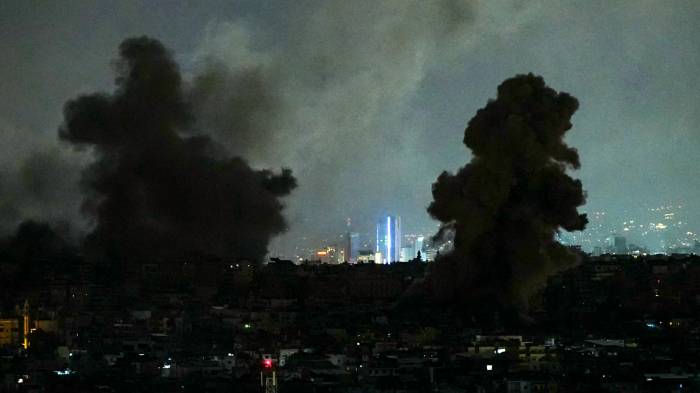
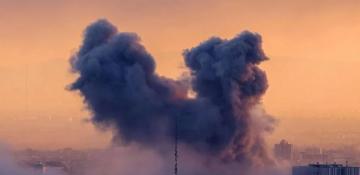
Smoke from Israeli airstrikes in Beirut. Photo: AFP via Getty
On November 20, Hezbollah Secretary-General Naim Qassem stated that the movement had received the proposed ceasefire agreement, reviewed it, and shared its comments on several provisions. This raises a critical question: should Israel even sign an agreement with a nearly defeated terrorist organization that impedes Lebanon’s progress toward becoming a fully functional and sovereign state?
Over the past two months, Israeli airstrikes have significantly weakened Hezbollah’s military capabilities, displacing hundreds of thousands of its supporters beyond Lebanon’s borders. The flight of members of the Shiite community could pave the way for Lebanon to restore sovereignty across its territory and free itself from Iran’s influence. In this context, Israel has a clear incentive to refrain from signing any agreement until January 20, 2025, when Donald Trump will assume the U.S. presidency.
Reports suggest that on November 10, Israeli Minister of Strategic Affairs Ron Dermer stopped at Trump’s Mar-a-Lago estate before heading to the White House. According to an Israeli official, the discussions at Trump’s residence centered on Israel’s proposal for a ceasefire agreement involving cooperation between the West and Russia.
Meanwhile, Jerusalem continues its precision strikes deep into Lebanon, as well as bombing the country’s south. On Sunday, November 17, Israeli attacks resulted in the death of Hezbollah’s head of media relations, Mohammad Afif. For the first time since the operation began in southern Lebanon, the Israel Defense Forces (IDF) deployed heavy artillery to the area.
Simultaneously, reports have emerged that Hamas is willing to negotiate a deal for the release of hostages. This development is likely linked to Israeli Prime Minister Benjamin Netanyahu’s offer of $5 million per captive and safe passage out of Gaza. Hamas leaders appear to have realized that the expected assistance from Iran and Hezbollah is unlikely to materialize, and survival remains a priority for everyone. Although unconfirmed, the release of hostages now seems plausible, and official confirmation is awaited.
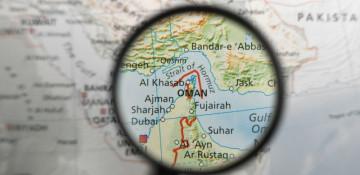
In the midst of these developments came unexpected news from Iran: President Masoud Pezeshkian announced plans to relocate the nation’s capital from Tehran to the Persian Gulf coast. According to ISNA, on November 20, Pezeshkian appointed his first deputy, Mohammad Reza Aref, to oversee the preparation of this plan.
This decision likely reflects the regime’s anticipation of unrest fueled by inflation, unemployment, and the potential imposition of harsher sanctions by the incoming U.S. administration. The Iranian leadership seems eager to distance itself from the anger of the population. Another significant factor influencing this move is the impending transition of power. At 85 years old, Ayatollah Ali Khamenei is reportedly maneuvering to appoint his son, Mojtaba, as the next Supreme Leader. However, Mojtaba lacks the clerical rank of Ayatollah, which makes his legitimacy questionable. The relocation of the capital could be part of this broader strategy.
Judging by recent events, Iran is entering a period of turbulence that could topple its unpopular regime and fundamentally alter the geopolitical landscape of the Middle East.
(If you possess specialized knowledge and wish to contribute, please reach out to us at opinions@news.az).


Similar news