Steinmeier's visit to Armenia and Azerbaijan reveals Germany's diverging regional Strategies — Andrey Petrov


By Asif Aydinly
In an exclusive interview with News.Az, Andrey Petrov, Deputy Director General of the Russian information and analytical agency Vestnik Kavkaza, commented on the visit of German President Frank-Walter Steinmeier to Armenia and Azerbaijan, stressing that the goals of the trip varied significantly between the two countries.
“In my opinion, the goals of Frank-Walter Steinmeier’s visit to Armenia and Azerbaijan differed substantially,” Petrov said. “Formally, he arrived as a representative of the new German authorities, since Germany’s new government had not yet been fully formed. That is why only the president could hold talks with the leadership of South Caucasus countries. Berlin could have waited for Friedrich Merz’s cabinet to be approved and then sent the new foreign minister, for example, to Baku and Yerevan. However, the decision to carry out a presidential visit immediately shows that Germany has urgent interests in the region.”
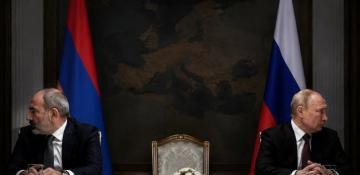
According to Petrov, Armenia is primarily of interest to Germany as part of an anti-Russian agenda. “While the United States is gradually winding down its anti-Russian activity in Eurasia, European leaders are striving to maintain pressure on Moscow. Trump’s administration has abandoned Biden’s pro-Armenian line, but this has not led Yerevan to turn away from the West — only to a course correction: if Washington is no longer willing to ‘buy’ Armenia’s loyalty, Nikol Pashinyan is now trying to sell it to European forces oriented against Russia.”
Petrov noted that Armenia’s case is unique due to the excessive demands it places on the West in exchange for breaking ties with Moscow. “Armenia receives significant benefits from the current geopolitical situation: participation in grey imports, membership in the EAEU, and continued economic cooperation with Russia. Yerevan is not ready to give this up without serious compensation. However, France or even the European Commission cannot meet these demands — especially now, when the EU's resources are focused on supporting Ukraine. That’s where Germany steps in.”
European leaders see Yerevan renewing its contacts with Moscow and want to act preemptively, Petrov said. “Hence Steinmeier’s visit to Armenia, which included visiting the Tsitsernakaberd memorial and coincided with anti-Iranian and sometimes even anti-Azerbaijani publications in the German press. This was Berlin’s attempt to meet some of Yerevan’s demands in exchange for organizing a symbolic strike by Armenia against Russia.”
“The choice of Steinmeier as the envoy was not accidental,” Petrov continued. “As president, he does not define foreign policy, so his actions and statements can be downplayed if necessary, allowing Germany to preserve working relations with Baku.”
“Thus, Steinmeier flatters the Armenian elites, while Berlin sends a clear message to the Azerbaijani authorities: there are no anti-Azerbaijani sentiments in Germany — everything happening is part of a pragmatic game whose goal lies beyond the Caucasus.”
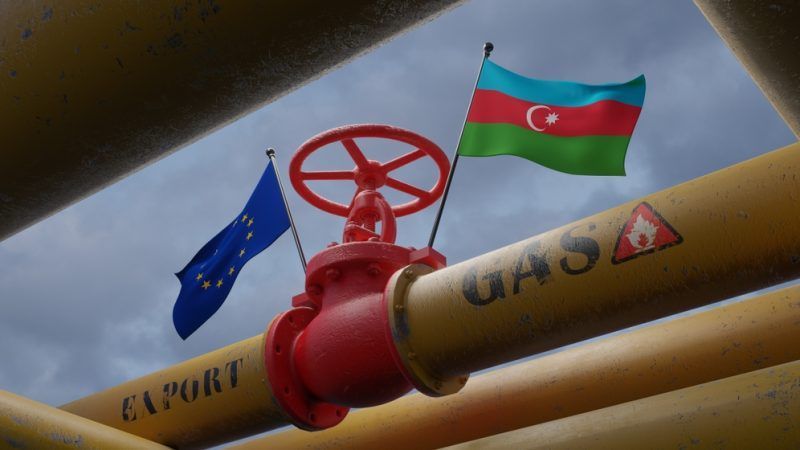
In contrast to Armenia, Petrov explained, Germany seeks long-term and stable relations with Azerbaijan. “This was particularly evident during the 11th Ministerial Meeting of the Southern Gas Corridor Advisory Council in Baku, where President Ilham Aliyev called for expanding the corridor’s capacity.”
Source: AzerTAG
“Azerbaijan has repeatedly emphasized its readiness to increase gas supplies to Europe, but under one condition — full support from the EU: financing infrastructure projects, signing long-term contracts, and eliminating bureaucratic barriers within the Union,” Petrov stated. “If Aliyev is now speaking about the objective need for expansion, it means that at least preliminary agreements have been reached between Baku and its European partners.”
Germany is one of these partners. “CDU leader Friedrich Merz, the likely head of the next cabinet, holds a tougher stance on Russia than Olaf Scholz. He is committed to a complete phase-out of Russian energy and therefore needs alternatives. Azerbaijan is the most logical choice: first, the country is increasing gas production, in part thanks to the development of green energy, which frees up gas volumes for export. Second, there is already an established and cost-effective logistics route — the Southern Gas Corridor — which can easily connect to the Austrian network and deliver gas to Germany.”
However, Petrov stressed, there is a problem: “As President Aliyev noted, the Southern Gas Corridor is currently operating at full capacity. There is gas for Germany, there are pipelines, but there is no throughput capacity. All volumes are already contracted by ten other European countries. Therefore, if Berlin truly expects to receive gas from Azerbaijan, it must urgently begin negotiations on specific pipeline expansion plans.”
“This is precisely what explains Steinmeier’s visit to Baku,” Petrov concluded. “The warm reception given to him by the Azerbaijani side shows that this visit was not a mere formality, but the beginning of a serious dialogue. Politically, Baku and Berlin have few overlapping interests, so the talks were primarily economic. It is logical to expect that once Germany’s new government is formed, bilateral or even multilateral agreements will be signed on expanding the capacity of the Southern Gas Corridor.”
As reported by News.Az, Steinmeier’s trip reflects Germany’s shifting approach in the South Caucasus — one driven less by symbolism and more by strategic energy partnerships.
By Asif Aydinly


Similar news