Azerbaijani cuisine showcased in Asharq Al-Awsat


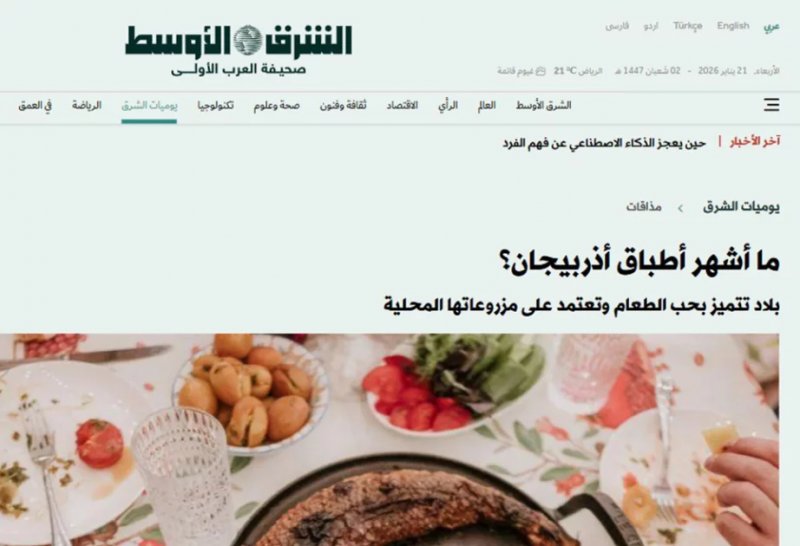
Azerbaijan’s rich culinary heritage has gained international spotlight after a leading Saudi-owned newspaper, Asharq Al-Awsat, published an extensive feature on the country’s traditional cuisine. The London-based publication presents Azerbaijani food not only as a collection of dishes, but as a cultural expression shaped by history, geography, and hospitality.
The article highlights that Azerbaijani cuisine remains deeply rooted in ancient traditions and local produce. Grilled meats, aromatic rice dishes, herb-filled flatbreads, and delicacies made from figs and pomegranates reflect a culinary identity preserved through generations. The influence of the Silk Road trade routes and the world-famous Azerbaijani saffron are credited with enriching flavor profiles that make the cuisine distinctive on the global stage, News.Az reports, citing Asharq Al-Awsat.
International culinary experts have increasingly turned their attention to Azerbaijan in recent years. Renowned chef William Hill, who traveled across the country to film a documentary on Azerbaijani gastronomy, describes his journey as a unique culinary exploration. He praises the warmth of local communities and the authenticity of traditional food practices.
“Azerbaijan embodies pure hospitality. The spirit of the people is strong, their communication sincere, and their traditions and craftsmanship deserve global recognition,” Hill says in the feature.
Readers are introduced to iconic street food scenes in Baku’s Old City, where vendors prepare freshly made qutab — thin flatbreads stuffed with herbs, pumpkin, cheese, or meat and cooked on a traditional saj pan. Served hot with yogurt or sprinkled with sumac, qutab is described as one of the simplest yet most beloved staples of Azerbaijani cuisine.
The article also explores regional specialties. Basqal halva, a centuries-old sweet made from sprouted wheat, walnuts, dill, cloves, and turmeric, is portrayed as an energy-rich delicacy historically considered essential nourishment. Meanwhile, tiny meat dumplings known as düşbərə, cooked in bone broth, are introduced as a comforting and satisfying dish despite their small size.
Azerbaijan’s dolma, recognized by UNESCO as part of the world’s intangible cultural heritage, is featured as a national symbol. Whether wrapped in grape leaves, cabbage, or other greens, each region adds its own variation, demonstrating the diversity within the country’s culinary landscape.
Kebab traditions also receive special attention. The article notes that Azerbaijani kebab is typically seasoned only with salt and pepper, allowing the natural flavor of the meat — especially Karabakh lamb — to stand out. Wrapped in lavash bread and served fresh off the grill, it remains one of the country’s signature offerings.
No presentation of Azerbaijani cuisine would be complete without plov. The publication describes saffron-infused basmati rice layered with dried fruits, chestnuts, and meat, culminating in the celebrated Shah plov — a dish known as much for its artistic presentation as for its taste. “This meal nourishes the soul,” Hill remarks.
The feature further introduces readers to Şəki piti, a slow-cooked clay pot stew, southern Azerbaijan’s famous ləvəngi, and traditional dishes baked in tandir ovens — all reflecting how local climate and agriculture shape regional tastes.
The article concludes that Azerbaijani cuisine is far more than food. It is history served on a plate, geography translated into flavor, and culture preserved through taste. As global interest in authentic culinary experiences grows, Azerbaijan’s kitchen is increasingly stepping onto the world stage.
By Aysel Mammadzada


Similar news