China and global markets: What awaits investors?



lead- China's economy has seen a modest recovery from the significant slowdown that began with the COVID-19 pandemic in 2020 and the subsequent restrictive policies. However, the country still faces substantial economic challenges. Despite this, it remains a crucial player in the global economy and the largest emerging market.
China continues to be hampered by pockets of fundamental economic weakness. “The property market is still upside down,” says Eric Freedman, chief investment officer at U.S. Bank Wealth Management. “Also, if you look at core demand from a consumer standpoint, it’s just not there.” These are factors that may limit China’s growth in the near term. Reports surfaced in May 2024 that to address the glut in vacant new homes, China devised a plan for local governments to purchase millions of unsold homes. That policy, if implemented, could help shore up the lagging property market.China’s trade activity is also under duress. In May 2024, President Joe Biden announced a new round of tariffs on electric vehicles, advanced batteries and other technology-related products. However, China’s economic prospects may not be dramatically affected. “The U.S. already had rules in place limiting imports of some of these products, so the marginal effect seems modest,” says Rob Haworth, senior investment strategy director at U.S. Bank Wealth Management.
Haworth also notes that while potentially taking a toll on China’s economy, tariffs imposed by the U.S. also hurt domestic consumers. “Tariffs tend to be inflationary, because you ultimately have to substitute higher-cost goods for lower-cost goods. That can add to U.S. consumers’ costs.”
After China’s consumer price index (CPI) declined 0.80% in January, prices rebounded in February through April, reflecting an uptick in consumer demand, a positive sign for the economy. Nevertheless, says Haworth, “Chinas economy does not yet indicate an ‘all-clear’ signal on prospects for accelerated growth. We still need to see consumer demand rise further.” Haworth adds that sustained economic improvement may require a rebound in global trade and possibly some government stimulus measures.
How do developments in China affect global markets today, and how should you assess investment opportunities based on China’s economic growth?
Promising signs in early 2024
Significant property sector challenges and export weakness are major contributors to China’s economic malaise. New home prices faced their steepest decline last year since early 2015. In April 2024, new home prices fell 3.5% compared to a year ago, with existing home prices down nearly 7% compared to year ago values.1 Exports, an important linchpin for China’s economic growth, fell 4.6% in 2023, the first annual decline in export activity since 2016. Once again, more encouraging data emerged in early 2024, with China’s exports growing in three of the first four months compared to the same periods in 2023. Despite recent weakness, China remains the largest global exporter of manufactured goods. However, ongoing trade battles with the U.S. aren’t likely to help boost exports.
At the same time, slowing domestic demand remains a challenge. “One reason for China’s property weakness is a broader economic concern that consumers have limited savings, having spent it down during the pandemic, and they have wealth tied up in housing, which has dropped in value. So they are not in a strong position,” says Haworth. “To the extent Chinese consumers are spending, demand is high for experiences, but not for goods.”
Investment market impact
China’s stock market alone makes up more than one-quarter of the MSCI Emerging Markets Index. “Any investor who puts money to work in a broad, emerging market index likely owns a significant position in Chinese stocks,” says Haworth.

Investors with positions in overseas stocks may look for opportunities to put money to work in China, the world’s second-largest economy (behind the U.S.). China is still classified as an emerging market, but its equity values represent, by far, the largest among all emerging market countries.
China’s evolving demographics
China’s economic transformation from an agrarian-based society to the more urbanized and industrialized China of today began in the late 1970s, and since then, rapid growth has been a staple of China’s economic story. Until the last decade, China’s economy often grew by more than 10% per year, resulting in an expansion of the country’s middle class.
“Any investor who puts money to work in a broad, emerging market index likely owns a significant position in Chinese stocks.” - Rob Haworth, senior investment strategy director at U.S. Bank Wealth Management.
“Two key factors at play are the fact that China now has a well-developed middle-class, and it also faces demographic issues,” according to Haworth. It has an aging population, causing some of its economic challenges. This includes fewer working-age people to support the needs of its elderly population, and ultimately, a potential decline in the country’s overall population, which could hamper future economic growth. For the first time in history, India in 2023 supplanted China as the world’s most populous nation.
China’s economic reopening
China’s economic recovery was slow to emerge since it eliminated its zero COVID policy in late 2022. China’s growth of 5.2% in 2023 exceeded the previous year’s 3.0% but is still considered lagging by historical standards.
Based on the latest indicators, it appears China’s GDP may be on a slower growth trajectory than was the case for much of the last two decades.
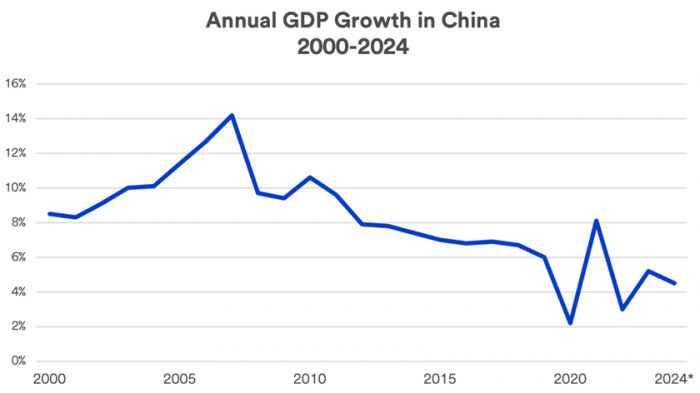
Nevertheless, China’s status as the second largest economy in the world continues to position it as an important player on the global economic stage. With Chinese manufacturing back online, global supply chain issues have eased.
International stocks can contribute to a well-diversified portfolio . “There are reasons to include emerging market exposure in your asset mix,” says Haworth. “After all, despite trade tensions, we’re still a globalized economy.” Emerging market stocks struggled significantly in 2022 and lagged performance of developed global markets in 2023. However, through May 16, 2024, emerging market stocks modestly outpaced developed global markets.
“As we look at the global market today , some investors may see a buying opportunity in emerging market stocks,” says Haworth. However, he favors emerging market funds that represent a broad index of stocks. “The emerging markets index provides significant exposure to Chinese stocks, since they make up about one-quarter of the MSCI Emerging Market Index,” says Haworth. “But it also provides exposure to other markets that help diversify investors away from potential risks arising from investing exclusively in Chinese markets.” Haworth notes that in recent times, a stronger dollar created headwinds for emerging market investors. When U.S. investors put money to work in overseas stocks, a stronger dollar detracts from net performance.
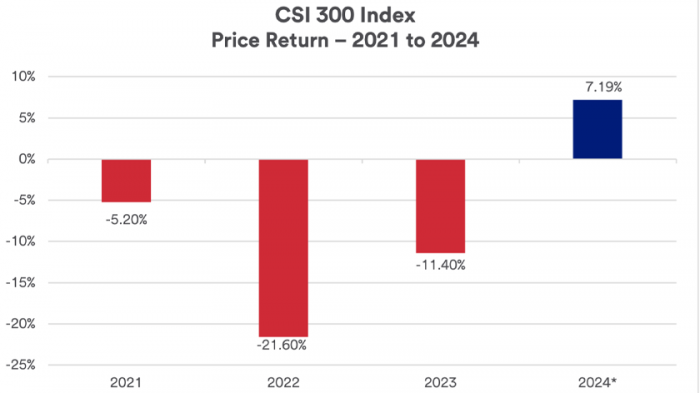
China’s equities market declined in three consecutive years between 2021 and 2023. “Earnings weakness and investor skepticism about future earnings have put pressure on Chinese stocks,” says Haworth. “For China’s stock market to stage a turnaround, investor confidence needs to stabilize.”
China’s stock market is showing modest improvement so far in 2024. “There’s not a great fundamental reason why we’ve seen the recent rebound beyond a ton of liquidity injections from China’s central government,” says Freedman. China’s economic trajectory may ultimately determine whether stocks can muster a sustained rally.
Investment risks in China include concerns about accurate financial reporting. “We no longer get real data from China’s government about unemployment or income growth,” says Haworth. Other risks include ongoing tensions between the U.S. and China, and the Chinese government’s potential for direct intervention that can affect specific companies or industries.
Any changes to your investment strategy should be consistent with your goals, time horizon and risk appetite. Talk with your U.S. Bank wealth professional to review your current financial plan and determine whether there is an opportunity to incorporate emerging market stocks – with exposure to China – into your broader, well-diversified portfolio.
Note: The MSCI Emerging Markets Index captures large and mid-cap equity performance across twenty-four emerging market countries. Investing in emerging markets may involve greater risks than investing in more developed countries. In addition, concentration of investments in a single region may result in greater volatility. International investing involves special risks, including foreign taxation, currency risks, risks associated with possible differences in financial standards and other risks associated with future political and economic developments.


Similar news