China and India reach six-point consensus as high-level border talks resume


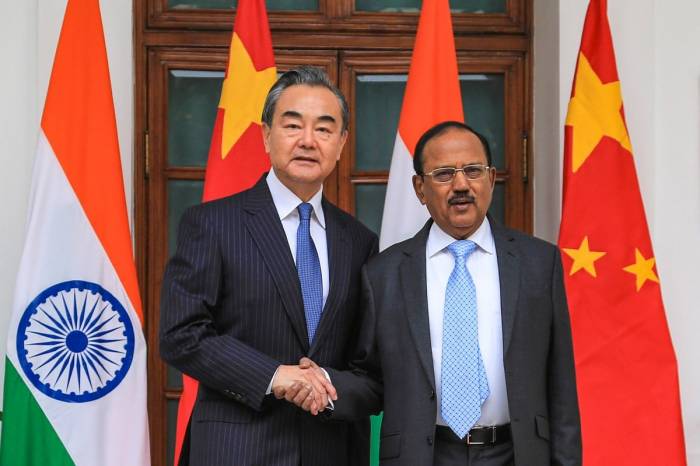
Photo: Xinhua
China and India reached a six-point consensus following border talks between Chinese Foreign Minister Wang Yi and India's National Security Adviser Ajit Doval in Beijing on Wednesday, News.az reports citing foreign media.
They agreed to “continue to take measures to maintain peace and tranquillity in the border areas and promote the healthy and stable development of bilateral relations”, according to a statement issued by the Chinese foreign ministry.The top diplomats “reaffirmed their commitment to continue seeking a fair, reasonable, and mutually acceptable package solution to the boundary issue” and to take “positive measures to promote this process.” The package settlement, first agreed upon in 2005, outlines the guiding principles for resolving the border dispute.
The two countries pledged to strengthen cross-border exchanges and cooperation, including resuming Indian pilgrimages to China, revitalising cross-border river cooperation, and renewing border trade, the statement said.
Additionally, they agreed to hold the next round of special representatives’ meetings in India next year, with the exact timing to be determined later through diplomatic channels.
According to another readout by the Chinese foreign ministry, the talks between Wang and Doval were “in-depth and constructive”.
During the discussions, Wang described the meeting as “a timely and powerful measure to implement the consensus” reached between Chinese President Xi Jinping and Indian Prime Minister Narendra Modi in Kazan, Russia, in October.
“It is hard-won and worth cherishing”, he said, urging both countries to “put the border issue in an appropriate position in bilateral relations” and “push China-India relations back on the track of healthy and stable development as soon as possible”.
The bilateral meeting was the first to take place under the “special representative dialogue” mechanism since 2019.
Established in 2003 during former Indian prime minister Atal Bihari Vajpayee’s visit to China, the dialogue is one of the top frameworks for Beijing and New Delhi to discuss boundary issues.
During their dialogue in New Delhi in December 2019, the two sides agreed to hold a round of talks in Beijing the next year, but the plans were interrupted by a series of border skirmishes – in particular, the 2020 Galwan Valley clash that killed 20 Indian soldiers and at least four Chinese.
China and India have never agreed on the demarcation of their shared border. Since a 1962 war over the disputed border, the two nations have been divided by a 3,200km (1,988-mile) Line of Actual Control (LAC), though they have not even been able to agree on precisely where that lies.
Ties between the two neighbours deteriorated sharply after the clashes first erupted in 2020, and several communication channels were shut.
Despite the tensions, top diplomat Wang continued his engagement with senior Indian officials. He and Doval met in Delhi in 2022 and Johannesburg in 2023. They concluded their most recent exchange in Saint Petersburg in September. But none of these were officially held under the dialogue framework.
During their latest meeting in Russia, Wang told Doval that the two nations should “choose unity and cooperation, and avoid consuming each other”.
The meeting between the two senior diplomats was a milestone in China and India’s efforts to resume senior defence and diplomatic talks this year.
Chinese President Xi Jinping met Indian Prime Minister Narendra Modi on the sidelines of the Brics summit in Russia in October, just a day after the countries announced an agreement on troop disengagement at the border, which led to the end of the high-altitude stand-off.
The leaders agreed to push for more engagement between officials at all levels to “promote the early return of relations between the two countries to the track of stable development”.
Liu Jianchao, head of the Communist Party’s international liaison department, met Indian ambassador to China Pradeep Kumar Rawat in Beijing last week and called for more bilateral cooperation.
Beijing and Delhi held four rounds of border dispute talks this year under another diplomatic mechanism, the Working Mechanism for Consultation and Coordination on India-China Border Affairs, established in 2012.
At the latest round of these talks, held earlier this month, the countries agreed to further “exchanges and contacts at the diplomatic and military levels through established mechanisms”, according to Delhi.


Similar news