China targets 2030 finish for world’s most difficult railway project


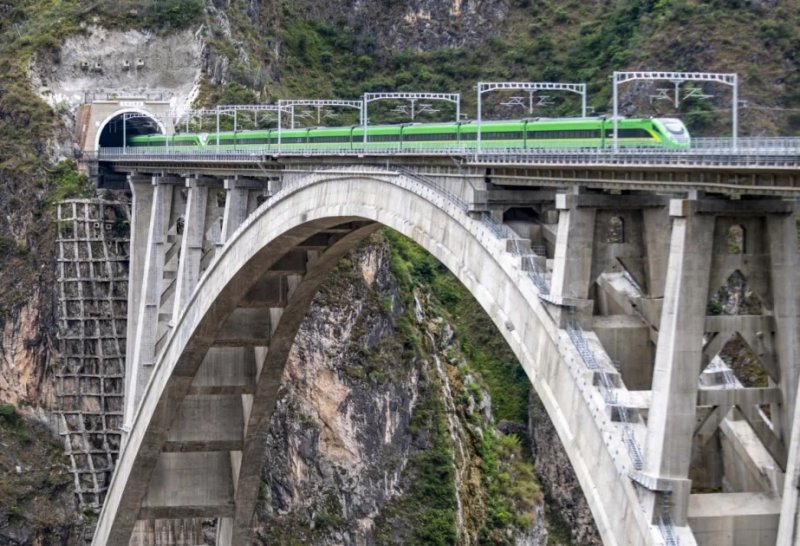
China is moving closer to completing what has been described as the world’s most challenging railway project, with the line in southwestern Yunnan province expected to be fully operational before 2030.
The railway links Dali with the border town of Ruili and is the first to pass through the rugged Hengduan Mountains—an area known for some of the most complex geological and topographical conditions in the world, News.Az reports, citing Chinese media.
Stretching about 330 kilometers (205 miles) along China’s southwestern frontier, the route is expected to strengthen transport connections between China and Southeast Asia.
RECOMMENDED STORIES
The project is being developed in two phases: from Dali to Baoshan, and from Baoshan to Ruili, a key border crossing with Myanmar. Construction on the first section began in 2008 and was completed in 2022. The remaining stretch is projected to begin operations within the next five years, according to state media citing local officials. Once finished, the railway is expected to stand as a landmark achievement in global rail engineering.
The 133-kilometer Dali–Baoshan segment now takes around one hour to travel, but required 14 years of construction by tens of thousands of workers due to the harsh terrain. In contrast, a similar railway built across flat and stable ground would typically take about three years.
When the first section opened in July 2022, its builder, China Railway Group, highlighted the extraordinary challenges faced during construction. The line runs through steep mountain ranges, deep valleys, areas of intense tectonic activity and unstable rock formations. Engineers had to avoid major fault zones while crossing four large mountain systems.
To support the railway, crews constructed 34 bridges and 21 tunnels. Among them, the 14.4-kilometer Dazhushan tunnel—cutting through six geological fault lines—took 12 years to complete and encountered nearly every major engineering risk associated with large-scale tunnel projects.
One of the greatest difficulties was massive groundwater inflows. The volume of water that flooded into the tunnels was equivalent to 156,000 standard swimming pools, forcing workers to operate for extended periods in submerged conditions.
By Nijat Babayev


Similar news