China’s strategy to deploy world’s largest army on Taiwan


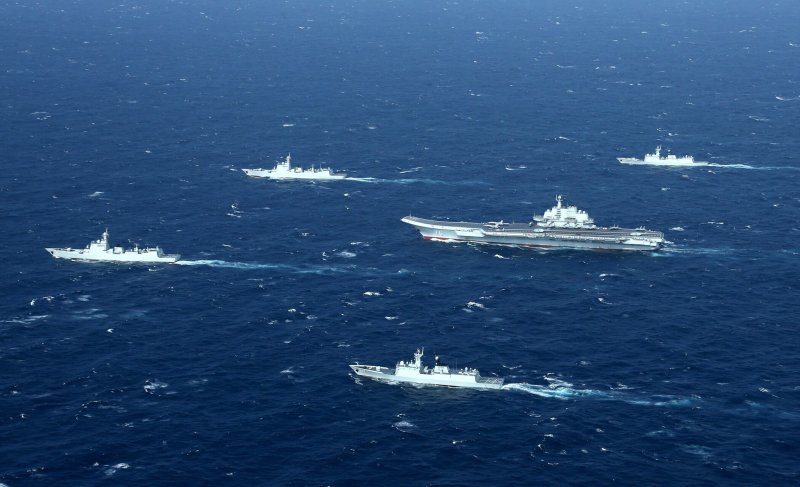
The Telegraph published an article detailing China’s strategy to deploy the world’s largest army on Taiwan.
The article highlights key locations and logistical advantages that could play a role in a potential military operation, News.Az reports.
According to the article, China has one of the most active shipbuilding industries in the world. Experts estimate that its shipbuilding capacity is at least 200 times greater than the United States’, despite its much smaller military budget ($246bn in 2025 against $850bn).
Today, China has an estimated 405 warships to the US Navy’s 295, and is on track to have at least 30 more by 2030.
In fact, a recent report from the Stockholm International Peace Research Institute (SIPRI) found that, while most of China’s defence firms had been losing revenue, the one area where revenue was rising was shipbuilding.
The article states that however, China wasn’t always a maritime leader. It’s only in recent decades that it has turned its navy – and its entire military apparatus – into one that rivals the world’s major powers.
Ridzwan Rahmat, the principal defence analyst at Janes, a leading military intelligence platform, said: “For a long time, the Chinese military modernisation focused on the land domains, because that was the existential threat at that time.
“But over the years, especially in the last 30 years or so, China’s existential threats have appeared from the sea, and the sea is a domain where they have been lacking compared to their adversaries.”
Today, China’s defence priorities are mostly maritime. These include disputes over islands in the South China Sea and its claims over Taiwan, which is across a nearly 100-mile wide body of water.
Xi Jinping, who came to power in 2012, has made the “reunification” of Taiwan central to his legacy. Hardly a week goes by without the president or one of his officials mentioning Beijing’s goal of bringing the country under China’s control.
The topic has had a particularly high profile in recent weeks, after Sanae Takaichi, the new prime minister of Japan, suggested that a conflict over Taiwan could trigger Japanese military involvement, prompting a fiery response from Beijing.
An $11bn arms package supplied to Taiwan by the US has similarly angered China.
While the People’s Liberation Army (PLA) Navy has hundreds of warships, these alone would not be sufficient for a seizure of Taiwan, said Tom Shugart, a former US submarine officer and senior fellow at the Center for a New American Security (CNAS).
He said: “There’s no question whatsoever that if you just look at the grey-painted PLA Navy amphibious assault shipping, it is nowhere near enough to do an invasion.”
Instead, China has maximised its dual-use shipbuilding, where civilian vessels are kitted out with military technology. Since 2015, all civilian shipbuilders have been required to ensure that any new ships could be used by the military in the event of an emergency.
The China Classification Society, a shipping industry association, said at the time that this plan would “enable China to convert the considerable potential of its civilian fleet into military strength”.
The plan included five types of ships, which are already being tested: container, roll-on/roll-off, multi-purpose, bulk carrier and break-bulk cargo vessels.
The roll-on/roll-off vessels, known colloquially as “ro-ro ships”, are commercial transport ships with reinforced ramps that can transport large military trucks and equipment.
China has been increasing production of ro-ro ships in recent years, with an estimated 200 set to be completed between 2023 and 2026 – more than double the number manufactured between 2015 and 2022, according to the US-based Center for Strategic and International Studies (CSIS).
It has also been increasing its use of semi-submersible vessels – heavy-lift ships that can partially submerge their cargo – as helicopter carriers. They are being tested in landing trials that seem to simulate a Taiwan operation.
Six ro-ro ferries were monitored in a recent Reuters investigation, alongside six-deck cargo ships, as they sailed from shipyards near Beijing in northern China to the waters off the coast of Guangdong further south, in what appeared to be a practice landing operation.
The article recalled that in 2020, the Chinese Ministry of Defence carried out a training scenario using semi-submersible ships to refuel helicopters as it rehearsed rescue operations with injured soldiers.
While China appears to be preparing for a large-scale amphibious assault, it is unlikely that an attack against Taiwan would begin with a landing operation.
Alexander Huang, the chairman of the Council on Strategic and Wargaming Studies, has spent the past 10 years simulating different ways China could attack Taiwan.
Based on his research, he sees two possible paths.
The first begins with a cyber attack as well as moves against critical infrastructure to “kill Taiwan’s communication control and command control systems”. This strategy would seek to “divide or weaken Taiwan for a swift victory”, said Mr Huang.
The second starts with a “maritime quarantine”, which would gradually block Taiwan’s energy supply and communication networks, to cut the island off from the rest of the world. Unlike a blockade, which would be enforced by the military, a quarantine would use coastguard and civilian ships.
As an island, Taiwan relies on imports for its energy and food, and a quarantine or blockade could be disastrous. Experts told The Telegraph that its current energy supply – which includes liquefied natural gas, renewable production and coal resources – could sustain the island for about 40 days.
A major military operation against Taiwan would likely take four times as long, and, said Mr Huang, China would effectively “squeeze Taiwan until it surrenders”.
Beijing has been practising this type of coercion for years. It has routinely deployed hundreds of ships and planes around Taiwan as part of its “grey zone” pressure – activities that fall short of open warfare but aim to demonstrate strength in the lead-up to an actual conflict.
Prior to the latest drills on Dec 30, China had previously launched a massive exercise around Taiwan days after Lai Ching-te was inaugurated as president in May 2024. More than 110 aircraft and 50 navy and coastguard ships were deployed.
Donald Trump said the latest drills were not a cause for concern because China had “been doing naval exercises for 20 years in that area”.
However, Taiwan’s Coast Guard Authority told The Telegraph that China seemed to be using the tactics “to familiarise themselves with the battlespace for future operational planning” and were simulating blockades “to apply military pressure to test Taiwan’s defence readiness”.
With a fleet at the ready, the next question is where China would land its troops – and how.
The Taiwan Strait is 110 miles wide, but with strong winds and high waves, it is a difficult body of water to navigate. Monsoons and typhoons – especially in summer – make it all the more treacherous.
If China were planning an amphibious assault, it would likely be limited to a handful of months.
What’s more, most of its vessels would need to dock at a port or jetty because they are too large to reach land through the shallow waters around much of Taiwan’s coastline.
Experts said that if China were able to take a port, it would make a seizure far easier, but it is unlikely to be allowed to do that in a wartime situation.
Mr Rahmat, of Janes, said: “In the event of an invasion, port infrastructure [and] a lot of piers and jetties will have been destroyed by Taiwan to slow down the invasion forces.”
Instead, China has been building barges, which seem ideal for a landing on a vulnerable red beach. These commercial vessels are equipped with legs that anchor into the sea floor, and extendable bridges that can connect to land, or other barges or ships.
China has at least two sets, according to satellite images seen by The Telegraph. Each set consists of three ships of different sizes. They could be used to create a deep-sea port miles off the coast, allowing it to land troops and equipment.
Mr Rahmat said: “The barges play a large part in ensuring that there is still connectivity between the large transport ships and logistic ships and [Taiwan’s] island itself.”
Even with the barges, some experts, including a former defence official who spoke to The Telegraph on the condition of anonymity, were sceptical of China’s ability to land troops on Taiwan.
They believe that changing sea levels and commercial construction, among other factors, along Taiwan’s coast have made virtually all of the beaches untenable for a landing operation.
Taiwan’s Ministry of National Defence said its armed forces “regularly survey major beaches and deploy marine corps to verify if the beaches are potential landing sites”, but wouldn’t comment on which locations posed the greatest risk.
While Beijing is focused on its dual-use maritime capabilities, it also has hundreds of cutting-edge amphibious warships on hand.
In November, China launched a new aircraft carrier known as the Fujian.
It is the most advanced carrier in its fleet, and has an electromagnetic aircraft launch system allowing it to catapult fighter jets on and off its deck. The only other ship in the world with this ability is the US Navy’s newest carrier, the USS Gerald R. Ford.
Before the Fujian was commissioned, building was already underway for China’s next new carrier – its fourth, and known as 004 – which will most likely be nuclear powered.
Experts told The Telegraph that in satellite images of the carrier at the Dalian shipyard, there did not appear to be exhaust ducts, which suggest it will rely on nuclear power instead of diesel.
Mr Rahmat said: “The problem with diesel aircraft carriers is that you can’t deploy too long beyond a two or three week window.
“Every three weeks you need to bring the ship back to port so it can be refuelled. However, if you have a nuclear aircraft carrier, the ship can remain on station almost indefinitely.”
For this reason, the latest US carriers are nuclear powered, and China has long been looking to do the same, although it has struggled to master the shipbuilding techniques.
A nuclear powered ship would give China a major leg-up in the event of escalation with Taiwan because it would allow the ship to remain at sea.
Along with the 004, China also recently launched the first amphibious assault ship in the world equipped with an electromagnetic catapult capable of launching drones, including the advanced GJ-11 stealth combat drone and the WZ-7 reconnaissance drone.
These warships would very likely join the merchant fleet in any assault against Taiwan, bringing the number of Chinese ships to an unprecedented scale.
Mr Shugart, of CNAS, said: “On the Chinese side, this is where I think most people may not understand the scale of what China would bring to a landing campaign. It’s not going to be dozens of ships in the Taiwan Strait, it’ll be thousands.”


Similar news