Following the impeachment, South Korea is left without an elected leader


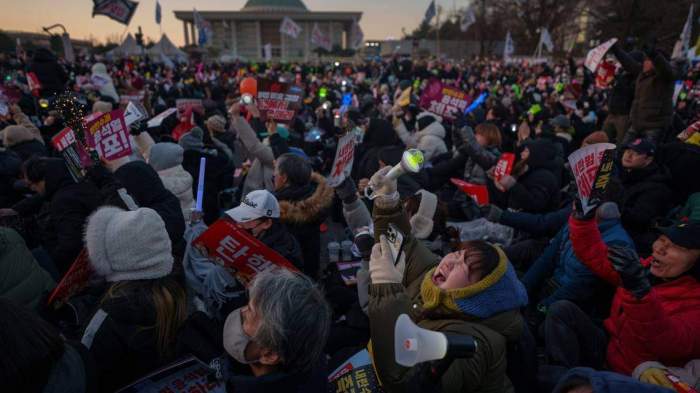
Chang W. Lee/The New York Times CHANG W. LEE NYT
The impeachment and suspension of President Yoon Suk Yeol have left South Korea, a key ally of the United States, without a strong elected leader to address issues such as an aggressive North Korea and increasing political polarization domestically, News.Az reports citing the Miamiherald.
By voting to impeach Yoon on Saturday, the National Assembly delivered a crushing vote of no confidence in a leader who had been unpopular through his term. Outside the legislature, people danced in the streets, celebrating Yoon’s peaceful removal from office less than two weeks after his declaration of martial law as proof of the resilience of the country’s democracy.Yet, despite their euphoria, the political turmoil and uncertainty unleashed by Yoon’s botched attempt Dec. 3 to place his country under military rule for the first time in 45 years remained unresolved. His impeachment has created a political vacuum at the top.
Prime Minister Han Duck-soo, the No. 2 official in the government hierarchy, has stepped in as the interim leader, but he has no electoral mandate. A new government cannot be born until the Constitutional Court decides whether to reinstate or formally oust Yoon.
The court’s deliberations could take up to six months. When the court deliberated on the impeachment of President Park Geun-hye in 2016, it needed three months to reach its conclusion and remove her. This time, the nine-member court has the additional problem of having three vacancies to fill. In the coming days, the National Assembly is expected to name three justices, asking Han to formally appoint them.
Only two of the existing six justices were appointed by Yoon’s progressive predecessor, Moon Jae-in. If Yoon is formally removed, South Korea will need another two months to elect a new president. Yoon said he would “never give up” the fight to return to office. But he also faces investigations by police and prosecutors on charges including insurrection, which could lead to his arrest. Prosecutors said they asked Yoon to present himself Sunday for questioning, but he did not show up. They said they would summon him again.
The impeachment bill accused Yoon of perpetrating an insurrection when he declared martial law, because he sent troops into the National Assembly to block it from voting down his martial law, as it is allowed to do under the constitution, and to detain his political opponents.
Senior officials in the government, police and military have been arrested on charges of helping him carry out an insurrection. The political turmoil will make it harder for South Korea to navigate the uncertainty around the incoming Donald Trump administration.
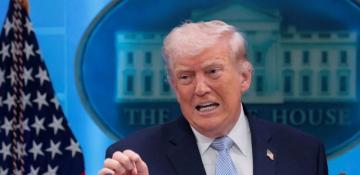
Trump has described the alliance with South Korea as a terrible bargain for the United States and said that he would get along well with North Korea’s leader, Kim Jong Un. Trump has threatened to make South Korea pay more for the 28,500 U.S. troops based on its soil and to impose bigger tariffs on South Korean exports to the United States. “We won’t have strong leaders who can actively negotiate with the Trump administration to sort these things out,” said Sung Deuk Hahm, a professor of political science at Kyonggi University, west of Seoul.
The challenge for Han, the interim leader, will be to keep the government functioning through this crisis. Though Han has been a career bureaucrat since the early 1970s, serving in posts that include trade negotiator, finance minister and ambassador to the United States, he lacks political clout because prime minister is not an elected post.


Similar news