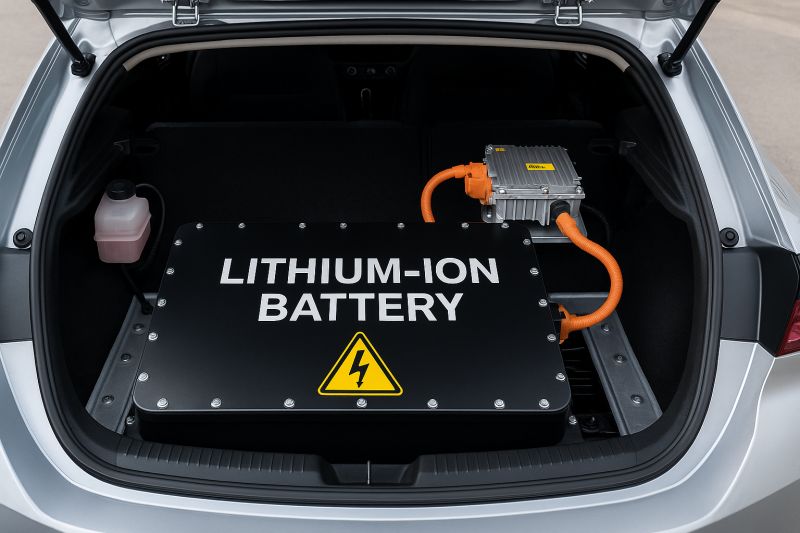
Lithium-ion batteries have become the dominant technology for powering modern electronics, electric vehicles, and renewable energy systems on Earth, News.Az reports.
The same advantages that make them attractive here at home also make them essential in space. From satellites in orbit to crewed spacecraft and rovers on other planets, lithium-ion cells help store and deliver reliable energy where traditional power sources are impossible to use. But space is an extreme environment, and that places unique demands on battery chemistry, design, testing, and safety systems. This FAQ-style explainer looks at how lithium-ion batteries are used in space, what makes them different from Earth-based systems, and how engineers manage the risks.
What are lithium-ion batteries and why are they used in space?
Lithium-ion batteries are rechargeable energy storage devices that work by moving lithium ions between a cathode and anode through a liquid or solid electrolyte. They are widely used because they offer high energy density, relatively low weight, and good recharge performance compared with older chemistries such as nickel-cadmium or nickel-metal hydride.
In space missions, every gram of payload matters and power must be reliable. Lithium-ion batteries provide more energy per kilogram than many alternatives, meaning spacecraft can either carry more instruments or reduce launch mass. They also have long cycle life, which is essential for satellites expected to operate for years.
Where are lithium-ion batteries used in space missions?
They appear across a wide range of applications, including:
• Earth-orbiting satellites, from telecommunications to weather monitoring
• Crewed spacecraft, including life-support and onboard electronics
• Rovers and landers on other planets
• Space station systems, including backup power modules
• Launch vehicles and upper-stage power supply systems
• Scientific instruments and sensors deployed in deep space
Some systems rely entirely on batteries, while others pair lithium-ion storage with solar panels to ensure power during eclipse periods or long planetary nights.
How do batteries work together with solar panels in orbit?
Most satellites use solar arrays as their primary energy source. When the spacecraft is in sunlight, the solar panels power onboard systems and recharge the battery. When the satellite passes into Earth’s shadow or a planet blocks sunlight, the lithium-ion battery becomes the sole power source.
This charge-discharge cycling happens thousands of times over a satellite’s lifetime. Lithium-ion batteries are well suited for this repeated cycling, as long as they are carefully managed to avoid overcharging, deep discharging, or overheating.
What makes space such a challenging environment for batteries?
Space exposes batteries to stresses rarely encountered on Earth:
• Extreme temperatures, from very hot in sun exposure to extremely cold in shade
• High radiation levels that can alter materials and degrade performance
• Vacuum conditions that affect heat transfer and outgassing
• Strong vibrations and shocks during launch
• Zero-gravity conditions that change how heat dissipates
Because repairs are impossible once equipment is in orbit or deep space, engineers must design batteries to survive all of these conditions for years without failure.
How do engineers protect lithium-ion batteries from temperature extremes?
Temperature is one of the biggest risks. Lithium-ion cells operate best in a moderate range. Too much heat accelerates chemical aging and can lead to thermal runaway. Too much cold reduces capacity and can damage the electrolyte.
Spacecraft use a mix of thermal insulation, heaters, radiators, and careful placement within the structure to maintain stable conditions. Some missions route heat generated from electronics toward battery packs to keep them within optimal limits. Thermal models are built during design to predict how the batteries will behave across all mission phases.
What is thermal runaway and why is it a concern in space?
Thermal runaway occurs when a battery overheats internally, triggering a self-accelerating reaction that produces more heat, gas, and potentially fire. On Earth, this is dangerous but can be contained. In a spacecraft or station, it poses a severe risk to equipment and crew.
To reduce this risk, space-rated lithium-ion systems include multiple layers of protection: cell-level separators, battery management electronics, physical isolation between cells to prevent cascading failure, and robust containment enclosures. Testing standards for space batteries are extremely strict, requiring that systems be able to withstand worst-case conditions.
How does radiation affect lithium-ion batteries?
Radiation can gradually damage battery materials, change electrolyte chemistry, and reduce charge capacity. Over time, this leads to increased internal resistance and loss of usable energy.
Designers choose radiation-tolerant materials, incorporate shielding where practical, and oversize battery capacity so that performance remains sufficient even as the system degrades. Some missions flying through intense radiation zones, such as around Jupiter, require especially careful planning.
Do lithium-ion batteries behave differently in microgravity?
In microgravity, convection does not occur in the same way, so heat does not dissipate as it does on Earth. That means hotspots can form more easily if systems are not designed for uniform thermal control.
Mechanical stresses also behave differently, so cells and connections must be reinforced to avoid fatigue. Testing in drop towers, parabolic flights, and orbital experiments has helped engineers understand these effects.
How are lithium-ion batteries tested before being approved for spaceflight?
They undergo extensive qualification processes that simulate the harshest mission conditions. These include vibration and shock tests, thermal cycling, vacuum exposure, radiation testing, charge-discharge cycling, and abuse testing to detect possible failure points.
Agencies and manufacturers also conduct fault-injection tests to see how the system responds to abnormal events like overcharging or internal short circuits. Only after passing these stages can a battery be approved for flight.
What role does the battery management system play?
A battery management system (BMS) monitors voltage, current, temperature, and state of charge. It prevents overcharging and over-discharging, balances cells within a pack, and triggers protective shutdowns if unsafe conditions arise.
In spacecraft, the BMS is designed with redundancy and failsafe logic because a malfunction could jeopardize an entire mission.
How long do lithium-ion batteries last in space?
Lifetimes vary widely depending on mission profile, temperature, depth of discharge, and radiation exposure. Many satellites are designed for 10–15 years of operation, and their batteries must last at least that long. Rovers and landers on planetary surfaces often face extreme daily cycling and temperature swings, which can shorten usable life.
Performance does decline over time, but careful operating limits allow systems to remain functional even with reduced capacity.
Are there differences between space-grade and consumer lithium-ion cells?
Yes. Although the fundamental chemistry may be similar, space-grade batteries use higher-purity materials, more rigorous quality control, specialized packaging, and extensive environmental protections. They are also far more expensive because of testing and certification requirements.
Consumer batteries are not designed to survive vacuum, radiation, or multi-year thermal extremes.
What are the main risks associated with lithium-ion batteries in space?
Key risks include:
• Thermal runaway or fire
• Gradual capacity loss leading to power shortages
• Mechanical or electrical failure during launch
• Radiation-induced damage
• Undetected manufacturing defects
Because the consequences of failure can be mission-ending, redundancy and safety margins are built into every design.
Have lithium-ion batteries replaced older battery types completely?
Not entirely. Some missions still use older chemistries such as nickel-hydrogen when long-term stability and tolerance to overcharging are prioritized over energy density. However, lithium-ion continues to expand its footprint as technology improves.
What innovations are improving lithium-ion batteries for space use?
Advances include solid-state electrolytes to reduce fire risk, improved cathode materials for higher stability, enhanced thermal management, smarter battery management systems, and more radiation-resistant designs. Research is also exploring hybrid systems combining lithium-ion with supercapacitors for high-power bursts.
How do astronauts work safely around lithium-ion batteries?
Procedures emphasize controlled charging, temperature monitoring, secure containment, and careful inspection. Hardware is certified only after strict testing, and crew are trained to recognize and respond to any abnormalities such as swelling, odor, or unexpected heat.
What happens to batteries at the end of a mission?
For satellites, the batteries are usually left in orbit as part of the spacecraft. Designers plan operational end-of-life states to minimize risk, such as leaving batteries at safe charge levels before deorbiting or moving to a graveyard orbit. Planetary missions typically cease operation when power levels fall too low.
Recycling in space is not yet feasible, although future long-duration missions may require in-situ refurbishment or manufacturing.
Are lithium-ion batteries essential for future space exploration?
They are expected to remain a critical technology for the foreseeable future. Human missions to the Moon and Mars, deep-space probes, commercial space stations, satellite constellations, and space robotics all depend on reliable energy storage. As missions become more ambitious and autonomous systems grow more capable, the demand for efficient batteries will expand.
Could hydrogen fuel cells or nuclear power replace batteries in space?
Other power sources do exist. Radioisotope thermoelectric generators provide steady power for missions far from the Sun, while fuel cells offer high energy density for limited-duration missions. However, none of these options eliminate the need for batteries, which smooth power delivery, handle peak loads, and store energy when primary systems are unavailable.
In most architectures, lithium-ion remains the practical backbone of electrical storage.
What is the future outlook for lithium-ion batteries in orbit and beyond?
Continued improvements in safety, longevity, and energy density are likely. Meanwhile, the rapid expansion of commercial space activity will push battery manufacturing and testing toward greater scale and specialization. If solid-state batteries reach maturity, they could reduce fire risk further while delivering even better performance.
For now, lithium-ion batteries remain one of the quiet workhorses of the space age, ensuring that instruments collect data, communications reach Earth, and life-support systems run without interruption in some of the harshest conditions imaginable.