Macron backs Pashinyan as Armenia deepens shift toward Europe ahead of election


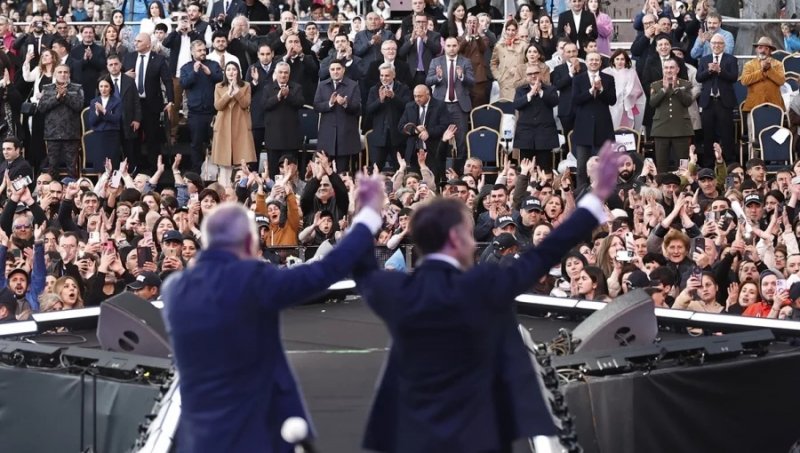
Emmanuel Macron threw his weight behind Armenian Prime Minister Nikol Pashinyan during a high-profile state visit, offering strong political support for Yerevan’s shift towards Europe just weeks before a closely contested election.
“Armenia is resolutely moving towards Europe,” Macron said, framing the country’s trajectory as part of a broader realignment in the South Caucasus, News.Az reports, citing Intelli News.
“We want and are determined to accompany you,” he added, signalling France’s readiness to deepen cooperation across economic, political and defence sectors.
The visit, which included the signing of a strategic partnership agreement and coincided with a summit between Armenia and the European Union, amounted to one of the clearest endorsements yet from a Western leader of Pashinyan’s reform agenda.
RECOMMENDED STORIES
It comes at a sensitive political moment. Pashinyan, in power since 2018, faces a tough re-election battle in June against opposition forces that favour closer ties with Russia or take a more nationalist line, particularly on relations with Azerbaijan. Critics accuse him of making excessive concessions in pursuit of a peace deal following the conflicts over Nagorno-Karabakh.
Macron’s intervention risks fuelling those criticisms, but also reflects the geopolitical stakes. Armenia, long reliant on Moscow for security, has in recent years begun cautiously diversifying its partnerships, seeking closer ties with the EU without fully severing its relationship with Russia.
The French president was unusually direct in his assessment of that relationship. Referring to the aftermath of the 2020 war and subsequent developments in Nagorno-Karabakh, Macron said: “We saw that Russia abandoned Armenia, we understood that greatest dreams are not reality.”
His remarks reflect a growing perception in Yerevan that Moscow is no longer a reliable guarantor of security, particularly after tens of thousands of ethnic Armenians were displaced in recent years without decisive Russian intervention.
At the same time, Pashinyan has sought to avoid provoking the Kremlin, maintaining formal alliances while gradually pivoting westward. That balancing act has become a defining feature of Armenian foreign policy.
Macron framed Armenia’s recent trajectory in broader historical terms, noting the country had “gone through war, then established peace, then prosperity,” and highlighting average economic growth of around 6% in recent years. “Armenia has always been a full member of the European family,” he said, adding that its progress towards Europe had become increasingly visible.
The visit showcased tangible elements of that shift. The European Union has stepped up engagement with Armenia, offering closer economic ties, visa liberalisation prospects and support for reforms. French-backed infrastructure and development projects, alongside defence cooperation agreements, point to deepening Western involvement.
Pashinyan was explicit in his appreciation of Macron’s role, saying French support had been felt “in all directions: economy, security, defensce, diplomacy, Armenia-European Union relations.” He added that “the role of French President Emmanuel Macron is key, without any exaggeration, key,” particularly in efforts to shape a peace framework with Azerbaijan.
A cornerstone of that framework is mutual recognition of territorial integrity based on the Alma-Ata Declaration, which Pashinyan described as forming the “architecture of peace” between Armenia and Azerbaijan.
Macron, for his part, said France was committed to supporting “the stable peace for which you have made a courageous decision,” while welcoming progress in talks between the two countries.
The South Caucasus is undergoing a period of significant geopolitical change, with traditional alignments shifting and new actors asserting influence. Macron used the visit to outline a vision for the region that moves beyond great power rivalry.
“The South Caucasus should not be an arena for the competition of empires,” he said, adding that the region could instead become “a crossroads between Europe, Asia and the Middle East.”
That message resonates with Armenia’s efforts to reposition itself as a bridge between regions, leveraging its geography and growing economic links.
The timing of Macron’s visit – and the strength of his endorsement – has drawn comparisons with other recent elections in the post-Soviet space. In Moldova, European leaders openly backed President Maia Sandu, whose victory was widely interpreted as a choice in favour of European integration over closer ties with Russia.
As in Moldova, Armenia’s upcoming vote is increasingly seen through a geopolitical lens, even as domestic issues such as economic performance and governance remain central.
Macron’s support could bolster Pashinyan among pro-European voters, but it also risks galvanising opponents who accuse the government of aligning too closely with the West at the expense of national interests.
Beyond the political messaging, the visit also featured moments of cultural diplomacy that highlighted the warmth of Franco-Armenian ties. Macron, whose country hosts a large Armenian diaspora, drew public attention by performing a French chanson at a state dinner, accompanied by Pashinyan on the drums, a moment that quickly circulated on social media.
Such gestures complement a relationship rooted in historical connections and reinforced by expanding cooperation in education, culture and local governance.
For Pashinyan, the challenge now is to translate that international support into domestic political capital, while continuing to navigate a complex geopolitical landscape.
For Macron and other European leaders, the stakes extend beyond Armenia itself. The country’s trajectory is increasingly viewed as a test case for whether deeper engagement can anchor reform-minded governments in a region long shaped by competing external powers.
By Leyla Şirinova


Similar news