N. Korea launches new intercontinental ballistic missile


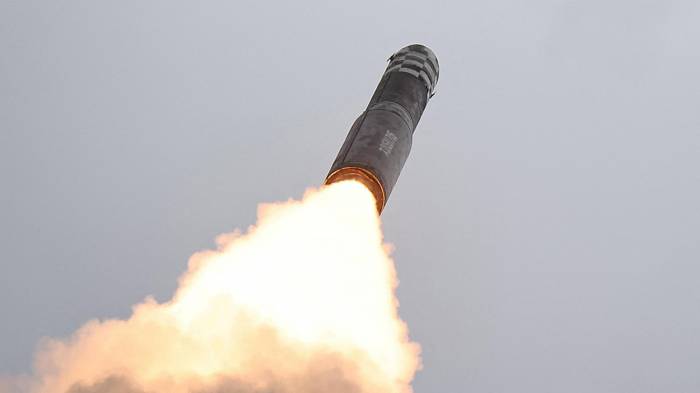
Pyongyang has confirmed the launch of a new intercontinental ballistic missile (ICBM) aimed at waters off its eastern coast, marking the longest flight time recorded for a North Korean missile.
North Korean leader Kim Jong Un was present at the missile test launch, and issued a warning to his enemies, News.Az reports, citing foreign media.“The test-fire is an appropriate military action that fully meets the purpose of informing the rivals, who have intentionally escalated the regional situation and posed a threat to the security of our Republic recently, of our counteraction will,” Kim was quoted as saying by KCNA.
South Korea’s Joint Chiefs of Staff (JCS) said in a statement the missile launched towards the East Sea, which is also known as the Sea of Japan, was detected at about 7:10am local time (22:10 GMT) and was fired on a “lofted trajectory”.
The JCS said later that initial analysis points to a possible use by North Korea of a newly developed solid-fuel booster for its long-range missiles.
Japan’s Defence Minister Gen Nakatani said the missile, which splashed down about 300km (190 miles) west of Japan’s Okushiri Island, off the country’s northern Hokkaido region, had flown the longest time of any of Pyongyang’s past missile tests.
“It was the longest time flying of any missile so far,” Nakatani told reporters.
“I think it may be different from conventional missiles,” he said.
North Korea’s launch of longer-range missiles in “lofted trajectory” means firing the missile almost vertically. This allows a missile to travel to a very high altitude but then land a short horizontal distance from the launch site. Such launches are said to enable Pyongyang to gather data to better understand the challenges faced when a long-range warhead re-enters the Earth’s atmosphere.
According to South Korea and Japan, the missile on Thursday recorded a flight time of 87 minutes, longer than the last ICBM test launch in December 2023, which clocked in at 73 minutes. The trajectory of the missile reached an altitude of 7,000km (4,349 miles) and flew a distance of 1,000km (621 miles), the Japanese government said, calling it an ICBM-class missile.


Similar news