Pakistan will respond decisively to any Indian aggression, Deputy Prime Minister Ishaq Dar


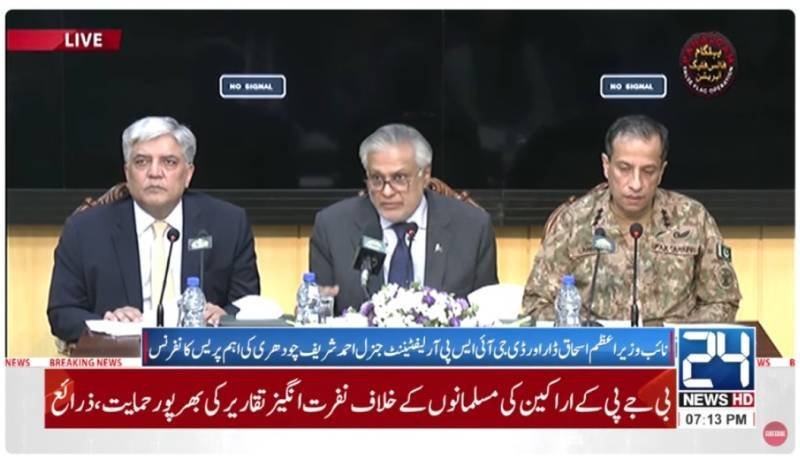
Pakistan on Wednesday strongly rejected India's claims linking Islamabad to the Pahalgam attack, accusing New Delhi of fabricating a narrative to inflame regional tensions for political purposes and engaging in state-sponsored terrorism, News.Az informs via 24Newshd.
In a powerful joint front led by DG ISPR Lt Gen Ahmed Sharif Chaudhry and Deputy Prime Minister Ishaq Dar, Pakistan said it would not initiate hostilities — but made clear that any aggression from across the border would be met with an even stronger response.
Addressing the press conference, Deputy PM Dar said the entire region was facing a serious threat to peace and stability owing to the “politically motivated and highly provocative environment being created by India” in the wake of the Pahalgam attack.
He said today’s presser was organised to brief the public on current developments and to share Pakistan’s concerns regarding India’s “highly irresponsible and destabilising” actions and statements.
“Let me start by reiterating that Pakistan condemns terrorism in all its forms and manifestations. No cause or objective can justify taking the lives of innocent people. This is the national and Islamic policy: killing of a human being is tantamount to killing entire humanity as per the Quran and saving a life is tantamount to saving entire humanity.”
Dar said the targeting of innocent civilians was sorely condemnable and deplorable, adding that Pakistan had been raising its policy in this regard wherever it was happening in the world.
“We are concerned over the loss of life during the Pahalgam attack. We also extend our condolences. Being a victim of terrorism itself, no one can feel the pain of those impacted by this scourge like Pakistan,” Dar said.
He said Pakistan was working with the world to end the menace of terrorism, while India was involved in state-sponsored terrorism in Pakistan as well as other countries of the world.
“India glorifies and even celebrates its assassination campaign and sponsoring of terrorism in Pakistan and other countries. No other country has sacrificed so much or suffered as much as Pakistan due to terrorism.”
Recounting the loss of over 80,000 lives and economic losses of over $150 billion, Dar said that in total, the overall loss incurred by Pakistan amounted to $500bn. He said Pakistan had been working closely with the international community to address the common threat.
He said the sacrifices made by Pakistan’s law enforcement agencies and civilians had helped to address the threat of terrorism and contributed towards regional and international peace and stability.
“Pakistan has been the victim of terrorism that has been planned, orchestrated and sponsored by India,” FM Dar said, adding that in such a backdrop, it was “preposterous to even suggest any kind of association of Pakistan with this (Pahalgam) incident”.
He said he took up the issue of the regional tension with the leaders of many countries. Dar said it has become habitual for India to blame Pakistan for every terrorist activity that happens there.
Dar alleged it was not the first time that India had resorted to this practice. “They have done it before and resorted again to the same to what they did in the Pulwama incident,” Dar said, adding that it had become a “very familiar template aimed at diverting attention from India’s inability to suppress the inalienable right of Kashmiris to self-determination, its security failures in occupied Kashmir as well as its decades-long state terrorism and oppression”.
The foreign minister said India deliberately raised tensions with Pakistan to distract the international community’s attention from the “horrors” of what was happening in occupied India.
“A durable solution for India lies in focusing on its internal problems instead of pointing fingers at other countries. India has been deploying allegations of terrorism to achieve its strategic objectives for a long time,” Dar said, adding that India had a history of using the excuse of terrorism to introduce “draconian laws” to suppress Kashmiris in the occupied territory and to defy UN Security Council resolutions on the issue.
“India needs to explain why such incidents usually coincide with high-profile visits … The root cause of instability and conflict in South Asia is the unresolved and long-festering Jammu and Kashmir dispute. India’s illegal occupation … in stark violation of UNSC resolutions and grave violations of human rights, must remain a matter of grave concern for the international community.
“At the same time, all such incidents are used to whip up domestic political sentiment for narrow political gains. We remain extremely concerned at the very vitriolic, highly inflammatory and blatantly Islamophobic narrative being directed against Kashmiris and Indian Muslims.
He said India wants to link the freedom movement in occupied Kashmir with terrorism.
The deputy PM said India resorted to black laws to suppress the rights of the people of occupied Kashmir. He said Kashmir was recognised as a disputed territory in UN resolutions.
Dar said the entire region is in danger due to India's irresponsible actions.
He said a vicious campaign against Muslims and Kashmiris is underway in India.
He alleged that India is fueling terrorism and extremism in the region.
Dar said Prime Minister Shehbaz Sharif has offered cooperation in an impartial and transparent investigation into the Pahalgam incident.
“We must consider why India undertook this campaign and what its objectives are?,” said Dar.
Dar said no party can unilaterally terminate the Indus Waters Treaty, and the Indian statement on the Indus Waters Treaty is a clear violation of international law.
He said water is a lifeline for the 240 million people of Pakistan.
He said India has taken extremely irresponsible actions and behaviour in the last two days and Pakistan will respond with full force to any kind of adventure.
“Pakistan will ensure its territorial sovereignty and integrity at all costs and will give a befitting reply if India commits any aggression.”
He urged the international community to hold India accountable for terrorist acts in various countries including Pakistan.
He said India's aggressive actions can bring the region to a standstill.
He said Pakistan's armed forces are fully prepared and with the support of the nation, the armed forces are determined to respond to every adventure.
He said Pakistan is fully aware of its responsibilities as a responsible country.
He said Pakistan will decide the time and target for a retaliatory strike in case of an attack.
Addressing the media, Foreign Office Spokesperson Shafqat Ali Khan said India is spreading disinformation.
He said Pahalgam is 230 kilometres away from the LoC.
He The FIR of the Pahalgam incident was registered in just 10 minutes whereas the police station is located 30 minutes away.
He said Indian social media accounts immediately started accusing Pakistan as the incident happened.
Addressing the media, ISPR DG Lt Gen Ahmed Sharif Chaudhry raised serious questions about the Indian narrative surrounding the recent Pahalgam incident, terming it hastily constructed and deeply flawed.
“How is it possible that an FIR was registered just 10 minutes after the attack?” asked the army spokesperson, questioning the legitimacy of the investigation and timing. “The FIR claimed that handlers were from across the border, and that people were fired upon indiscriminately,” he added.
Lt Gen Chaudhry said the Indian government appeared more focused on scapegoating Pakistan than conducting an impartial investigation.
“Instead of examining facts, they launched a narrative-building campaign to accuse Pakistan — almost as if it was pre-planned,” he stated.
He further revealed that social media handles linked to Indian agencies reported the incident at 3:05 pm, while Indian news channels began broadcasting the story around 3:30 pm, even though the video footage from the scene showed tourists fleeing in panic, not being selectively targeted based on religion, as Indian media later claimed.
“India falsely pushed the narrative that victims were questioned about their religion before being shot,” said the DG ISPR, debunking claims of communal targeting. “In fact, even a Muslim tourist was among those killed, clearly contradicting the religious profiling angle,” he added.
The Pahalgam incident, which took place nearly 230 kilometres from the Line of Control, was immediately linked to Muslims and Pakistan without any credible investigation, Lt Gen Chaudhry noted.
“Such prompt FIR registration and the swift temple references that followed only raise further questions,” he remarked.
Calling out the Indian government and media for their baseless allegations, he stressed, “Terrorists have no religion — the term ‘Islamic terrorist’ is a contradiction. We reject this label entirely.”
Lt Gen Chaudhry said that instead of hurling accusations, India must answer hard questions and allow an impartial, fact-based probe into the Pahalgam incident.
“We will not respond with propaganda — we will respond with facts,” he asserted.
Displaying visuals of the area’s rugged geography, he emphasized that the nearest police station was at least 30 minutes away, raising doubts about the credibility of the investigation.
“The FIR claimed handlers were from across the border and victims were fired upon based on religion,” he said. “But this is not what the facts suggest. A Muslim tourist was also among those killed, and footage clearly shows indiscriminate panic rather than communal targeting.”
Calling out a systematic media campaign, Chaudhry said Indian social media handles, previously linked to other terrorist attacks in Pakistan — including the Mianwali airbase attack in November 2023 and the Karachi assault on Chinese nationals in October 2024 — had projected, predicted, and then glorified the Pahalgam incident.
“This choreography is predictable,” he noted. “First the forecast, then the event, and within minutes, Indian electronic media picks it up.”
Drawing historical parallels, he cited the Pulwama attack in 2019, which was followed by India's unilateral revocation of Article 370, and now the weaponisation of Pahalgam to deflect from violations of the Indus Waters Treaty (IWT) and Pakistan’s anti-terror and economic progress.
Lt Gen Chaudhry warned of another troubling dimension: the use of illegally held Pakistani prisoners in fake encounters by Indian forces, projecting them as cross-border terrorists. “There are hundreds of such cases,” he said.
He also condemned Indian media for airing interviews of BLA spokespersons after the Jaffar Express bombing, showcasing footage filmed by the terrorists themselves. “This is transnational terrorism. India’s footprint is visible not just in Pakistan but in Canada, the US, and Australia as well.”
“We now have credible intelligence that after Pahalgam, India has instructed all its proxies — especially in Balochistan — to stage attacks throughout Pakistan,” the DG ISPR revealed.
Since January 24, Pakistan has endured 3,700 terror incidents, conducted 77,816 operations, eliminated 1,666 terrorists, and suffered nearly 4,000 casualties. “This is a war India wants to prolong to serve short-term political goals,” he declared.
Chaudhry slammed the demonisation of Indian Muslims, pointing out the irony that victims in Pahalgam were transported in Muslim-owned taxis, stayed in Muslim-owned hotels, and were shielded by Muslims during the attack. “Yet India tried to portray it as Islamist terror. What agenda is this? A society poisoned by hate?”
He warned that those questioning the Indian narrative are being clamped down upon, reflecting a wider effort to externalise internal problems like extremism, and internalise external ones like Kashmir.
Deputy PM Dar reiterated Pakistan’s desire for peace, but warned against miscalculation. “We will exercise restraint for the sake of regional peace. But if provoked, our response will be stronger than the provocation,” he declared.
He cited a unified stance from Pakistan’s National Security Committee (NSC), with all political parties and provinces backing a firm defence of sovereignty and territorial integrity. “There will be no compromise. The message is loud and clear.”
Dar also clarified: “This is not about mediation, it’s about investigation. Our friends may be trying to calm things down — and we appreciate that. But this issue demands facts, not face-saving diplomacy.”
Responding to questions, the DG ISPR said Pakistan’s military was monitoring the situation across “all terrains and all domains,” and had decisive countermeasures ready. He confirmed a routine weekly call between Indian and Pakistani military officials on Tuesday, where Islamabad raised the issue of ceasefire violations along the Line of Control.
“This weekly contact is standard and usually kept confidential,” he noted. “We don’t know why India chose to make it public — perhaps to distract from its own actions.”


Similar news