S. Korea's ruling party secures landslide victory in local elections


South Korea’s ruling Democratic Party (DP) secured a decisive victory in the country’s local elections and parliamentary by-elections, capturing a majority of key regional leadership positions, although it failed to unseat the incumbent mayor of Seoul.
According to final vote counts, the DP won 12 of the 16 major mayoral and gubernatorial races held nationwide, News.Az reports, citing Yonhap.
Among its most notable victories was the mayoral race in Busan, a city traditionally regarded as a conservative stronghold, where Jeon Jae-soo was elected mayor.
RECOMMENDED STORIES
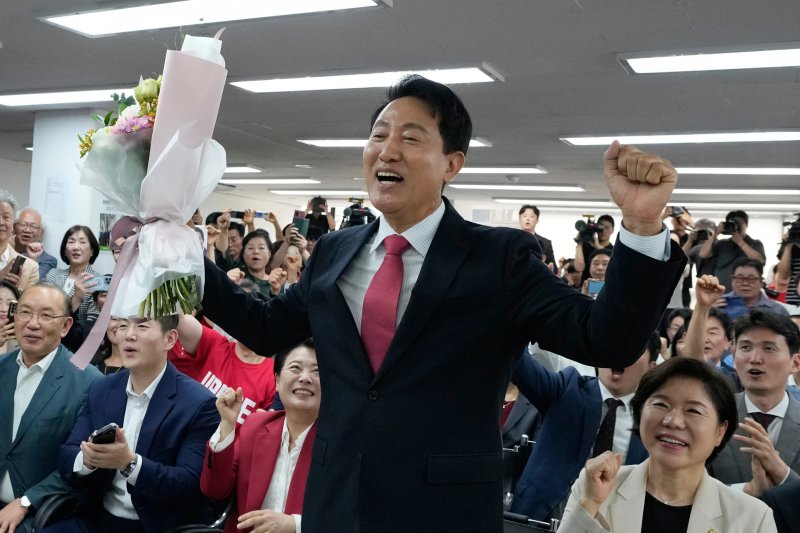
The main opposition People Power Party (PPP) won the remaining four mayoral and gubernatorial seats, including Seoul, where incumbent Mayor Oh Se-hoon secured a fifth term in office.
In the parliamentary by-elections, which took place simultaneously with the local polls, the DP also emerged as the leading force. The ruling party captured nine of the 14 seats contested, while the PPP won four seats. The remaining constituency was claimed by an independent candidate.
Although the DP lost four parliamentary seats that had previously been under its control, the setback was viewed as relatively minor given the party’s existing majority in the 300-seat National Assembly.
The elections were held exactly one year after the administration of President Lee took office on June 4.
The strong performance by the ruling party is expected to reinforce the government’s political mandate and strengthen its ability to advance key reform initiatives. The results also represent a significant challenge for the PPP, which continues efforts to rebuild conservative support following the removal of former President Yoon Suk Yeol from office.
The outcome marked a dramatic shift in voter sentiment compared with the previous local elections held four years ago. In those elections, the then-ruling PPP won 12 of the country’s 17 major mayoral and gubernatorial positions. The 2022 local elections took place just one month after Yoon assumed the presidency.
The latest results underscore the changing political landscape in South Korea and highlight the ruling Democratic Party’s strengthened position at both the local and national levels.
In Gyeonggi Province, veteran DP lawmaker Choo Mi-ae won by a wide margin against the PPP's Yang Hyang-ja, becoming the country's first female head of a provincial government.
The capital region -- home to roughly half of the country's population -- is often considered a key, if not the most important, battleground.
In the southeastern city of Busan, DP candidate Jeon was declared the winner against the PPP's Park Heong-joon by a slim margin.
The results for the parliamentary by-elections marked sharply different political fates for two heavyweights -- former PPP leader Han Dong-hoon and Cho Kuk, leader of the liberal Rebuilding Korea Party -- with only Han, who ran as an independent, securing a seat in the National Assembly.
Cho, on the other hand, narrowly lost to Yu Eui-dong of the PPP in the closely watched race of the Pyeongtaek-B constituency, which also included Kim Yong-nam of the DP in a tight three-way competition.
The elections were widely seen as the first nationwide test for Lee, who was elected in a snap presidential election following the ouster of Yoon over his botched martial law bid in December 2024.
Throughout its election campaign, the DP had urged the public to make a stern judgment on what it called the "remnants" of Yoon's "insurrectionist forces."
Yoon was sentenced to life imprisonment by a district court in February for his failed martial law bid.
Also at stake in this year's local elections were 16 education superintendent seats, along with 227 heads of local governments and some 4,000 members of local councils.
In Seoul, the DP won 17 of the city's total 25 district chief posts, a solid improvement from the previous 2022 local elections, when the party secured only eight seats while the PPP captured the remaining 17 seats.
Of the 227 district chief posts nationwide, including those in Seoul, the DP won 119 seats while the PPP secured 95, with the remainder going to independents and a minor party.
This year's elections were partly marred by an unprecedented shortage of ballots at 14 polling stations in parts of Seoul, prompting the temporary suspension of voting there, with some voters said to have left without voting.
The PPP was quick to raise issues over poor election management, calling on the NEC to immediately stop the vote counting and hold a revote if necessary.
Voting took place from 6 a.m. to 6 p.m. at 14,288 polling centers nationwide, with the exception of one of the affected polling stations in Songpa Ward, which extended the voting hours to 10 p.m.
By Nijat Babayev


Similar news