Snow spotted on Mount Fuji after record absence


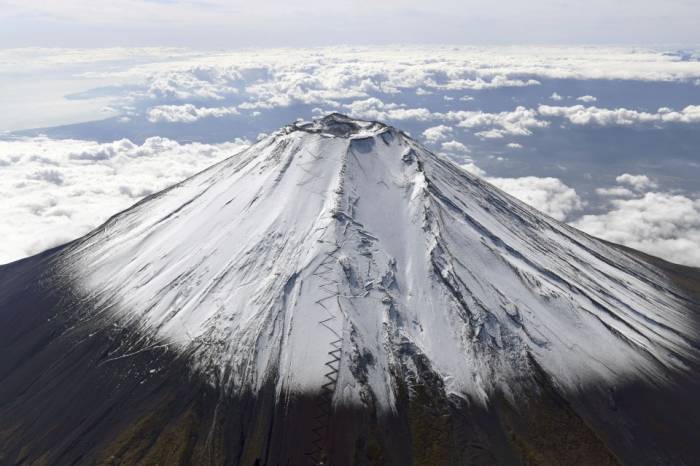
Snow has finally blanketed Mount Fuji, as images from Wednesday revealed, marking the end of an unusually warm period that resulted in the mountain’s longest-ever stretch without snow on its slopes.
The volcano's famous snowcap begins forming on Oct. 2 on average, and last year snow was first observed by government meteorologists on Oct. 5, News.Az reports, citing foreign media.The national weather agency — which compares conditions in exactly the same location in Kofu, Yamanashi Prefecture, each year — has not yet announced a new record for the slowest start to the snowcap, due to cloud cover at its monitoring station.
But this year already marks the latest arrival of snow since comparative data became available in 1894, beating the previous record of October 26 — seen twice, in 1955 and 2016.
Photographs taken from different points around the active volcano, where the skies were clearer early on Wednesday, showed a covering of snow on its peak.
"These are photos of Mount Fuji, seen from the city hall this morning. We could see a thin layer of snow cover near the summit," said a post on the official X account of the city of Fuji in Shizuoka Prefecture.
Many others in the area also posted their own photographs of snow on the country's highest mountain, and aerial footage from national broadcaster NHK showed close-ups of white powder on the rocky slopes.
"Finally, the first snow cover! Mount Fuji looks good with snow," said a post from a nursing home, also in Fuji.
A Meteorological Agency official in the Kofu office said on Wednesday morning it was still too cloudy to declare a new record. That was still the case in the afternoon.
"The temperature is low today," so any snow on the mountain will likely stay put for now, the official added.
Global warming is one of many factors that led to the slow snow cover, he said. "The temperature in October at the top of Mount Fuji was warmer than the average."
Japan's summer this year was the joint hottest on record — along with 2023 — as extreme heat waves fueled by climate change engulfed many parts of the globe.
Mount Fuji is covered in snow for most of the year, but during the July-September hiking season, more than 220,000 visitors trudge up its steep, rocky slopes.
Many climb through the night to see the sunrise from the 3,776-meter summit.
The symmetrical mountain has been immortalized in countless artworks, including ukiyo-e artist Katsushika Hokusai's "Great Wave." It last erupted around 300 years ago.


Similar news