Stevan Gajić: Serbian protests are about restoring institutions, not regime change - INTERVIEW


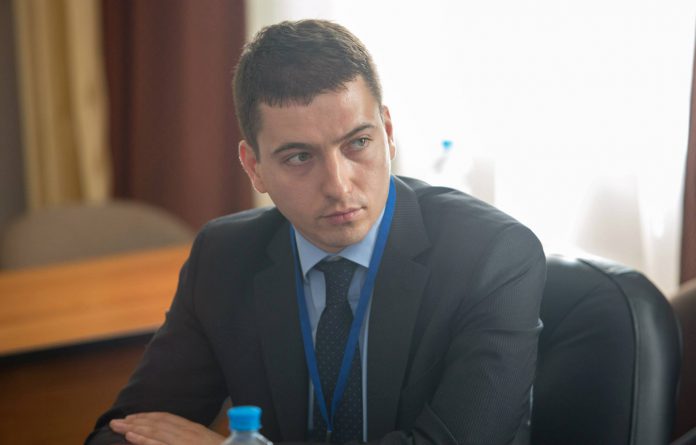
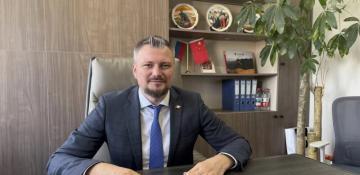
News.az presents an interview with Stevan Gajić, a renowned Serbian political expert, a research fellow at the Institute of European Studies (Belgrade), and a visiting professor at the Moscow State Institute of International Relations (MGIMO).
- What are the main reasons behind the student and faculty protests in Serbia?
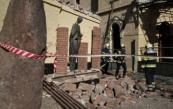
- A tragedy occurred in Serbia: on November 1, 2024, the recently renovated bus station in the city of Novi Sad collapsed, resulting in the deaths of 15 people. The reconstruction of the station cost €65 million—an astronomical sum for a project of this nature. This immediately raised suspicions of large-scale corruption, which many believe is a systemic feature of the ruling party under Aleksandar Vučić. Increasingly, the authorities are being compared not to a political organization but to an organized criminal group.
Students participating in the protests have put forward several key demands. First and foremost, they call for the full disclosure of all documentation related to the station’s reconstruction, including tender conditions, information about contractors, and a detailed breakdown of payments—who received the funds, when, and under what conditions. The public has the right to know where this money has gone.
Additionally, students demand the immediate dismissal of charges against those arrested during the initial days of the protests. These individuals bear no responsibility for the tragedy, and their detention serves only as a means of exerting pressure on demonstrators.
Another crucial demand is the identification of all individuals who attacked students during the protests. There have been multiple documented incidents of attacks by unidentified assailants, including the use of baseball bats. In one such attack in Novi Sad, a female student suffered a triple jaw fracture. It is imperative that all those responsible be held accountable. If any of the perpetrators hold government positions, they must be dismissed immediately.
Protesters are also calling for a 20% increase in university funding. For years, the government has cut education spending, leading to its deterioration. Furthermore, there were previous attempts to license foreign universities with full state funding, allowing them to operate solely under their own curricula while disregarding national education standards. Fortunately, public opposition prevented this plan from being implemented.
Today, the protests extend beyond the issue of corruption; they represent a broader struggle for transparency in state institutions and the protection of the education system.
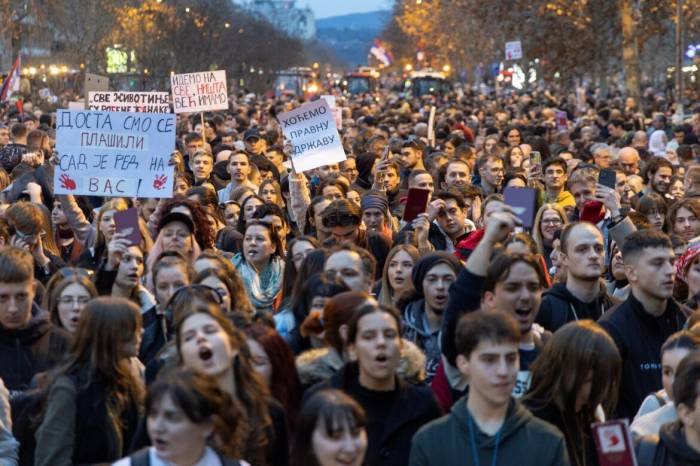 Serbian students protest in front of the ruling Serbian Progressive Party's headquarters in Novi Sad Jan. 28, 2025, following the overnight beating of fellow protesters colleagues by what they say were party activists. (OSV News photo/Mitar Mitrovic, Reuters).
- What consequences has the Serbian government already faced as a result of the mass protests?
- The consequences are clear: the government has fallen, and Miloš Vučević has resigned. As a result, our government is now in a caretaker capacity.
- What are the potential long-term implications of these protests for Serbia’s education system and political landscape?
- If the truth comes to light and the students’ demands are fully met, the government will face a significant challenge. This entire scandal inevitably leads to the president’s office, as those behind the companies responsible for the station’s reconstruction have close ties to the head of state. Moreover, there are rumors that some of these companies’ owners may be his close relatives.
There is a possibility that Vučić himself, along with his ministers, was directly involved in this project, given the scale of corruption and the enormous opportunities for embezzling state funds.
- How has the Serbian government responded to the protesters’ demands, and what concessions have been made?
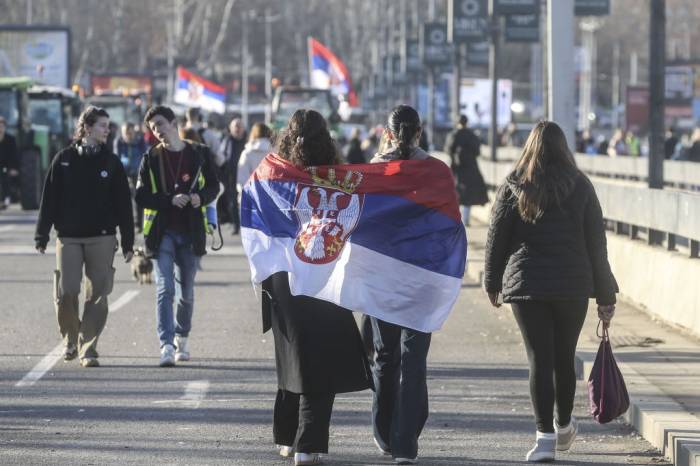
Image:jacobin
- The authorities’ response to the protests has been highly inadequate. From the outset, they attempted to suppress the demonstrations by force. In Novi Sad, during the first protest, the government deployed masked individuals who began rioting and vandalizing city infrastructure to discredit the demonstrators. However, video footage soon emerged clearly showing these individuals entering and exiting the offices of the Serbian Progressive Party. This exposed their involvement in the provocations.
Rather than acknowledging their responsibility, the authorities continued an aggressive campaign against the students, accusing them of violence. Physical intimidation of protesters has become a regular occurrence. Particularly alarming have been instances of deliberate vehicle attacks on demonstrators, including women participating in blockades. Fortunately, no fatalities have occurred, but these intimidation tactics reveal the panic and fear gripping the government.
- Can Aleksandar Vučić’s initiative to negotiate with the protesters help de-escalate tensions in the country?
Image:Ura.ru
- Serbian students are not demanding anything from Vučić personally—they do not seek dialogue with him as a dictator who positions himself above state institutions. Their primary stance is that he is the problem, as he obstructs the normal functioning of government institutions. The students advocate for the restoration of the judiciary, ministries, and prosecutorial bodies so that the country is governed not by the iron will of one man and his party—more reminiscent of an organized crime syndicate—but by the rule of law and functioning institutions.
A key demand of the protesters is the liberation of state institutions from the ruling party’s influence, particularly the judiciary, which must fulfill its duties independently. This issue extends beyond corruption scandals to include the matter of Kosovo and Metohija. Serbia’s Constitutional Court has effectively ignored the illegality of the Brussels, Ohrid, and Washington agreements signed by the Serbian leadership. As a result of these agreements, Vučić has systematically compromised national interests in Kosovo in exchange for Western support, which has allowed him to act with impunity within the country.
The protests in Serbia have a distinctly national character. Among the participants, one can see numerous Serbian flags and symbols featuring the map of Kosovo and Metohija, accompanied by the slogan "No Surrender—Kosovo is Serbia." Notably, there is a complete absence of European Union symbols at the rallies. When some activists attempted to bring EU flags, they were met with strong opposition and immediately expelled from the protest columns. This demonstrates that comparing events in Belgrade to protests in Bratislava or Tbilisi is inaccurate, as their nature and goals differ fundamentally.
Another significant feature of the Serbian protests is their decentralized structure. The students have no formal leader, making it impossible for security services and the government to exert pressure on individual activists. Moreover, they deliberately refuse to cooperate with political parties and react sharply to any attempts at political interference. In one recent case, when political leaders in Novi Sad attempted to join the demonstrators, students officially stated that they had no affiliation with them and would not allow the protest to be used for political gain.
Thus, the protests in Serbia are not a movement for a change in power but a struggle to restore the rule of law and the independence of state institutions.


Similar news