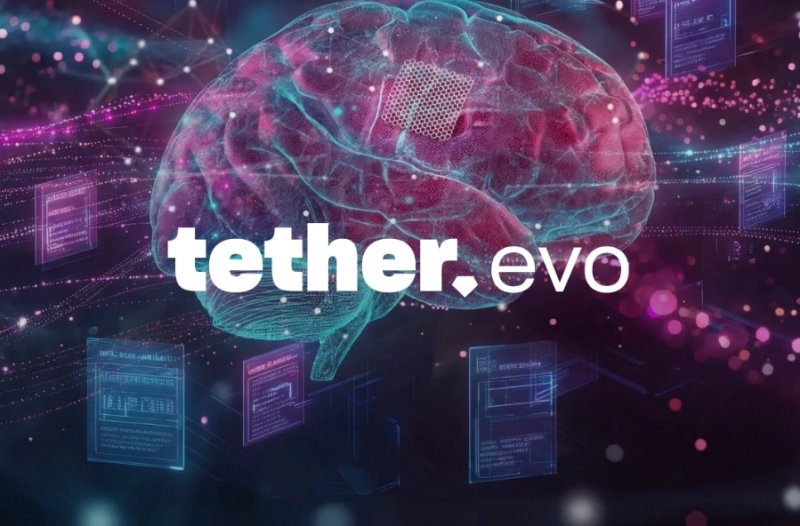
The project, known as BrainWhisperer, is designed to convert brain signals into written language, offering potential new communication pathways for people with speech impairments or paralysis, News.az reports.
The system has already demonstrated the ability to reconstruct complex sentences from neural signals recorded via intracranial implants.
In one example shared by the company, BrainWhisperer successfully decoded phrases generated purely from brain activity, highlighting the rapid progress of brain-to-text technologies.
A new step in brain-computer interface development
BrainWhisperer forms part of a broader initiative by Tether, described as “Brain OS” – an open-source platform intended to connect brain-computer interfaces with artificial intelligence systems and wearable technologies.
The company says the system is built on top of AI models inspired by Whisper, adapting automatic speech recognition techniques to neural signals rather than audio input.
By converting brain activity into phonemes and then into text, BrainWhisperer aims to reduce word error rates and improve decoding precision across different users and conditions.
Competitive performance and technical benchmarks
Tether reported that its system ranked fourth out of 466 participants in a recent international brain-to-text competition hosted on Kaggle.
According to the company, BrainWhisperer achieved a word error rate of 1.78%, placing it close to the top performers in the field.
The system uses a multi-stage architecture combining several machine learning models, ensemble techniques and phoneme-to-text conversion frameworks to maximise transcription accuracy.
Towards universal decoding across individuals
One of the key challenges in brain-computer interface research is the need to calibrate systems for each individual user – a process that can take hours or even days.
Tether says it is working on “cross-subject” decoding, a method aimed at creating a universal system capable of interpreting neural signals from different individuals without extensive recalibration.
Early results suggest that this approach could significantly reduce setup times while maintaining competitive accuracy compared with existing state-of-the-art models.
Balancing performance and accessibility
Current high-precision systems often rely on invasive brain implants, which require surgical procedures. Tether says it is also exploring non-invasive alternatives, including wearable sensors that can capture signals from the skin or muscles.
These approaches could make brain-to-text technologies more widely accessible, though they face technical challenges such as signal interference and reduced precision.
Implications for healthcare and human-AI interaction
Advances in brain-to-text systems are widely seen as a potential breakthrough for assistive technology, particularly for individuals who are unable to speak or move.
By enabling direct communication from neural signals, such systems could transform how people with severe disabilities interact with the world.
Tether says its long-term goal is to develop systems that allow users to communicate more naturally and efficiently, while maintaining privacy by processing data directly on personal devices.
While independent verification of the latest results is still awaited, the announcement underscores the accelerating pace of innovation at the intersection of neuroscience and artificial intelligence.