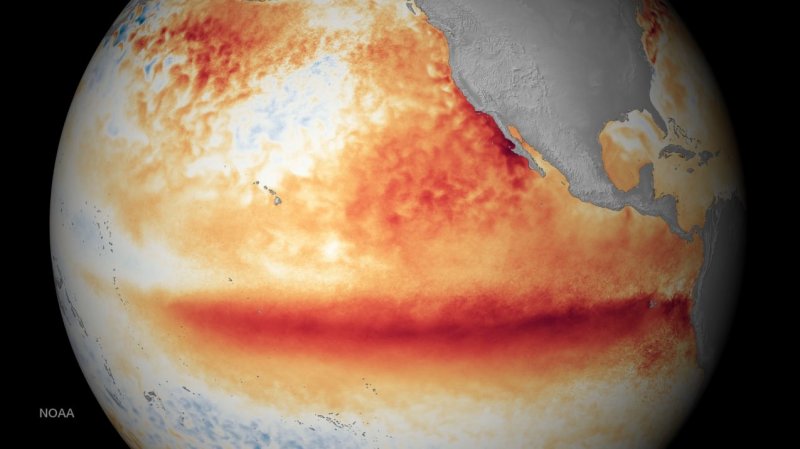
Recent seasonal outlook reports from the U.S. National Oceanic and Atmospheric Administration’s (NOAA) Climate Prediction Center and the European Centre for Medium-Range Weather Forecasts have identified a significant ocean warming signal. If this signal continues to intensify, forecasters warn it could lead to substantial impacts across Southern California and other regions around the world, News.Az reports, citing Xinhua.
According to forecasters, increasing ocean heat accumulating along the equatorial Pacific at present could create conditions favorable for an unusually strong El Niño later this year.
The U.S. agency notes that such a climate pattern could increase the likelihood of wetter and stormier conditions in Southern California and across other parts of the western United States. It may also generate ripple effects that influence the Atlantic hurricane season and affect weather systems as distant as Southeast Asia.
The agency explains that El Niño and La Niña represent opposite phases of the El Niño–Southern Oscillation (ENSO). During El Niño events, the winter storm track typically shifts southward, increasing the probability of above-normal rainfall in Southern California. In contrast, La Niña events tend to push storm tracks northward, often resulting in drier-than-average conditions in the region.
For residents of Southern California, the primary concern is not isolated rainfall events but the potential for repeated high-intensity storms associated with El Niño conditions. Such storms can overwhelm drainage systems and saturate dry, arid terrain. The California Coastal Commission has warned that areas affected by previous wildfire burn scars, combined with steep and dry landscapes, may become highly unstable. In such cases, hillsides can collapse rapidly, sending mud, rocks, and vegetation cascading into communities below. Additionally, strong offshore storms can generate hazardous surf conditions and accelerate beach and cliff erosion.
Historical El Niño events have shown alternating patterns of heavy rainfall and extended dry intervals, which can also complicate wildfire preparedness depending on when storms occur.
When El Niño develops into its strongest category, “it’s essentially the upper echelon of El Niño events,” Jonathan O’Brien, a meteorologist with the U.S. Forest Service, told the Los Angeles Times.
According to the National Aeronautics and Space Administration (NASA), strong El Niño events can elevate sea levels and increase extreme precipitation, which in turn raises the risks of both coastal flooding and inland flooding along California’s coastline.
The California Geological Survey also cautions that El Niño winters often bring above-normal precipitation to Southern California. This increases the likelihood of mudslides, road-blocking landslides, and destructive debris flows triggered by heavy rainfall.
Even the possibility of a strong El Niño event is already causing concern among residents, emergency management officials, and water resource agencies.
“I used to have a house on the beach in Malibu,” filmmaker “Skippy” Bakel told Xinhua. “I’m glad I’m not living there now.”
For California’s water managers, a strong El Niño presents both opportunities and risks. The National Weather Service notes that increased precipitation can replenish reservoirs and improve snowpack levels. However, warmer storm systems can raise the snow line, causing precipitation that might otherwise fall as snow to instead fall as rain. This can reduce the natural “snowpack reservoir” that gradually releases water during spring and summer, while simultaneously increasing flood risks due to rapid runoff.
UCLA climate scientist Daniel Swain has cautioned against assuming that every El Niño event behaves the same way, even when ocean temperatures are unusually elevated.
A strong event “does have the potential for strong impacts on California,” Swain said, while emphasizing that the eventual outcomes depend heavily on how storm systems develop and align over the course of several months.
Beyond California, the World Meteorological Organization (WMO) states that El Niño significantly affects global weather patterns when warmer Pacific Ocean waters release heat into the atmosphere. This process shifts jet streams and storm tracks, alters atmospheric circulation over the western Pacific, weakens the Walker Circulation, and changes patterns of convection in ways that can influence monsoon systems across East and Southeast Asia.
The WMO further notes that strong El Niño events contribute additional heat to the atmosphere by releasing stored ocean heat on top of ongoing human-caused greenhouse gas warming. This view is supported by research published in Nature Climate Change, which suggests that extreme El Niño events could become more frequent as global temperatures rise.
Such developments could increase the likelihood of record-breaking global temperatures, placing additional strain on global power grids and contributing to public health challenges. The NOAA Coral Reef Watch program also directly links El Niño-related ocean warming to marine heatwaves and widespread coral bleaching events, which severely disrupt marine ecosystems and fisheries.
With several months remaining before winter conditions fully develop, public officials are urging Southern California residents to prepare for potentially stormy weather. Recommended precautions include reviewing evacuation plans for areas below recent wildfire burn scars, preparing sandbags and emergency supplies, and ensuring drainage systems are cleared.
Meteorologists continue to monitor Pacific Ocean temperatures and wind patterns closely to determine whether El Niño conditions will strengthen further and potentially reach the rare and extreme “super” category, which is associated with significantly amplified weather impacts.