Ukraine strikes Moscow oil refinery, exposing Russia’s energy vulnerability


Editor’s note: Zaur Nurmamedov is a journalist and a graduate of the Faculty of Political Science at the Academy of Public Administration under the President of the Republic of Azerbaijan (1993–1999). He previously served as first deputy editor-in-chief of the Vesti.Az news portal (2009–2023). The views expressed in this article are his own and do not necessarily reflect the position of News.Az.
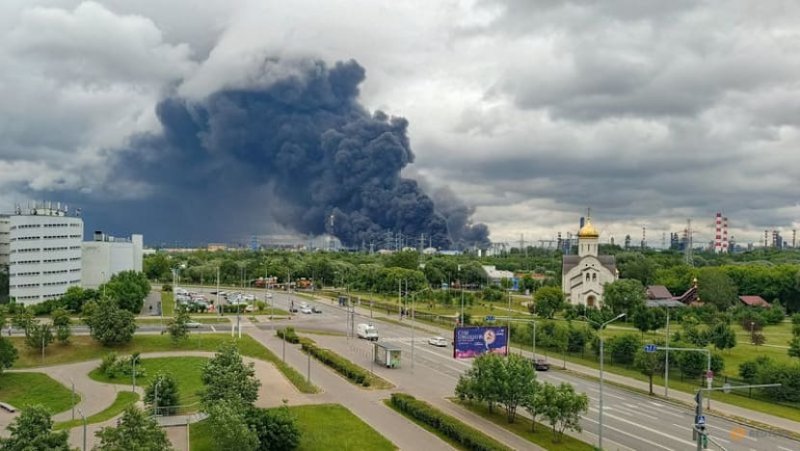
For more than four years, Russia has tried to keep the war physically distant from its political and economic core. The Kremlin’s message to the public has been simple: the “special military operation” is being fought somewhere else — in Ukraine, on the front line, far removed from the routines of life in Moscow. But the latest Ukrainian drone strikes on the Moscow oil refinery have shattered that illusion, sending black smoke over the Russian capital.
The strike on the refinery in Kapotnya, in south-eastern Moscow, was not just another symbolic attack. It targeted one of the most sensitive assets in Russia’s domestic energy system. The Moscow Oil Refinery, operated by Gazprom Neft, has a processing capacity of roughly 230,000 barrels of crude oil per day. It is not merely an industrial facility on the outskirts of the city. It is a key supplier of fuel for Moscow and the surrounding region, producing petrol, diesel, bitumen and other petroleum products.
According to Western media reports, the refinery supplies up to 40% of Moscow’s petrol and a significant share of the region’s diesel fuel. That is why the attack on Kapotnya matters. It was not simply a strike on an industrial site, but direct pressure on the fuel security of Russia’s largest city. For Moscow — home to the country’s political institutions, financial sector, logistics networks, major businesses and vast consumer market — stable fuel supplies carry both economic and political significance.
This is what gives the attack strategic weight. Ukraine is no longer limiting itself to strikes on military depots, airfields or logistics hubs near the border. Kyiv is expanding pressure on Russia’s energy heartland — the infrastructure that keeps the economy moving, the military supplied and the state budget funded.
The scale of the damage is particularly important. According to Reuters, the second attack in a week damaged the Euro+ unit, which has a capacity of about 140,000 barrels per day — roughly 47% of the refinery’s total capacity. An earlier strike hit the CDU-6 crude distillation unit, which accounts for around 53% of the plant’s capacity. In other words, these were not minor fires affecting peripheral equipment. They were strikes on the core processing units of one of Moscow’s most important refineries.
That means the consequences could extend far beyond smoke and explosions. If the reported damage to key units is confirmed, the refinery may be forced to operate at reduced capacity or temporarily shut down some production lines. Even if the fires are quickly extinguished, a refinery is a complex technological system. Damage to pipelines, secondary units, storage tanks, control systems and auxiliary infrastructure can reduce fuel output for weeks.
The first economic signal has already appeared. Following the attacks, one Moscow fuel retailer, Neftmagistral, raised the price of AI-95 petrol by around 19% in a week — from about 80 to 95 roubles per litre. The company operates around 100 filling stations in Moscow and the Moscow region. Following the sharp increase, Russia’s Federal Antimonopoly Service demanded an explanation. This does not mean that Moscow is already facing a large-scale fuel shortage, but it does show that the market has begun to price in the risk of disruption.
If the Moscow refinery reduces output, fuel will have to be brought in from other regions. That would increase pressure on railways, road transport, storage facilities and wholesale suppliers. For Moscow and the wider region, where daily fuel consumption is enormous, even a temporary loss of part of the refinery’s capacity could trigger a chain reaction: higher transport costs, higher wholesale prices, tighter administrative controls and the risk of local disruptions.
There is also a military dimension. The refinery does not produce only civilian petrol. Diesel, aviation fuel and other petroleum products are vital for transport, military logistics, heavy equipment, construction and supply chains. Even if the Russian military receives fuel from several sources, reduced refining capacity in central Russia adds pressure to the wider supply system. Ukraine is therefore targeting not only the economy, but also Russia’s ability to sustain the war.
Repairs may prove difficult. Modern refining complexes depend on imported components, automation systems, pumps, compressors, catalysts, sensors and software. Under sanctions, restoring damaged units can take longer and cost more. Even if Russia manages to source equipment through parallel imports or grey-market channels, the core problem remains: repeated strikes can put repaired capacity out of service again.
RECOMMENDED STORIES
The strike on the Moscow refinery is part of a broader Ukrainian campaign against Russian energy infrastructure. These are no longer isolated attacks, but part of a systematic strategy. Ukraine is trying to damage not only military sites, but also the fuel base that enables Russia to wage a prolonged war. Ukrainian officials have described such long-range attacks as “long-range sanctions”. The logic is clear: if traditional sanctions are slow, incomplete or circumvented through shadow fleets, intermediaries and alternative markets, drones can create direct pressure on physical infrastructure.
The effect is already extending beyond a single plant. The International Energy Agency reported that Russian oil production in May fell to around 8.7 million barrels per day — about 5% lower year on year and 10% below the target for that month. According to Reuters, Ukrainian attacks on energy infrastructure were among the factors behind the decline. For a country whose budget still relies heavily on oil and gas revenues, this is no longer a tactical problem but a form of strategic pressure.
At the same time, Russia has not lost its oil income. In May, its oil exports remained at around 7.4 million barrels per day, while oil revenues stood at about $20.8 billion. But the trend matters: production is falling, refining is under pressure, repairs are complicated by sanctions, and Moscow is finding it increasingly difficult to supply the domestic market, the front line and export channels simultaneously.
Oil and gas revenues remain one of the foundations of Russia’s budget. In 2026, Moscow expects to receive about 8.92 trillion roubles from oil and gas out of total federal revenues of just over 40 trillion roubles. That means roughly one in every five roubles of federal income is expected to come from the energy sector. If attacks on refineries and oil infrastructure continue, the state will have to spend more on repairs, protection, logistics and possible measures to contain domestic fuel prices.
The psychological impact is just as important. For the Kremlin, the damage to the refinery is painful, but the fact that Moscow itself was hit is even more politically sensitive. The Russian capital has long been presented as a protected and untouchable centre. Now the war is appearing not only in border regions, but also in the skies over Moscow. According to Western media reports, the attack was one of the largest Ukrainian aerial assaults on the Russian capital since the beginning of the full-scale war. Airports faced disruptions, traffic restrictions were introduced, and casualties were reported.
For ordinary residents, this changes perceptions of the war. What once seemed like a distant reality seen on television is now visible in explosions, smoke, debris, airport disruptions and rising fuel prices. This does not mean an immediate political crisis. But it gradually erodes one of the Kremlin’s central domestic narratives: that the war can continue indefinitely while having little impact on life in the capital.
Russia will likely respond by strengthening air defences around refineries, fuel depots, power plants, airports and other strategic sites. But this creates another dilemma. The more air defence systems are needed to protect Moscow and energy infrastructure, the fewer resources remain available for the front line, border regions and other strategic areas. Russia is a vast country with thousands of kilometres of pipelines, dozens of refineries, fuel depots, pumping stations and export terminals. Defending all of this against relatively low-cost drones is extremely difficult.
For Ukraine, this campaign also carries risks. Strikes inside Russia may provoke harsher retaliation and concern some Western partners who fear escalation. But Kyiv’s argument is that Russia has already escalated for years through missile strikes on Ukrainian cities, drone attacks, the destruction of power plants and attacks on civilian infrastructure. From Ukraine’s perspective, targeting Russia’s fuel system is not escalation for its own sake, but an attempt to reduce Moscow’s capacity to continue its aggression.
That is why the strike on the Moscow refinery was more than a dramatic episode in the war. It signalled a new phase of the conflict of attrition. Ukraine is trying to shift part of the cost of the war back onto Russia’s economy, infrastructure and society. Moscow wanted a war fought on Ukrainian soil, financed by Russian energy revenues and largely insulated from daily life in the capital. Ukraine is now challenging all three assumptions.
The black smoke over Kapotnya carried a strategic message: Russia’s energy heartland is no longer beyond reach. And as long as the war continues, the infrastructure that fuels Russia’s economy and military machine will remain one of Ukraine’s primary targets.
(If you possess specialized knowledge and wish to contribute, please reach out to us at opinions@news.az).


Similar news