Azerbaijan, Kazakhstan, and China accelerate work on the TITR


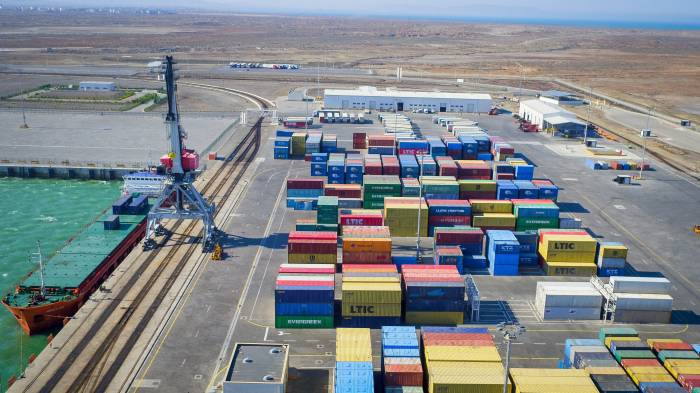
Photo: portofbaku.com
By Tural Heybatov
During the 29th UN Climate Change Conference (COP29) in Baku, an agreement was signed to implement a project for the establishment of an intermodal cargo terminal at the Baku International Sea Trade Port in Alat.
The agreement was signed by Taleh Ziyadov, Director General of the Baku Port, Nurlan Sauranbayev, Chairman of the Board of Kazakhstan Railways (KTZ), and Yuan Xiaojun, General Director of Xi'an Free Trade Port Construction and Operation Co., Ltd. The ceremony was also attended by Ruslan Alihanov, Director General of the Azerbaijan Investment Holding, and Nurlan Zhakuparov, Chairman of the Board of Samruk-Kazyna JSC.The agreement outlines the creation of an intermodal cargo terminal at the Baku Port to enhance and expand the port's freight handling capacity. Initially, the project will develop infrastructure across 40 hectares. The terminal will become a key element of infrastructure, designed to handle various types of cargo using multiple modes of transport, including maritime, rail, and road. The new terminal will feature a universal cargo area, a covered warehouse complex spanning 5,000 square meters, and a container yard capable of accommodating over 1,000 containers.
Azerbaijan has already established itself as a reliable transport and logistics hub. Strengthening the port infrastructure at Alat will further solidify the country’s role on the New Silk Road. The new intermodal terminal will significantly boost container train volumes along the China-Europe-China route via the Trans-Caspian International Transport Route (TITR), also known as the Middle Corridor. The project will help reduce delivery times, lower transportation costs, and expedite cargo transshipment between different modes of transport.
X social media platform
According to experts, the agreement is equally important for the other two signatories. Simultaneously, Kazakhstan and China have commenced the construction of a container hub in Mangystau, which will increase the throughput capacity of the Aktau Port from 58,000 to 240,000 TEU (twenty-foot equivalent units) per year. The project is expected to be completed by mid-2025.
It is evident that TITR participants are committed to significantly increasing the corridor’s capacity, with work progressing rapidly across all sectors. Notably, cargo volumes along the TITR route grew by 70% in the first nine months of 2024, reaching 3.4 million tons. Container shipments totaled 34,600 TEU, tripling the figures for the same period last year. Moreover, transit of containers from China increased more than 20-fold.
Answering questions from journalists at COP29, Taleh Ziyadov, Director General of the Baku International Sea Trade Port, noted that the second phase of port construction is underway, focusing on creating container transportation infrastructure. The first phase has already ensured a throughput capacity of 15 million tons of cargo. The second phase will increase this capacity to 25 million tons, with a primary focus on container transportation. Most cargo from China to Europe and from Central Asia to Turkey will be transported in containers. In this context, the construction of the new intermodal cargo terminal at the port is of critical importance, Ziyadov emphasized.
“Cargo from both China and Kazakhstan destined for Europe will transit through our port and be delivered to their destinations by rail and road through the new terminal. The terminal will also provide storage facilities for cargo. Kazakhstan’s export potential through our port is approximately 4 million tons. The volume of goods transported from China to Europe is expected to grow steadily from 100,000 to 300,000 containers annually,” said Ziyadov.
It is projected that the total number of trains dispatched from China via the TITR this year will reach 300, equivalent to approximately 30,000 TEU. Baku and Astana are taking steps to achieve even higher figures: forecasts suggest that by 2025–2026, cargo transportation along the TITR could reach 600 container trains annually, rising to 1,000 trains by 2027.
The Baku International Sea Trade Port in Alat is a vital component of the Trans-Caspian International Transport Corridor. Covering 400 hectares, the port has 13 berths capable of accommodating Ro-Ro vessels, ferries, and general cargo ships. Currently, Azerbaijan and Kazakhstan, with support from China, are actively improving port infrastructure and expanding the capacity of cargo terminals.
Last week, Belgium's Prime Minister Alexander De Croo, who was in Baku to participate in COP29, visited the Baku Port in Alat to familiarize himself with its operations. This visit highlights the significant interest of Azerbaijan's European partners in the development of the TITR. In light of recent geopolitical developments, Azerbaijan has become an indispensable link in cargo transportation along the Europe-Asia route. The new intermodal terminal will make this route even more efficient.


Similar news