Middle Corridor is essential for both China and the West


Just a year or two ago, international and even local experts were pessimistic about the prospects of the Middle Corridor, claiming that the Trans-Caspian International Transport Route (TITR, also known as the Middle Corridor), actively promoted by Azerbaijan and Kazakhstan, was pointless and would never gain recognition in the East or the West.
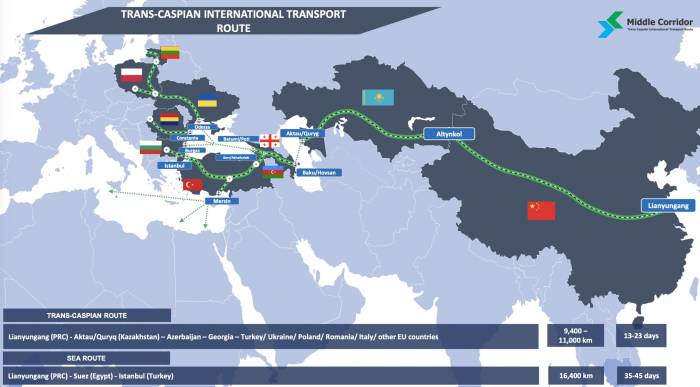
For a time, it seemed that China, the key player in this logistics project, and Europe, China’s main trading partner, were leaning toward the southern transit route. However, the calculations of the regional countries have proven more accurate.On September 20 , a ceremonial departure of a container train along the China–Europe route via the Trans-Caspian International Transport Route took place in Xi'an, China. The train, consisting of 55 forty-foot containers, departed from the Xi'an International Port Station bound for Budapest. The train is expected to cover approximately 7,000 kilometers to Baku in 8 to 11 days. It is estimated that the train will reach Budapest in about 25 days, following the Xi'an-Altynkol-Aktau-Baku-Poti-Burgas-Belgrade-Hamburg route.
It’s worth recalling that on June 28, the first freight train via the Middle Corridor departed from Nanjing , the capital of Jiangsu Province, bound for Istanbul. The train consisted of 110 containers loaded with household appliances and essential goods. Following this event, the China Railway Group announced that it had designated 87 routes for trains traveling from China to Europe and 39 routes for trains from China to Asia. It has also intensified efforts to organize train movements along the China-Europe and China-Asia routes via the Trans-Caspian International Transport Route. Additionally, the China-Europe train schedule has been expanded.
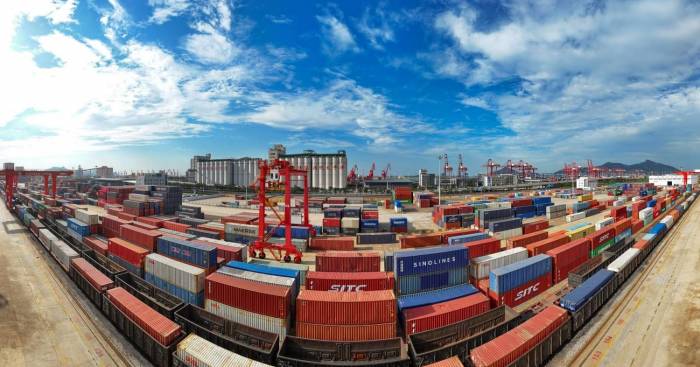
The increasing freight traffic from China via the Middle Corridor can be seen in statistics recently published in Baku. The capital of Azerbaijan hosted an event called the "Black Sea-Caspian Logistics Forum 2024: Corridors, Cargo, Infrastructure," which was accompanied by a meeting of heads of railway administrations from seven countries to discuss the Baku-initiated International Association 'Eurasian Transport Route.' During the meetings, some remarkable numbers were shared. Since the beginning of the year, 212 container trains, equivalent to 420,000 tons of cargo, have traveled along the TITR. For comparison, only 11 block trains traveled this route from China in 2023. This significant increase in figures clearly demonstrates China’s growing interest in the Middle Corridor.
According to Rovshan Rustamov, Chairman of Azerbaijan Railways JSC, up to 1,000 container trains per year could be sent from China via the Middle Corridor. It is expected that by the end of the year, 300 container trains from China will have passed through the TITR.
On average, trains travel from China to Azerbaijan within 8 to 10 days and reach Georgian ports in 12 days. In the current geopolitical situation, where the northern and southern routes are blocked for global trade due to military conflicts and the activities of various armed groups along traditional logistics routes, the Middle Corridor remains the safest option. Attempts to offer alternative cargo transportation routes have proven unprofitable and risky, as proposed projects would pass through potentially unstable regions. As a result, China and its European partners have chosen the TITR . At the same time, the countries along the Middle Corridor are very interested in ensuring China’s involvement in the projects, despite clear signals from the U.S. State Department and previous unequivocal wishes expressed by European officials. In any scenario, China remains a critical point along the Middle Corridor, as the route’s efficiency and future depend on the participation of the "Asian dragon." China is the world’s second-largest economy, accounting for more than 18% of global GDP, and has been and continues to be one of the European Union’s largest trading partners.
Yang Bin, Head of the China Railway Container Transport Corporation, noted during consultations in Baku that 40 Chinese cities are connected with 225 European cities via various transport routes, with the Middle Corridor becoming increasingly important. China is interested in increasing the flow of goods through the Eurasian region and joining the 'Eurasian Transport Route' association.
China’s commitment to the Middle Corridor was also emphasized in the Joint Declaration on the Establishment of a Strategic Partnership between the Republic of Azerbaijan and the People’s Republic of China , signed on July 3 during the Shanghai Cooperation Organization summit in Astana by President Ilham Aliyev and President Xi Jinping. The document highlighted China’s intention to actively participate in the construction and use of the Trans-Caspian International Transport Route.
In September, China signed a Memorandum of Understanding with Georgia on the creation and use of the Middle Corridor.
The interest of one of the world’s leading logistics companies, MAERSK, is also crucial for the development of the route. This Danish company, specializing in sea freight and port terminal services, has subsidiaries and offices in more than 135 countries, employing around 100,000 people. At the Baku forum, Irakli Danelia, MAERSK’s Business Development Manager for Central Asia and the Caucasus, stated that the company is focused on developing the transit route through the Middle Corridor. Danelia also emphasized that in addition to everything else, MAERSK actively facilitates connections between the Caucasus and Central Asia with Europe, Africa, and America via the Western Corridor.
Liliana Krutonog, CEO of the Czech international transport and logistics company MALBI-trans, also spoke about her company’s choice of the TITR. Previously, MALBI-trans operated along the Brest-Malaszewicze corridor but now plans to focus on the TITR. According to Krutonog, the company’s clients are demanding alternative delivery routes to the Ukrainian one.
The importance of the TITR for Europe is evidenced by the European Union’s intention to invest 10 billion euros in this route. The EU press service noted that "amid international crises – the change of power in Afghanistan, armed conflicts in Ukraine and the Gaza Strip – more funds should be invested in physical links between Europe and Central Asia, seeking alternatives for transport, energy, and supply chains."
It is worth noting that the Trans-Caspian International Transport Route connects China with Turkey and Black Sea countries of the European Union. The TITR begins at the China-Kazakhstan border (the 'Dostyk' and 'Altynkol' railway crossings) and follows by rail through Shymkent and Beineu to the ports of Aktau and Kuryk. Feeder or ferry vessels cross the Caspian Sea from the ports of Aktau and Kuryk to the port of Alat, followed by rail through Azerbaijan and Georgia to the ports of Poti and Batumi, with further delivery across the Black Sea. Another option is delivery along the Tbilisi–Akhalkalaki–Kars line (the Georgian section of the BTK) toward Istanbul or the ports of Izmir and Mersin.
The current capacity of the TITR is estimated at around 6 million tons of cargo annually (including up to 80,000 containers). The total volume of cargo transported by rail along the TITR in 2023 amounted to 2.76 million tons, an 86% increase compared to 2022. These figures were disclosed by the European Bank for Reconstruction and Development (EBRD).
From 2017 to 2023, more than 8 million tons of cargo , including 150,000 TEU, were transported via the TITR. According to the World Bank, freight volumes along the TITR are expected to triple by 2030. By 2030, freight traffic along the TITR is projected to grow by 30%.
These figures clearly demonstrate that the Middle Corridor is necessary for everyone. This means it holds great prospects.
(If you possess specialized knowledge and wish to contribute, please reach out to us at opinions@news.az).


Similar news