Baku holds the cards: Expert analyzes Armenia-Azerbaijan peace talks and Pashinyan’s diplomatic games


By Asif Aydinly
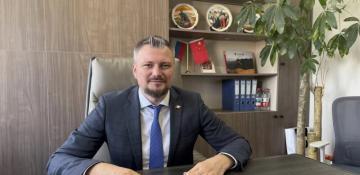
As tensions continue to simmer in the South Caucasus, Armenia’s ambiguous position between East and West and Azerbaijan’s growing geopolitical clout are reshaping the regional order. In this exclusive interview with News.Az, Russian international affairs expert Grigory Trofimchuk offers a candid assessment of the current stage of Armenia-Azerbaijan normalization, Prime Minister Nikol Pashinyan’s volatile diplomatic maneuvers, and the shifting balance of power involving Russia, the EU, and Türkiye.
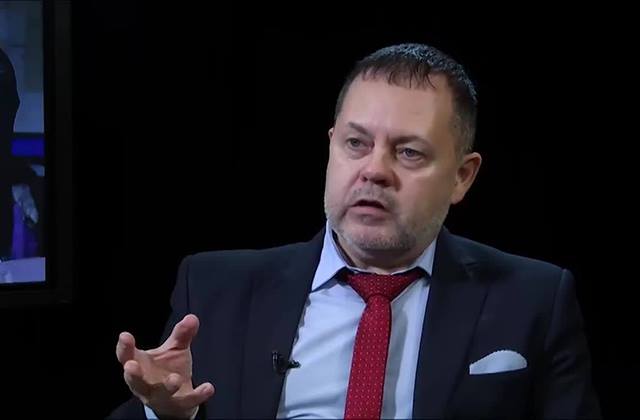
Source: TASS| Russian international affairs expert Grigory Trofimchuk
– How would you assess the current stage of Armenia-Azerbaijan normalization? Prime Minister Nikol Pashinyan’s recent statement suggests he does not intend to tie the signing of a peace agreement with Azerbaijan to amending Armenia’s Constitution with regard to territorial claims...
– Baku has shown extraordinary patience. To hold a dialogue with politicians like Nikol Pashinyan requires a great deal of it. However, this patience is not aimless. Azerbaijan will eventually be able to state that it did everything possible — and more — in front of the world. No one will be able to say otherwise.
Pashinyan is a unique negotiator: he can talk endlessly, sign agreements, postpone their implementation, link unrelated issues, break those links — and go around in circles. Years ago, I told Azerbaijani media that he could sign virtually anything, discuss any topic, but he consistently struggles with practical implementation. He is still following the same pattern.
However, Pashinyan should keep in mind that he is dealing with Baku — a capital that stands out for not making empty statements. This makes it particularly dangerous for those who try to play diplomatic games.
Source: The Media Line
His latest speech in parliament is a vivid example of how politicians behave when they run out of arguments. The world is no longer shocked by mentally unstable leaders, but it seems we’ve turned a new page here.
Against this backdrop, everything is going according to plan for Azerbaijan — and crucially, this plan is in its own hands. If it wishes to speed things up, it will; if it chooses to pause, it can. And Pashinyan, who seemed struck by lightning at the parliamentary podium, must understand that after the events in Karabakh and Syria, Azerbaijan is no longer viewed as a mere regional actor. It is now a different magnitude altogether — and there’s no changing that.
There is also another reason behind Nikol Vovaevich’s current “electrified” state. He truly believed he would gain the support of France and the European Union after distancing himself from Moscow. But he misjudged both the timing and his own capacity. As a result, he finds himself again in a political “splits” — like a Volochkova on stage — unable to fully turn his back on Russia or draw closer to the West. He clearly sees how the EU is losing its former grip.
Let me give a specific example — the International Criminal Court (ICC). This institution once commanded significant authority, but today, its standing is visibly declining in Brussels, The Hague, and other Western centers. At one point, the Trump administration even imposed sanctions on the ICC’s leadership — turning it into something of a farce, in which the Court continues to play a part without realizing the absurdity.
These are the kinds of “partners” Pashinyan had hoped to rely on. He looked to “Old Europe” for support to reshape the regional balance of power in the South Caucasus — and even imagined dictating terms to President Ilham Aliyev. But now, Pashinyan’s rhetoric has become erratic, and everyone can see it.
Incidentally, the issue of the ICC and global criminal justice is directly relevant to Azerbaijan as an important member of the Non-Aligned Movement. Given the ICC’s increasing legal and technical ineffectiveness as an EU tool, we must ask: how viable is the current international legal system — especially in the context of Armenia-Azerbaijan relations?
The world — particularly Asia and China, with which Baku is building strategic ties — needs new legal institutions that are more adequate and authoritative. Global criminal justice must reflect the profound changes underway worldwide. Many countries could play a more prominent role in shaping this.
I’m not insisting, but as one of the most recognized international forum hubs, Baku could take the initiative in hosting a conference on reforming global justice. This would be a natural extension of its growing international stature.
Source: The Media Line
– In recent months, the Armenian authorities have intensified efforts to normalize relations with Türkiye. How do you assess these developments? What’s behind them?
– This is not Armenia’s first attempt to build ties with Ankara. One need only recall the “Caucasus Platform” initiative, which envisioned opening the Armenia-Türkiye border and other rapprochement steps. But the situation today is different — Pashinyan is now dealing not with the past leadership but with Erdoğan, and he understands that perfectly well.
Normalizing relations with Türkiye requires concrete steps from Armenia, not just words. The same applies to the peace treaty with Azerbaijan. Pashinyan faces significant pressure at home — he’s accused of betrayal, called a “Turk,” and so on. But Ankara expects real actions — for example, on the Zangezur Corridor. Endless diversion and delay are no longer viable — decisions are needed.
– At the same time, we are seeing attempts by Armenian authorities to resume dialogue with Russia. For instance, parliamentary speaker Alen Simonyan is set to attend the CIS Interparliamentary Assembly in St. Petersburg, although he declined to go last year. What’s behind this rapprochement?
– The reasons are simple. First, disillusionment with Europe. Pashinyan, observing the sluggishness and inconsistency of European institutions, seems to see a reflection of himself. Second, the ongoing Russia–Ukraine conflict has left him bewildered — he can’t tell who’s winning, and he’s being thrown into political hot and cold flashes. It's a kind of “electric tension” once again.
Still, it’s too early to speak of a real Armenian-Russian rapprochement. Pashinyan remains in office, and his position hasn’t changed. This is a classic case of political opportunism — almost museum-worthy. In addition, Armenian society harbors deep resentment toward Moscow, accusing it of abandoning and failing to protect them. Moscow has yet to respond convincingly, and words about “friendship and brotherhood” no longer suffice.
Pashinyan has been trying to distance himself from the CSTO since spring 2018, as soon as he came to power, but even now, in 2025, he can’t openly declare “I’m leaving.” Participation in interparliamentary events is mostly symbolic — they carry on as usual and have little impact on strategic developments.
Source: TASS
– Recently, there’s been tension in Azerbaijan-Russia relations, but both sides are taking steps to stabilize them. What are your forecasts?
– Yes, we are indeed witnessing a difficult period. Perhaps the only similar cooling occurred in the run-up to 2013. But the current situation — especially after the events of 2024 — is much more serious. Baku now has a “longer memory,” because the circumstances are highly unusual. Azerbaijan and Türkiye have transformed — they are far more influential now, and the old format of Azerbaijan-Russia relations no longer fits.
Everything will be rebuilt based on calculations and Azerbaijan’s new regional status. In fact, Baku has become the most rational and strategically minded country in the post-Soviet space. Some observers mistakenly believe that Azerbaijan has “forgiven everything” — but this is an illusion. One must soberly assess the changes in the South Caucasus and understand just how deep the transformation process has gone.
Azerbaijan is waiting. It is watching and calculating. And today, with a modern and powerful army, it can afford to take this strategic pause.


Similar news