Classified documents on Israel-Syria contacts against Iran: Fact or propaganda?



AN illustrative image of former Syrian president Bashar al-Assad. Photo: MAJID ASGARIPOUR/WANA/REUTERS, SHUTTERSTOCK/ADEM ALTANLOUAI BESHARA/AFP via Getty Images
The emergence of reports claiming the discovery of classified documents allegedly confirming contacts between Israel and Syria raises more questions than it provides answers. The Arab publication Kainius released these materials, asserting that the documents presented are not merely copies but photographs of the originals. However, let us examine the credibility of these claims and their potential implications.
First, it is worth noting that experts often approach such "leaks" with considerable skepticism. Some believe these documents are genuine, while others question their origin and purpose. At this point, it remains unclear whether these materials were indeed intended for one intelligence agency and eventually fell into the hands of another, as the source claims. Nevertheless, the mere existence of these documents raises an important question: could contacts between Israel and Syria have taken place?According to the published data, the issue is not one of cooperation but rather of information exchanges. Israel reportedly warned Bashar al-Assad’s government about hostile actions originating from Syrian territory and declared its readiness to retaliate. Responsibility for these actions was allegedly placed on Syria. This does not resemble an alliance or partnership—it is more of a demonstration of determination and strength directed at a regime already under significant pressure.
Contacts between adversarial countries are not uncommon. They often occur out of necessity to maintain a minimal level of interaction and avoid conflict escalation. However, portraying such contacts as an alliance between Israel and Syria is a clear exaggeration unsupported by facts.
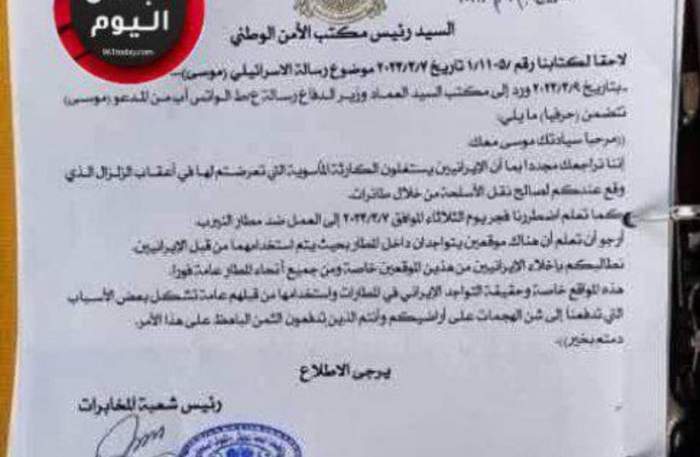
One of the leaked documents that allegedly reveals correspondence between Israel and Assad's government. (credit: SCREENSHOT/X)
The context must also be considered. Israel routinely conducts strikes on Syrian territory , targeting infrastructure linked to Iran and its proxy groups. These actions demonstrate that Israel has no need to rely on Assad's support to achieve its goals. Israeli intelligence is well-known for its effectiveness and capability to gather information independently.
It is plausible that the spread of such rumors is part of a deliberate campaign to discredit both the Syrian and Israeli governments. In Arab media, such narratives are not uncommon. For example, previous reports claimed that Israel used "radioactive pigs" against Palestinians. These absurd allegations are clearly designed to shape public opinion in a specific direction.
Interestingly, such tactics serve particular objectives and audiences. In the context of Assad's regime's decline , such claims could function as a tool of pressure. The international community, already aware of the Syrian regime's issues, might perceive this information as further evidence of its weakness. This opens the door to increased pressure on Assad from both domestic and international fronts.
It is essential to recognize that any information leak, especially concerning the Middle East, is rarely accidental. Given Assad’s regime’s vulnerabilities, such reports might aim to further weaken his position domestically and on the global stage. This is a classic case of "kicking someone when they're down," targeting an opponent already incapable of mounting an effective response.

Celebrations broke out on Sunday after President Bashar al-Assad’s government in Syria collapsed, including at a border crossing in Lebanon, above. Photo: Daniel Berehulak/The New York Times
Additionally, the publication of these documents raises questions about their sources. If the documents are indeed genuine, who provided them? Why now? It is possible that this timing is linked to an attempt to divert attention from other regional events. For instance, escalating tensions between Israel and Iran or recent attacks on Syrian infrastructure could be key factors.
In my view, there is no basis to consider these documents as evidence of any alliance between Israel and Syria. Instead, they appear to be a propaganda tool aimed at discrediting both parties. The dissemination of such rumors is merely an attempt to distract from the region’s real issues and create additional tension.
Thus, such publications should be approached critically. They do not offer new facts but merely fuel old stereotypes and suspicions. Without substantial evidence, discussing “cooperation” between Israel and Assad is a waste of time. However, it remains crucial to monitor the situation closely to uncover details that may shed light on the true motives behind these publications and their potential consequences.
(If you possess specialized knowledge and wish to contribute, please reach out to us at opinions@news.az).


Similar news