Domino effect: What awaits the Middle East after Assad's fall?


.jpg)
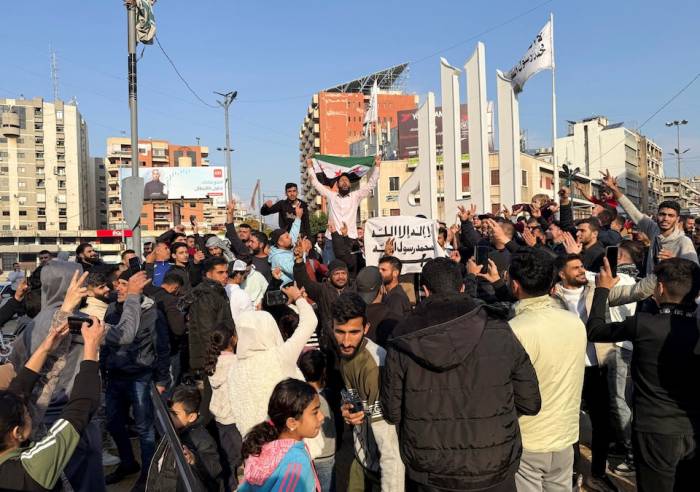
People gesture as a man holds the Syrian opposition flag, after Syrian rebels announced that they have ousted President Bashar al-Assad, in Tripoli, northern Lebanon December 8, 2024. REUTERS/Omar Ibrahim Purchase Licensing Rights
They say empires aren’t built in a day, but their unraveling? That begins long before anyone notices the first brick out of place.
The fall of Bashar is a ripple in a much larger pond, a gauntlet where the rules change mid-play, the players cheat, and somehow, the referee always wins. Welcome to the neighborhood.For years, Tehran spun its regional web with remarkable ambition, even if the craftsmanship was hasty. Syria was the IRGC’s showpiece, the bridge connecting Lebanon’s Hezbollah, Iraq’s militias, and Gaza’s Hamas—a strategic artery pumping lifeblood into a sprawling network of proxies.
But now, Assad’s fall has severed that lifeline, and the web is fraying faster than a spider abandoning its base. Tehran’s ambition to dominate the Middle East is starting to look more like a bad investment in a crumbling Ponzi scheme.
While Tehran scrambles to save face, Türkiye is already reading the fine print on the deeds to northern Syria. Erdogan’s Ankara is playing the long game, seizing opportunities wherever they arise—sometimes under the guise of humanitarian corridors, sometimes with tanks and drones.
Jolani, once a divisive figure shrouded in extremism, has emerged as a symbol of realpolitik’s unyielding logic.
His history—a series of actions that would raise eyebrows in less malleable regions—has been strategically overlooked in favor of his current disposition. This is not forgiveness but calculation—pure, simple, and mathematical. In the Middle East , ideological purity is a luxury neither actors nor observers can afford. Abu Mohammad al-Jolani’s transformation is a testament to the enduring principle that alliances are forged not through shared values but shared interests. His orders restricting attacks on government offices in Damascus highlight a successful rebranding campaign.
Islamabad, ever the cautious pragmatist, surveys these convulsions with carefully constructed detachment. Its calculus is neither emotional nor reactionary but shaped by the belief that stability is paramount and entanglement perilous.
Tehran’s hostile ambitions have often encroached uncomfortably close to Islamabad’s sphere, but outright confrontation remains an unlikely possibility.
Islamabad continues its delicate balancing act—aligning strategically with Ankara and Baku, maintaining cordiality with Riyadh, and engaging with Tehran only when absolutely necessary.
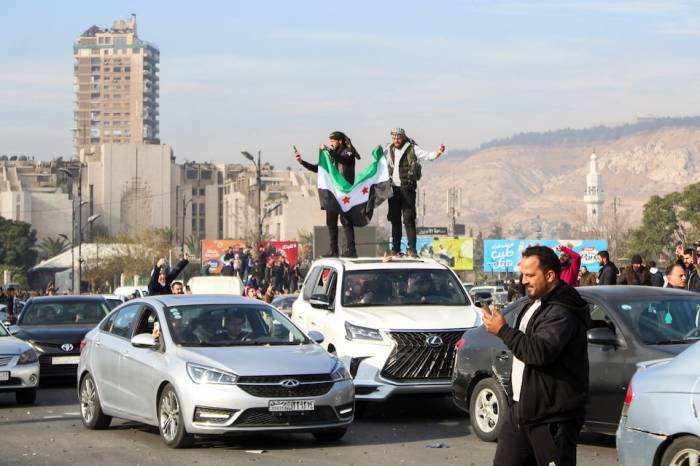
Men hold a Syrian opposition flag on the top of a vehicle as people celebrate after Syrian rebels announced that they have ousted President Bashar al-Assad, in Damascus, Syria December 8, 2024. REUTERS/Firas Makdesi Purchase Licensing Rights
This intricate ballet underscores Pakistan’s enduring commitment to adaptability in a region that punishes rigidity.
For Israel, of course, this is a win so sweet it’s almost cruel. But Tel Aviv isn’t the only beneficiary. Gulf monarchies, once terrified of Iran’s shadow, are starting to breathe easier, while Türkiye’s geopolitical ambitions gain a fresh lease on life.
Even Russia, whose half-hearted attempts to prop up Assad now seem laughably futile, might quietly welcome the chaos. After all, a weakened Iran is a distracted Iran, and Moscow thrives on distractions.
For Tehran, however, the risks are too high to ignore. The fall of the Assad regime is not merely a tactical setback but a profound indictment of Khamenei’s overreach.
The construction of its influence—long woven through proxies and ideological fervor—is beginning to buckle under the weight of miscalculations and external pressures.
The Middle East, in its perpetual ebb and flow of power, has moved on from the narratives that once anchored Tehran’s regional strategy.
Realpolitik, not ideology, is now the order of the day, and Tehran’s inability to recalibrate has left it more isolated than ever.
As the dust settles—or shifts to cloak the next miscalculation—the domino effect is as evident as it is eternal.
Assad’s fall is not just a blow to Tehran’s hegemony; it’s a reminder that no amount of ideology, proxies, or military spending can outpace the ruthless efficiency of realpolitik.
In the Middle East, history isn’t written by the victors but by the survivors—those nimble enough to evolve while others cling to crumbling paradigms.
Living in the past, Iran spins tales of resistance like an old storyteller in the corner, captivating no one but itself.
The region, as always, marches on with its peculiar mix of pragmatism and absurdity. Yesterday’s outcasts are today’s diplomats, and once-firm alliances dissolve faster than promises at a summit table. Assad’s fall is merely another shift in the eternal chaos—a chaos that rewards adaptability and punishes arrogance.
(If you possess specialized knowledge and wish to contribute, please reach out to us at opinions@news.az).


Similar news