EU and the South Caucasus: Brussels recalibrates its strategy


By Tural Heybatov
On May 22, the European External Action Service issued a carefully worded statement following the sixth round of the EU–Azerbaijan Security Dialogue held in Brussels. Officials described the discussions as “frank and constructive,” a diplomatic phrase often reserved for exchanges that signal both difficulty and forward movement.
The timing of the dialogue was notable. It came after a flurry of high-level meetings between Brussels and Baku—in Malta, Baku, Brussels itself, and Tirana—underscoring the EU’s renewed interest in restoring trust after a period of strained relations. Most significantly, the parties agreed to resume long-stalled negotiations on a new partnership and cooperation agreement.
This diplomatic thaw coincides with a broader shift in tone from Brussels. The visit to Baku last month by Kaja Kallas—High Representative for Foreign Affairs and Security Policy and Vice President of the European Commission—marked a strategic reset. Her meeting with President Ilham Aliyev served as a symbolic break from the approach of her predecessor, Josep Borrell, whose tenure was characterized by a heavy-handed style and political missteps. Under Borrell, relations soured as the EU attempted to wield pressure and institutional leverage—often backed by declarations from the European Parliament and PACE.
Kallas, by contrast, appears to recognize both the geopolitical and economic weight Azerbaijan carries in the South Caucasus. Her visit signaled a pragmatic course correction. Brussels has remembered what it once seemed to forget: that Azerbaijan is the EU’s most reliable partner in the region and a critical player in European energy diversification and security.

Source: reglobal
The shift is already visible. Anti-Azerbaijani rhetoric has noticeably decreased across EU institutions, suggesting that Brussels is now more focused on engagement than confrontation.
But this re-engagement is not without contradictions. One ongoing source of tension is the European Peace Facility (EPF), which was used in 2024 to propose €10 million in military aid to Armenia—a move blocked by Hungary until similar aid was offered to Azerbaijan. A renewed attempt this year to grant €20 million to Armenia met the same Hungarian veto. As Hungarian Foreign Minister Péter Szijjártó explained in Yerevan, Hungary supports aid to Armenia, but insists that an equal amount be allocated to Azerbaijan in the interest of regional balance—especially with a peace agreement between Baku and Yerevan potentially on the horizon.
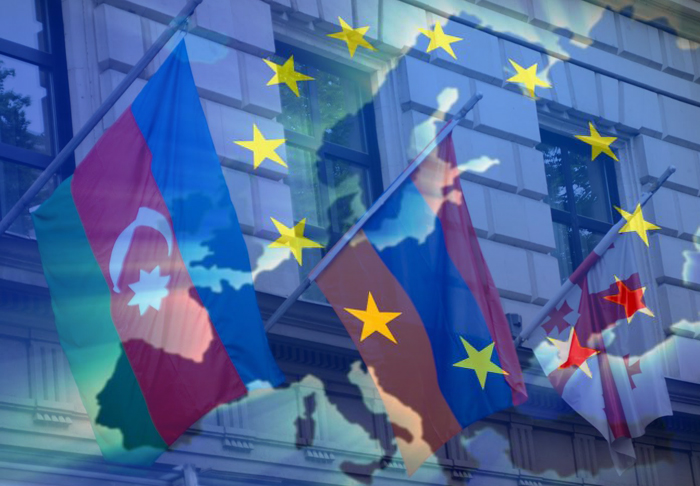
Such disputes highlight the EU’s chronic struggle to maintain strategic balance in the South Caucasus. Its record has been uneven, marked by alternating signals and inconsistent policies. While Azerbaijan has remained relatively immune to EU pressure—thanks to its non-alignment with European integration goals and its strategic importance as an energy hub—Georgia, which has made EU membership a national objective, finds itself increasingly at odds with Brussels.
A new EU strategy document on the Black Sea, adopted on May 28 and authored by Kaja Kallas, lays out a more collaborative vision. It offers incentives to partners like Georgia in return for alignment with EU foreign policy. However, doubts remain. Germany’s ambassador to Georgia, Peter Fischer, has publicly questioned the credibility of Georgia’s EU ambitions, citing the government’s contradictory rhetoric. Similarly, EU Ambassador Paweł Herczyński warned that Brussels is reviewing Georgia’s preferential status—including visa-free travel, association agreements, and even candidacy status. “We need to determine whether these privileges are still deserved,” he said bluntly.
Relations hit a low point during last year’s protests in Tbilisi, when Brussels attempted to pressure the Georgian government into shelving its controversial foreign agents law. The standoff badly damaged mutual trust. Unless Georgia makes concessions—a scenario that appears unlikely—the EU’s enlargement door may remain closed until there is a change in leadership in Tbilisi.
Meanwhile, Armenia is going to great lengths to demonstrate its willingness to align with the EU. Earlier this year, its parliament passed legislation formally launching the accession process. The move was enthusiastically welcomed in Brussels—but substantive progress has stalled. Financial support, preferential trade arrangements, and visa liberalization remain elusive. EU member states are wary of opening the door to mass migration, a concern rooted in their experience with Georgia’s visa-free regime, which triggered a wave of undocumented movement.
Despite warm words, Armenia’s integration path remains little more than symbolic. The EU monitoring mission, however, has taken on an increasingly active—and controversial—role. A new cooperation agreement was recently signed between the EU monitoring teams in Armenia and Georgia, aimed at enhancing operational coordination and joint responses to crises. But the mission's behavior near Azerbaijan’s borders has raised serious concerns. Its presence in areas of heightened Armenian military activity, combined with its conspicuous silence on provocations, suggests a troubling departure from neutrality.
Source: TREND
These developments reflect a broader challenge for the EU: how to maintain credibility in a strategically vital region where it has often overplayed its hand. In recent years, Brussels has seen its influence in the South Caucasus wane amid mounting tensions with Azerbaijan and an increasingly difficult relationship with Georgia. The arrival of Kaja Kallas at the helm of EU foreign policy offers a chance to recalibrate.
So far, the EU’s most promising course of action lies in rebuilding its relationship with Baku—a move that serves both geopolitical and economic interests. While Georgia’s future with the EU remains uncertain, and Armenia’s trajectory hinges on the balance between Brussels and Moscow, Azerbaijan represents the most stable and beneficial partner. And in Brussels, it seems, that reality is finally being acknowledged.


Similar news