Forecast for the future: How will Haniyeh's assassination impact Iran?



Editor's note: Moses Becker is a special commentator on political issues for News.Az, a PhD in political science and an expert on interethnic and interreligious relations. The article expresses the personal opinion of the author and may not coincide with the view of News.Az.
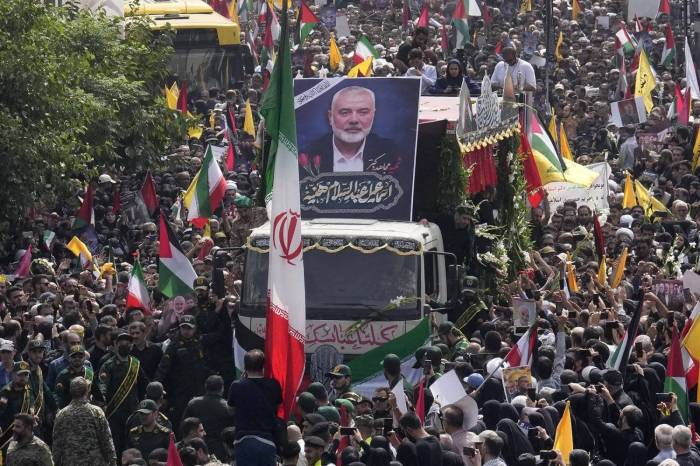
On the night of July 31, 2024, following the inauguration of Iran's new president, Masoud Pezeshkian, the head of Hamas' political bureau, Ismail Haniyeh, was killed in an explosion at a heavily guarded IRGC residence. Israeli intelligence services were blamed for the attack. However, after some deliberation, Iranian authorities began to consider the possibility that the bomb might have been planted in Haniyeh's apartment two months earlier by agents of Iran's own intelligence services. The investigation will reveal the truth. In any case, arrests and interrogations are underway, and only time will tell where the convoluted struggle among Iranian elites will lead.Currently, Iran finds itself in a state of confusion and bewilderment: if this was done by "their own," it means the regime is rotten from within; if it was Israel, then how to counter the combined might of the U.S., the U.K., France, and other adversaries of the ayatollahs? In any scenario, the Islamic leadership stands at the edge of a precipice. Its prestige has plummeted below zero in the eyes of its own people as well as neighboring states. Even the loyal Hezbollah is losing its footing. Iran's weakness may prompt patriotic forces in Lebanon to finally overcome their fear and take the fate of the divided country into their own hands.
Thus, Iran's poised hand hovers in midair. While aggressive rhetoric remains, whether a strike will be carried out, and most importantly by whom and when, remains unclear. The American armada gathered in the potential conflict zone is unlikely to stand idle for long: it is too costly to keep a fleet sailing the seas. It would be cheaper to eliminate the ayatollahs' regime once and for all, trigger a spike in oil prices, deprive China of cheap energy resources, and thereby weaken the main competitor, rather than wait for someone to beat the drums of war.
A potential scenario for the start of a full-scale war could be the escalation of the ongoing conflict with Hezbollah into a serious confrontation. The constant tension could soon lead to a massive strike by Israel. In this case, Iran would definitely have to intervene to save its client, making war inevitable. In this context, the buildup of American military power in the region becomes understandable. U.S. Defense Secretary Lloyd Austin ordered additional cruisers and destroyers capable of providing missile defense to be sent to the Middle East, within the responsibilities of CENTCOM and the U.S. European Command (USEUCOM). An aircraft carrier strike group led by the USS Abraham Lincoln, with a crew of about 7,500, has also been deployed. Measures are being taken to increase the readiness of U.S. forces to deploy additional ground-based missile defense.
Austin also ordered an additional squadron of fighters to be sent to the Middle East. Among them is the radar-evading F-22 Raptor , a fifth-generation multirole fighter. The aircraft is equipped with two turbofan engines and can fly at supersonic speeds without afterburner. It features an AN/APG-7 radar, integrated communication systems, eight air-to-air missiles, and a 20-millimeter cannon. In addition to this "miracle" of modern military thought, the U.S. Air Force has deployed F-15E Strike Eagles from the 335th Squadron, F-16 Fighting Falcons from the 510th Squadron, and A-10 Thunderbolt II attack aircraft from the 107th Squadron to the Middle East. It can be said that the U.S. has concentrated the most powerful naval and air force grouping in the Persian Gulf and Eastern Mediterranean since the NATO invasion of Iraq. The degree of increased tension is also reflected in the activity of allied command. General Michael Kurilla, head of the U.S. Central Command (CENTCOM), arrived on a working visit to Israel, where he met with IDF Chief of Staff Lieutenant General Herzi Halevi and Defense Minister Yoav Gallant. They discussed military cooperation in case of a possible attack by Iran and Hezbollah.
Let's now consider what the Islamic Republic, aspiring to be a regional leader, has at its disposal. Iran's main striking force against Israel consists of numerous medium-range ballistic missiles, cruise missiles, and drones, including kamikaze drones. Their quantity and variety are significant. These include medium-range ballistic missiles like Khorramshahr, Qadr, Sejjil, Haj Qassem, Kheibar Shekan, medium-range ballistic missiles with hypersonic maneuvering warheads like Fattah-1, cruise missiles from the Paveh and Soumar families, kamikaze drones like Shahed-136, Arash, etc. The total number of all Iranian missiles and drones that can reach Israel is quite large, numbering in the thousands. It should be noted that the majority of this arsenal consists of liquid-fueled missiles, which require a long time to refuel.
As for Israel, it possesses the most powerful air force among Middle Eastern countries, equipped with the world's best American fifth-generation F-35 fighters. An airstrike on the Yemeni port of Hodeidah showed that nothing is impossible for the Israeli Air Force. Israeli fighters can employ a wide range of guided weapons, up to and including aeroballistic missiles. In addition, the State of Israel has Jericho family ballistic missiles, and Israeli submarines reportedly carry cruise missiles as well. Another important factor is that the Jewish state has the best multi-layered air defense system in the world, unmatched in the entire Middle East.
Now let's consider the "post-war" situation. In the event of Iran's defeat, its armed proxies would disappear. Hezbollah would be finished off by Lebanese Christian, Druze, and Sunni militias. The Syrian president would find himself without Iranian support, possibly reigniting civil war in the country. The Houthis would fade from the world stage and cease threatening unarmed shipping. The role of the Suez Canal would be restored. Iran itself would face internal contradictions and hostility from neighboring countries. In this situation, the best course for the ayatollahs would be to sit at the negotiating table, recognize Israel's right to exist, and focus on resolving internal issues.
(If you possess specialized knowledge and wish to contribute, please reach out to us at opinions@news.az).


Similar news