Hamas and Fatah in Beijing: A step towards peace or another agreement on paper?


By Faiq Mahmudov
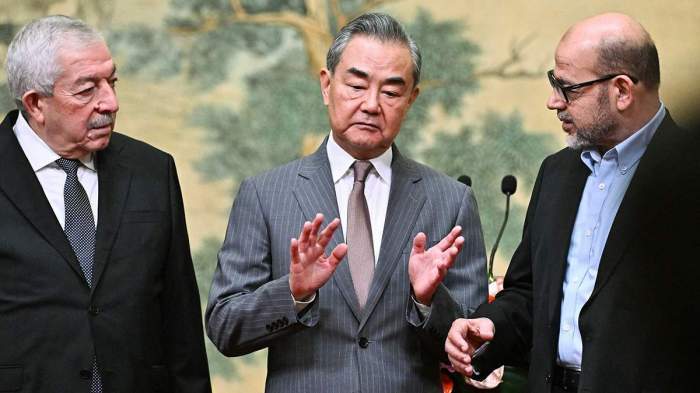
Palestinian factions, including rivals Hamas and Fatah, signed an agreement in Beijing aimed at ending internal divisions and strengthening Palestinian unity. According to the Chinese Ministry of Foreign Affairs , this announcement followed reconciliation talks that began in China on July 21 with the participation of 14 Palestinian factions. These talks are taking place against the backdrop of Israel's war against Hamas in the Gaza Strip, with Beijing seeking to position itself as a potential peace mediator in the conflict.How might the Beijing agreement affect the current situation in the Gaza Strip and the prospects for a peaceful resolution of the Palestinian-Israeli conflict? Will the talks under China's auspices lead to a final resolution of the conflict between Hamas and Fatah? News.Az sought the opinions of Middle East political experts.

Political analyst Fuad Shahbazov, in an interview with News.Az , noted that the main goal of the Beijing Declaration is to resolve existing ideological differences between the two factions: "As is known, since 2006, Hamas has been the main organization controlling both political and military power in Gaza. On the other hand, Fatah is the main organization controlling the Palestinian Authority in the West Bank. In general, the Beijing Declaration does not fundamentally solve the existing problem. It is only a temporary solution, as the name suggests. On the other hand, it adds an additional dimension by positioning China not as a direct party in international conflicts, but rather as a mediator. In the last two years, China has attempted to play a mediating role while remaining neutral in Middle Eastern conflicts."
Shahbazov does not expect active Chinese involvement in such issues directly, stating: "In 2023, when China mediated between Iran and Saudi Arabia, it ensured that the main points of the agreement were agreed upon by the two main parties and left the primary implementation of the document to the responsibility of each country. China traditionally adheres to the principle of neutrality in conflicts. This approach allows it to act as a mediator and maintain a neutral position, which is reflected in its diplomatic principles established decades ago. This principle applies to resolving diplomatic disputes, as China prefers to conduct its policy in this area through diplomatic means."
Shahbazov said that from the early days of the war with Israel, the international community issued statements in support of Israel: "Hamas has been recognized as a terrorist organization by leading countries of the world. Including Israel, all countries have rejected any interim government or peace proposal involving Hamas. Therefore, it is not surprising that both the US and especially the European Union and other allies of Israel have strongly rejected any transitional government or peace initiative involving Hamas."
Middle East expert Sadraddin Ismayilov believes that the Beijing agreement will not significantly impact resolving the differences between the two Palestinian organizations: "In recent years, China has increased its involvement in processes unfolding in the Middle East and Central Asia. For example, several years ago, China initiated and expanded its relations with Gulf countries through the Gulf Cooperation Council (GCC). At one of these meetings, China supported a resolution concerning the disputed islands of Greater and Lesser Tunbs, as well as Abu Musa, which are disputed by Iran and the United Arab Emirates. This action caused diplomatic tensions between China and Iran, with Iran expressing its objections to China. After Hamas attacks on Israel, China also began increasing its involvement in Gaza. This clarified the international ranking of forces in the Gaza conflict. On one side are the US and its allies supporting Israel, along with armed political alliances like Hamas. On the other side, support is visible from Iran, Russia, China, and their allies such as North Korea and Venezuela. Meanwhile, Arab countries are trying to maintain neutrality, expressing protests against the displacement of Arabs in their statements and speeches."
Ismayilov noted that although the Beijing agreement was signed, it would not stop the war and the struggle of new formations of surrounding forces against Israel: "Imagine, Iran chants the slogan 'Death to Israel!'. The goal of Iran, as well as Hamas, Hezbollah, the Houthis, and other armed groups created and protected by Iran, is to erase Israel from the political map of the world. Under such circumstances, what can be Israel's position? Israel must defend itself, guard itself, and act accordingly. This means that Israel must consider Iran's alliance in Lebanon, Gaza, and Yemen.
The Beijing agreement will be useful only when Hamas and other armed groups stop operations against Israel, Hezbollah ceases its activities against Israel, borders are defined and demarcated with Lebanon, and Yemen's Houthis stop missile attacks against Israel. Otherwise, this peace agreement will be of no use. So far, many agreements, treaties, and contracts have been signed regarding Palestine in the US, Egypt, Switzerland, and other countries, but no results have been achieved. For example, the Camp David Accords were signed in the 1970s, but no results were achieved. Therefore, I do not think that the Beijing agreement will have a significant impact."
The world may see the importance of increasing China's role in the region, possibly even portraying it as a key player. However, issues such as Hamas and the Gaza Strip are considered internal affairs by the Israeli government. Therefore, Israel follows the line of cleansing the Gaza Strip of illegal armed groups and ensuring the integrity of its country. How will China protect this process? Support Hamas? At best, statements can be made against Israel, accusing it of killing civilians in the Gaza Strip. What else can they do?
However, one side of the conflict is Israel. Israel does not accept the conditions put forward by Beijing, Washington, or Moscow on behalf of Tehran. This is because none of these conditions include the withdrawal of Hamas or similar armed groups from the region. None of them demand that Hamas lay down arms, cease its activities, and enter peace talks. Neither China, Russia, nor Iran say this. On the contrary, both China and Iran, as well as Russia, want to use Hamas's conflict with Israel for their own purposes. This means that it is not only Israel's problem with Hamas but also an armed conflict manifesting between the US, the UK, and their allies on one side, and China, Russia, Iran, and their allies on the other side."
The political expert believes that the solution to the problem in the Gaza Strip and the resolution of the Palestinian issue lies in the elimination of Iran-backed forces that Iran has drawn into war and equipped for war. "As long as Iran's interests put pressure on Israel, it will be impossible to achieve peace in the region."


Similar news