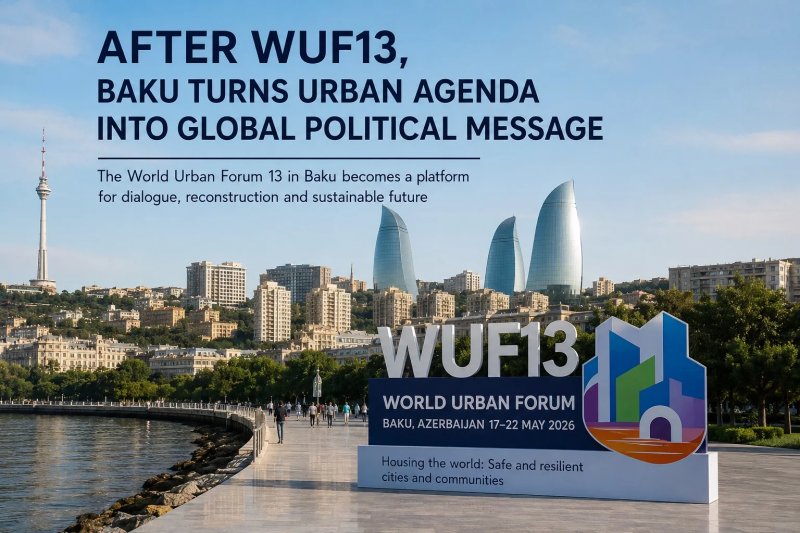
After WUF13, Baku turns urban agenda Into global political message


Editor’s note: Zaur Nurmamedov is a journalist and a graduate of the Faculty of Political Science at the Academy of Public Administration under the President of the Republic of Azerbaijan (1993–1999). He previously served as first deputy editor-in-chief of the Vesti.Az news portal (2009–2023). The views expressed in this article are his own and do not necessarily reflect the position of News.Az.
The 13th session of the World Urban Forum in Baku was not merely another major international event for Azerbaijan. It became an important part of the country’s broader effort to present itself as a platform where global challenges are discussed, political messages are shaped and practical solutions are promoted. After hosting COP29, Baku once again placed itself at the centre of an international agenda — this time through the language of cities, housing, resilience, reconstruction and sustainable development.
The World Urban Forum 13, held in Baku from 17 to 22 May 2026 under the auspices of UN-Habitat, focused on the theme “Housing the world: Safe and resilient cities and communities.” The event brought together tens of thousands of participants from around the world, including government officials, urban planners, international organisations, experts, civil society representatives and private sector actors. For Azerbaijan, however, the forum was not only about urban development. It was also about international positioning.
The choice of Baku as the host city carried clear symbolic meaning. Azerbaijan has been actively trying to strengthen its image as a country capable of hosting global forums and contributing to major international discussions. COP29 gave Baku visibility in climate diplomacy. WUF13 added a new dimension: the future of cities. Together, these events allow Azerbaijan to present itself not as a peripheral state, but as a country situated at the crossroads of several strategic agendas — climate, energy, infrastructure, transport, urbanisation and post-conflict reconstruction.
The urban agenda is especially important for Azerbaijan because it directly overlaps with one of the country’s central domestic priorities: the reconstruction of the liberated territories and the return of former internally displaced persons. For many states, urban planning is largely associated with housing policy, transport systems, architecture, public spaces and environmental standards. For Azerbaijan, it is also linked to national recovery after decades of occupation. The rebuilding of cities and villages in Karabakh and East Zangezur, the development of “smart city” and “smart village” concepts, and the gradual return of people to their ancestral lands form a key part of the country’s post-war agenda.
RECOMMENDED STORIES
This is why WUF13 in Baku carried broader political significance. Azerbaijan used the forum to demonstrate that reconstruction is not only a local or national issue. It can also be framed as part of the global conversation on resilient communities, safe housing and sustainable urban development. In other words, Baku linked its own experience to a universal international theme. This helped transform a domestic reconstruction agenda into a global political message.
The forum’s outcome document, the Baku Call to Action, further reinforced this message. Such documents matter because they give host countries an opportunity to leave a mark on international debates. They are not merely technical texts. They become part of the language through which global institutions, governments and experts define priorities for the coming years. By hosting the forum and associating its name with the outcome document, Baku positioned itself within the broader UN urban development process.
This has real diplomatic value. In modern international politics, influence is not measured solely by military power, energy resources or economic weight. It is also measured by the ability to shape narratives and host platforms where global priorities are discussed. Azerbaijan understands this well. By hosting COP29 and then WUF13, the country has sought to expand its diplomatic profile beyond traditional energy politics and regional security. It is now seeking to speak the language of global governance.
At the same time, WUF13 helped Baku present itself as a modern capital capable of organising events on a global scale. Over the past decades, Baku has undergone a major transformation. The city has combined its historic identity with new infrastructure, modern architecture, improved transport links and expansive public spaces. For international visitors, the forum became an opportunity to see Baku not only as the capital of an energy-rich Caspian state, but as a city with growing diplomatic and urban ambitions.
Still, the political significance of the forum goes far beyond image-building. Cities today are becoming central to global politics. They are where climate change is felt most directly, where migration pressures accumulate, where housing crises emerge and where infrastructure either strengthens or weakens state resilience. Transport corridors, energy systems, digital technologies and social stability are all increasingly tied to urban development. Therefore, a forum about cities is also a forum about security, economics and governance.
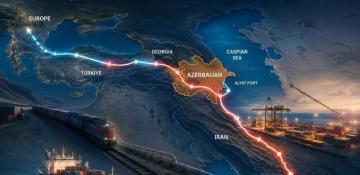
For Azerbaijan, this is particularly relevant. The country is located between Europe and Asia, the Caspian region and the Middle East, the South Caucasus and Central Asia. It is part of major transport and energy discussions, including the Middle Corridor, regional connectivity projects and energy diversification routes. By linking urban development with infrastructure, resilience and reconstruction, Baku can strengthen its role as a practical hub connecting different regions.
The forum also fit into the broader debate surrounding the Global South. Many developing countries face rapid urbanisation, housing shortages, informal settlements, climate risks and infrastructure gaps. These problems are not abstract. They affect millions of people and shape political stability. By hosting WUF13, Azerbaijan provided a platform where these concerns could be discussed in a broader international format, rather than solely through a narrow Western lens. This helps Baku strengthen its image as a country capable of engaging with both developed and developing states.
There is also a regional message. The South Caucasus is often described through the lens of conflict, competition and geopolitical rivalry. WUF13 allowed Azerbaijan to present a different image of the region — one associated with reconstruction, development, sustainability and international cooperation. For Baku, this is important because it wants the world to see Azerbaijan not only through the prism of war and security, but also through the prism of rebuilding and forward-looking development.
However, the real test will come after the forum. Hosting major events creates visibility, but long-term influence depends on continuity. Azerbaijan will need to demonstrate that WUF13 was not a one-time success, but part of a sustained strategy. This may include new partnerships with international organisations, urban development projects, investment in housing and infrastructure, expert platforms and the continued promotion of the Baku Call to Action.
If COP29 strengthened Azerbaijan’s role in climate diplomacy, WUF13 added another layer to its international identity. It allowed Baku to speak not only about energy and security, but also about cities, housing, resilience and human-centred development. That is why the forum became more than a professional gathering of urban experts. It became a political message.
(If you possess specialized knowledge and wish to contribute, please reach out to us at opinions@news.az).


Similar news