Syria bleeds again: Sweida burns as druze and army clash


Editor's note: Russian military-political analyst, expert in the field of strategic security, specialist in the Middle East and Africa Vladimir Bekish. The article expresses the personal opinion of the author and may not coincide with the view of News.Az.
Once again, there is gunfire in Syria. Once again, people are dying, and military clashes are erupting. And once again, the confrontation involves the Syrian government forces and the Druze community.
It all began on Sunday and escalated after a Druze merchant was kidnapped on the Damascus–Sweida highway last Friday. Local sources report rising tensions between Druze militias and Sunni Bedouin tribes, leading to clashes that have engulfed the city of Sweida.
According to residents and observers, these were not just skirmishes—they were brutal confrontations marked by violence and killings on both sides, both Druze and Bedouin. Two days after the fighting began, the Syrian authorities deployed troops to Sweida to contain the violence and restore order. But as has happened before in similar situations, the government forces themselves became targets of Druze militias in Sweida.

Photo: Reuters
A military source claimed the operation was partially coordinated with local Druze factions, including the city’s spiritual council. However, Sheikh Hikmat al-Hijri, a controversial Druze leader who has long refused to strike any deal with Damascus, remained defiant. His fighters, entrenched in residential neighborhoods, laid deadly ambushes for government troops.
As is often the case in such conflicts, both sides accuse each other of brutality and murder.
“There were brutal confrontations,” a Syrian security officer said. “Hikmat al-Hijri’s gangs ambushed us repeatedly. We lost dozens of soldiers. They are trying to split the country.”
The UK-based Syrian Observatory for Human Rights reported that at least 116 people were killed in the initial wave of fighting—a figure expected to rise as more bodies are recovered. Local hospitals are overwhelmed, while electricity and water cuts have added to the suffering.
Residents describe entire neighborhoods being looted. “They stole phones, jewelry, electronics,” one witness said. “We even saw soldiers carrying razor blades. They came prepared to humiliate.”
As of now, government forces and Druze groups appear to have reached a ceasefire agreement. A curfew was imposed starting 8 a.m. Tuesday, and residents were ordered to stay indoors, though sporadic gunfire could still be heard late into the night.
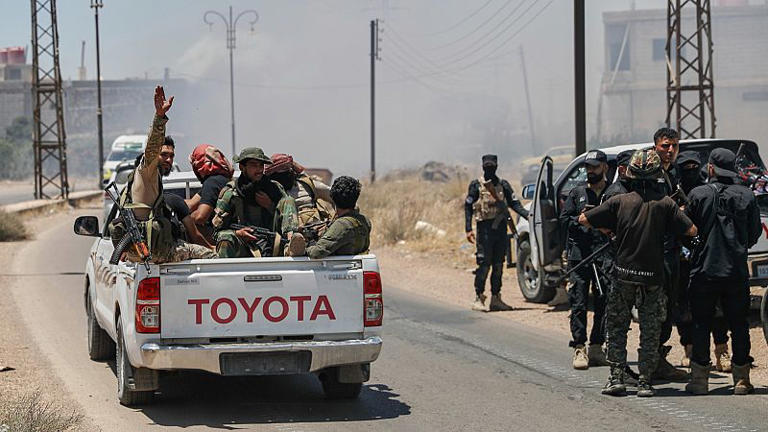
Photo: Reuters
And then—Israel entered the picture. Of course it did. In the Middle East, no armed conflict ever goes unnoticed by Israel—usually not without its direct involvement either.
On Monday, the office of Prime Minister Benjamin Netanyahu announced that Israeli forces had been ordered to strike Syrian troops in response to attacks on the Druze community in the city of Al-Suwayda.
“Prime Minister Benjamin Netanyahu and Defense Minister Yisrael Katz instructed the IDF to strike immediately at Syrian regime forces and their weaponry deployed in Al-Suwayda. This violates the previously agreed demilitarization policy, which prohibits the deployment of forces and weapons in southern Syria, posing a threat to Israel,” the statement read.
The statement also emphasized that Israel's actions were motivated by a "deep fraternal alliance with Israeli Druze and their historic family ties with the Druze in Syria."

Photo: Reuters
The Israeli military acted without delay. On Monday, the IDF struck Syrian government military equipment near the city of Sayed. Israeli drones continue to monitor the situation in and around Sweida, including key roads and Syrian military bases.
All of this is happening against the backdrop of quiet coordination between Israeli authorities and Syria’s emerging leadership—even while Israel continues its regular strikes on the Gaza Strip.
Meanwhile, as always, Iran is watching closely. Tehran has never stood aside from developments in Syria—and neither has Türkiye. Both countries have already condemned Israel’s strikes on Syrian troops in Sweida.
There were also reports from the U.S. that the Trump administration urged Israel to halt its military actions in southern Syria. According to Israeli officials, “...Israel promised to stop the attacks by Tuesday evening.”
Israel’s willingness to comply with Trump’s request is not surprising. Netanyahu will not risk souring relations with Trump—especially not in the context of their joint efforts to counter Iran. And while the situation with the Druze may carry emotional and political significance for Israel, it does not rise to the level of a strategic imperative.
What matters more—for both Netanyahu and Trump—is how this situation can be spun in their favor. For Trump, it’s another opportunity to project his image as a global peacemaker—a man who stops wars and ends bloodshed. For Netanyahu, it's another step in maintaining strong ties with Washington.
So what’s next for Syria?
Most likely, what has happened many times before. The warring sides will take a break. They’ll rest. They’ll regroup. They’ll consult with their allies and wait.
And when the right moment comes—when the timing is perfect and the pretext is ready—they’ll strike again. To show who’s really in charge. Or at least, who still believes they are invincible.
(If you possess specialized knowledge and wish to contribute, please reach out to us at opinions@news.az).


Similar news