From ruins to return: Azerbaijan’s new model for post-conflict recovery


Editor’s note: Seymur Mammadov is a special commentator for News.Az and the director of the international expert club EurAsiaAz. The article reflects the author’s personal opinion and does not necessarily represent the views of News.Az.
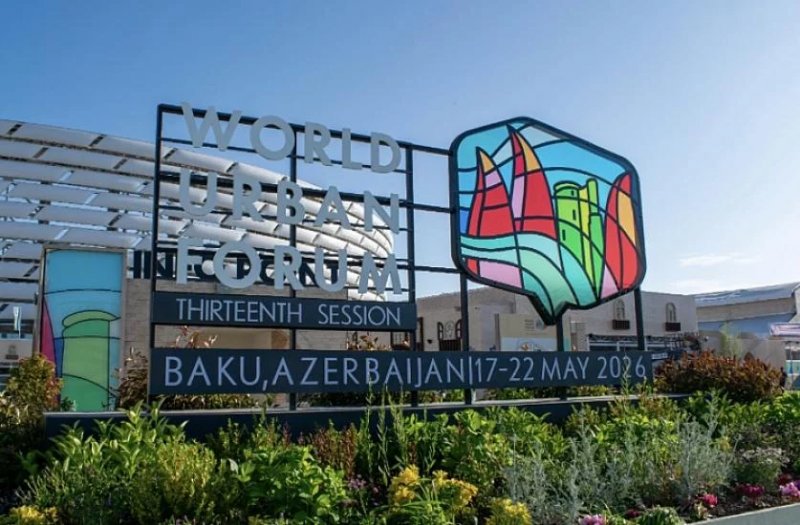
The 13th session of the World Urban Forum in Baku has brought many important discussions to the table, but one theme stands out with particular force: post-conflict urban development. For Azerbaijan, this is not an abstract academic concept, nor a distant international issue. It is a national reality, a state policy, and one of the most ambitious reconstruction processes seen anywhere in the world after a modern conflict.
The second day of WUF13 focused on “Post-Conflict Urban Development: Restoring Destroyed Identity and Reshaping an Integrated Future.” Few countries could speak on this topic with the same moral authority and practical experience as Azerbaijan. The country is rebuilding an area of 11,000 square kilometers — cities, towns, villages, roads, power lines, water systems, schools, hospitals, homes, and entire communities. This is not restoration in the usual sense. In many places, there was almost nothing left to restore. Karabakh and Eastern Zangezur are being rebuilt from the ground up.
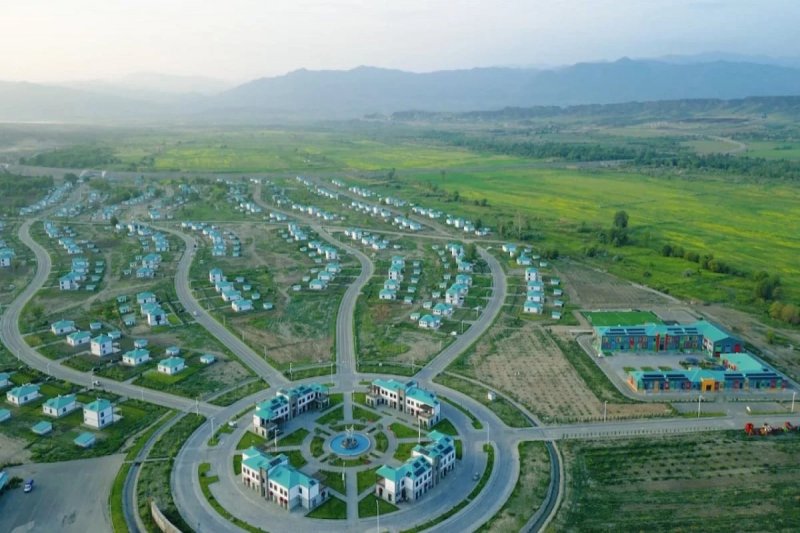
Reconstruction of Karabakh and East Zangezur (Five years after the conflict). Photo: APA.
Literally, across a territory comparable in size to Lebanon, Azerbaijan is creating everything required for normal life from scratch. Underground communications are being laid. Roads and tunnels are being built. Power plants, pipelines, residential complexes, enterprises, schools, and public buildings are rising where ruins stood for decades. Since the end of the Second World War, it is difficult to find another example of a country that, after a devastating conflict, has had to rebuild such a vast area almost entirely on its own. If there were a scale measuring the degree of post-war destruction, the Karabakh conflict would likely stand at the very top. President Ilham Aliyev is not exaggerating when he says Azerbaijan is restoring its liberated cities and villages from scratch.
RECOMMENDED STORIES
The scale of destruction left no other option. What makes Azerbaijan’s experience even more striking is that this reconstruction is being carried out using the country’s own resources and at an accelerated pace. Normally, bringing thousands of square kilometers of mined and devastated land back to life would require decades, major donor conferences, international patronage, and long-term financial mechanisms. The war in Ukraine has not even ended, yet discussions are already underway about creating donor structures to finance its future reconstruction. In Azerbaijan’s case, however, there were no major international donor initiatives for the restoration of Karabakh and Eastern Zangezur. Baku did not wait for anyone, did not ask for handouts, and did not build its strategy around external assistance. Azerbaijan simply began rebuilding.
According to the Ministry of Finance, 22 billion manats were allocated from the state budget in 2021–2025 for the restoration and reconstruction of Karabakh and Eastern Zangezur. Another 3.5 billion manats are planned for 2026, while projected budget expenditures for 2027–2030 amount to 13.3 billion manats, or about $7 billion. For a relatively small country, these are enormous sums. But when one sees the liberated territories coming back to life, the question of cost becomes secondary. Today, more than 85,000 people already live, work, and study in those areas. Karabakh is once again regaining the colors, sounds, and energy of life that it had been deprived of for three decades. This became possible due to five years of intensive construction carried out in parallel with demining. That detail is crucial.
Azerbaijan is not only rebuilding destroyed cities; it is doing so on land that remains heavily contaminated with mines. For people returning to their homes, safety is the first and most important condition. “I believe that by now we have developed a unique experience in building cities and villages from scratch,” President Ilham Aliyev said in an interview with Euronews on the sidelines of WUF13. “Unfortunately, this became the result of large-scale destruction in the occupied territories, and we had no other choice. A phased approach, and in some cases the parallel implementation of development work, has led to the fact that in five years, 85,000 people have already returned.”
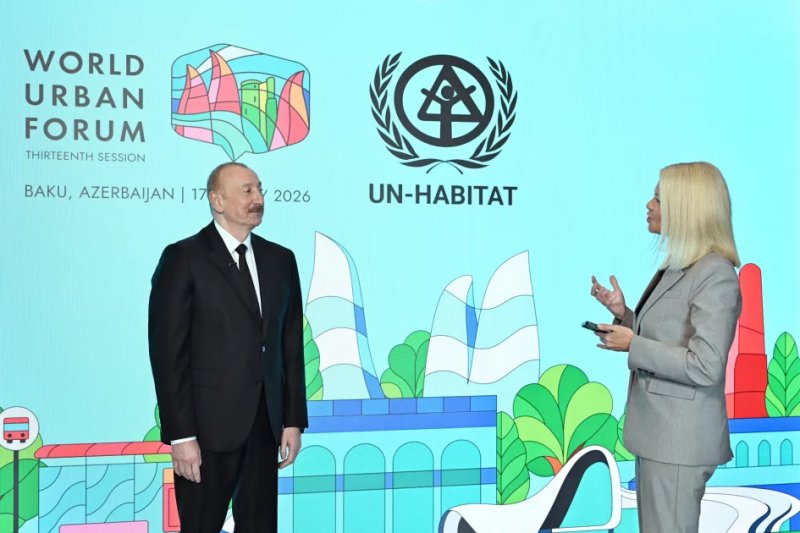
President Ilham Aliyev gives interview to Euronews. Photo: Trend
Azerbaijan’s approach has been systematic. The first priority was energy. Today, 307 megawatts of hydropower capacity have already been commissioned in the liberated territories, while solar power plants with a capacity of 340 megawatts are under construction. This is not only enough for Karabakh and Eastern Zangezur, but also for a much wider area. In other words, the region is not being rebuilt as a dependent periphery, but as a future driver of development.
The next stage is transport infrastructure. Azerbaijan plans to implement 68 road projects in the liberated territories, with a total length of 3,878.1 kilometers. As of early May, 48 tunnels with a total length of 71.2 kilometers are planned, seven of which have already been completed. In addition, 447 bridges are planned in Karabakh and Eastern Zangezur, 392 of which have already been built. More than 1,400 kilometers of highways and over 120 kilometers of railway tracks have already been laid. The Aghdam–Shusha highway is nearing completion, while roads such as Sugovushan–Sarsang Reservoir–Gozlukorpu–Kalbajar, Sugovushan–Kalbajar–Aghdara–Aghdam, Asgaran–Khojaly–Khankendi, and Barda–Aghdam–Asgaran are under construction.
The development of the railway network is especially important. In 2025, traffic was opened on the Baku–Aghdam route. In 2026, the Aghdam–Khankendi line is expected to be completed, along with the reconstruction of the Yevlakh–Barda section. This will make direct high-speed railway service between Baku and Khankendi possible. All this has been achieved in just five years. That fact alone shows the seriousness of the state’s approach. “This is how the true owners of this land behave, unlike those who come only to demolish, destroy, and bring grief and suffering,” President Aliyev said at the opening of WUF13. These words are politically sharp, but they also reflect a visible reality. The contrast between destruction and reconstruction is now one of the central symbols of post-war Azerbaijan.
During the years of occupation, international observers compared Aghdam to Hiroshima. President Aliyev recalled this comparison, noting that Aghdam had been completely razed to the ground. But unlike Hiroshima, he said, this did not happen in one day as a result of an atomic bomb. It happened over 30 years, as buildings, historical monuments, public facilities, and homes were dismantled and destroyed.
In May 2021, at the ceremony marking the beginning of Aghdam’s reconstruction, Ilham Aliyev said: “We will build an Aghdam that will become an example for the entire world.” Today, the outlines of that new Aghdam are already visible. It will not be a small district town, but a modern urban center with advanced infrastructure and smart technologies. Its master plan offers original and ambitious solutions.
Developed through cooperation among specialists from different countries, the project will allow displaced residents to return not simply to their old city, but to a new and modern Aghdam. Many of those who were forced to settle in Baku and other cities after ethnic cleansing may find that the difference in living standards is no longer dramatic. Aghdam has every chance to become a city that surprises the world. More broadly, Karabakh and Eastern Zangezur may eventually surpass many other regions of Azerbaijan in terms of urbanization, infrastructure, and technological planning. It would not be surprising if one day the World Urban Forum itself were held in Aghdam or Khankendi.
According to Anar Guliyev, Chairman of the State Committee for Urban Planning and Architecture, the projects being implemented in the liberated territories represent an important experience for the entire world. This includes institutional organization, planning approaches, construction management, and the return of people to their native lands. By presenting this experience at WUF13, Azerbaijan is offering not only a national reconstruction model, but also a post-conflict urban development framework that other countries may one day need. And this is perhaps the most important point. Azerbaijan’s experience is unique, but it may not remain isolated.
Unfortunately, the current geopolitical situation suggests that the number of conflicts in the world may continue to grow. Many countries may face the painful question of how to rebuild destroyed cities, restore identity, return displaced people, and reconnect broken territories. Azerbaijan is already answering that question — not through theory, but through action. Karabakh is no longer only a symbol of loss and occupation. It is becoming a symbol of return, reconstruction, and state capacity. What is being built there is not just roads, bridges, homes, and power plants. Azerbaijan is rebuilding historical memory, human dignity, and the future of a region that was once deliberately erased from the map of normal life. That is why the discussion at WUF13 matters.
Azerbaijan is not simply hosting a global urban forum. It is demonstrating to the world what post-conflict reconstruction can look like when a country has the political will, resources, and determination to restore what was destroyed.
(If you possess specialized knowledge and wish to contribute, please reach out to us at opinions@news.az).


Similar news