The Middle Corridor: Why China is betting on Azerbaijan


Amid growing global concern over fragile supply chains and geopolitical uncertainty, a quiet but significant shift is taking place in Eurasia. At the heart of this transformation is the strategic partnership between China and Azerbaijan, aimed at reinforcing the Middle Corridor as a reliable, sustainable, and future-oriented trade route between East and West.
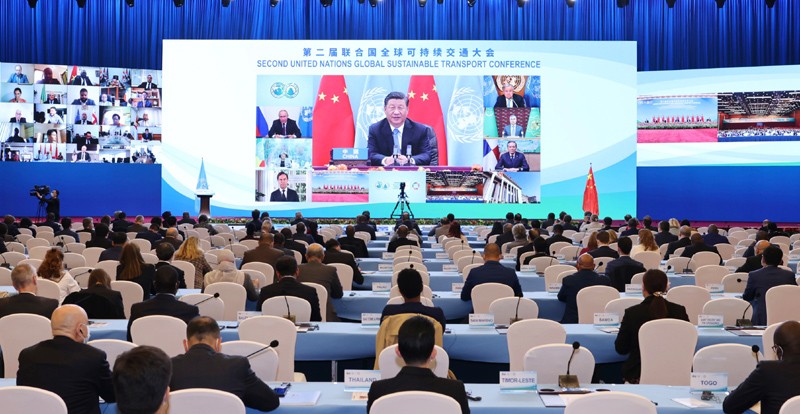
One of the key developments under discussion at the recent Global Forum on Sustainable Transport in China was the potential opening of a branch of the Global Innovation and Knowledge Center for Sustainable Transport, established in China in 2022, in Azerbaijan. Such a step would not only enhance research and innovation in Azerbaijan’s transport sector but also align Baku more closely with Beijing’s long-term strategic vision for global connectivity.
Chinese President Xi Jinping, in his remarks at the launch of the Center, emphasized the importance of promoting sustainable development in global transport and strengthening global interconnectedness to ensure the stability and efficiency of international supply chains. China, he noted, is prepared to work with all partners to use this platform to advance the Global Development Initiative and support the implementation of the UN 2030 Sustainable Development Agenda.
China is undoubtedly a vital link—and often the starting point—of many global supply chains. In recent years, Azerbaijan has also positioned itself as a central logistics hub in Eurasia. While the scale of the two countries may be vastly different, their partnership is increasingly symbiotic. For China, Azerbaijan has become a trusted transit partner. For Azerbaijan, this collaboration underscores its growing strategic importance in continental trade. By investing heavily in infrastructure, Baku has ensured that it is not merely a waypoint but a critical node in regional and global logistics.
Transport resilience is now synonymous with economic resilience. The turbulence that has rocked the Eurasian region in recent years, from wars to sanctions to political disruptions, has severely impacted traditional transport routes. In many ways, Azerbaijan has offered an alternative, filling the gap with the Middle Corridor. As conventional routes faltered, the Middle Corridor emerged as the most stable and secure path linking China to Europe.
Even as Western countries, under pressure from the U.S., began distancing themselves from China's Belt and Road Initiative, Azerbaijan remained pragmatic. It chose dialogue over division, infrastructure over ideology, and it made the right call. Today, this policy is bearing fruit.
On April 23, during President Ilham Aliyev’s visit to Beijing, a joint statement with President Xi Jinping affirmed both sides’ commitment to enhancing transport cooperation. “The parties highly appreciate their collaboration in the field of transportation and express their readiness to further develop transport infrastructure, improve the efficiency of logistics and freight operations, and promote regional interconnectedness,” the document read.
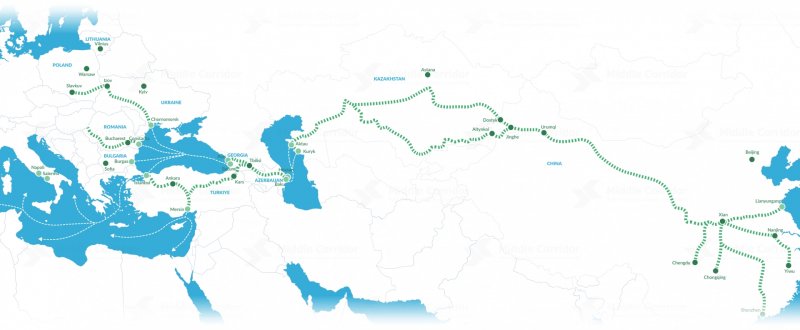
A significant result of that visit was the signing of a new agreement on international multimodal transport. Just weeks later, on June 30, a freight block train departed from Beijing’s Fangshan district en route to Baku via a multimodal route combining rail and sea. Covering over 8,000 kilometers, the journey is expected to take just 15 days. Upon arrival in Baku, the cargo will be further distributed to Georgia, Türkiye, Serbia, and other countries.
The management of Azerbaijan Railways noted that this new route not only strengthens the Trans-Caspian International Transport Route (TITR, or Middle Corridor), but also underscores the strategic role of the Baku International Sea Trade Port as a regional logistics hub. The new multimodal option provides a faster and more sustainable alternative to northern and maritime routes.
Azerbaijan Railways has a clear mandate: increase freight volumes along the Middle Corridor. Recent efforts in this direction include the June 26–27 working group meeting in Warsaw, where key agreements were finalized to accelerate the Corridor’s development. Special attention was given to digitalization, stable navigation in the Caspian Sea, and expanding container shipments.
The Asian Development Bank (ADB) has also shown strong support. Last month, it announced over $3.5 billion in funding for more than 10 specific infrastructure projects tied to the Corridor’s expansion between 2025 and 2028.
The first test shipments along the pilot route “Direct China–Europe Express via the Trans-Caspian” were launched in May 2024. The initiative aimed to evaluate border wait times, customs procedures, inspection requirements, and road infrastructure across China, Kazakhstan, Azerbaijan, and Georgia.
Another key milestone came this year when, for the first time, China and Azerbaijan exchanged official permits for international road freight transportation.
It is worth remembering that the Middle Corridor starts in China, runs through Central Asia and the Caspian Sea, crosses Azerbaijan, Georgia, and Türkiye, and continues into Europe. In the first half of 2025, freight traffic between China and Europe has grown steadily. The number of freight trains on the China–Central Asia route rose by 23% during the first five months alone. In contrast, Chinese freight volumes through Russia declined by 5–6%.
While maritime transport remains cost-effective for large shipments, its vulnerability is becoming a growing concern. The Strait of Hormuz was under threat amid rising Iran-Israel tensions. Hostilities eventually paused before any closure, but the scare was enough to rattle global markets. Similarly, the Bab-el-Mandeb Strait—disrupted by Houthi attacks in the Red Sea—remains a flashpoint. These two choke points are among Asia’s only maritime gateways to Europe, and their instability reinforces the need for secure overland alternatives.
In today’s fractured global environment, where uncertainty dominates international trade and diplomacy, the most valuable traits in any transport corridor are reliability, security, and neutrality. That’s why China, a country known for pragmatism, is doubling down on the Middle Corridor—not just with words, but with concrete investments.
Each agreement signed, each freight train dispatched from Beijing to Baku, is more than a logistical operation—it is a strategic statement. The Middle Corridor is no longer an alternative route. It is becoming the route of the future.
By Tural Heybatov


Similar news