What objectives is Ukraine pursuing in the Battle for Kursk?


By News.Az
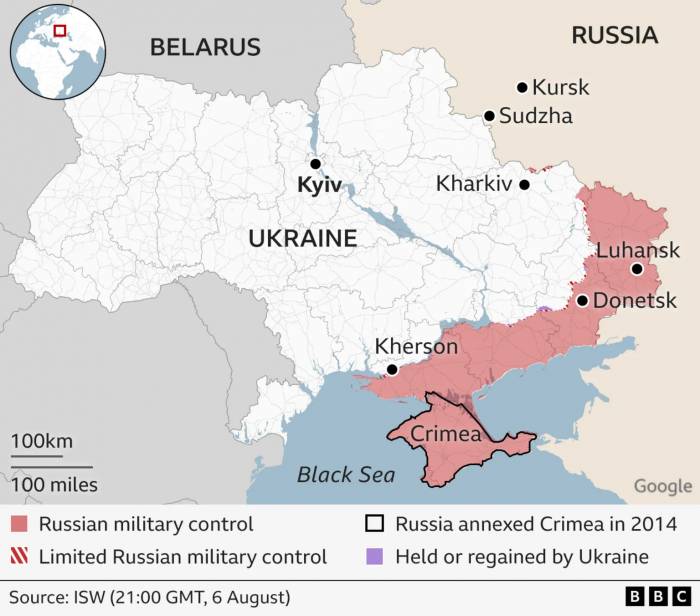
The Armed Forces of Ukraine (AFU) recently launched an unexpected attack on the Russian region of Kursk, capturing approximately 350 square kilometers of territory. This marks the largest territorial gain for the AFU since the beginning of the war, comparable to the offensive in Kharkiv in 2022.This is Ukraine's first operation on Russian territory, catching the Russian forces by surprise. Analysts are still uncertain about the objectives of this offensive. The capture of Kursk could either be a brilliant strategic move to strengthen Kyiv's negotiating position or a potential misstep that diverts resources from defending against the ongoing Russian offensive along the entire front line.
Among the possible objectives of the offensive, analysts highlight: slowing down or halting the Russian advance that has been ongoing throughout 2024; changing the narrative of the war in favor of Ukraine and countering Russian propaganda; capturing a key gas substation that supplies Europe with Russian gas; boosting the morale of the Ukrainian population after months of primarily defensive operations; and seizing territory for potential negotiation settlements.
The AFU also seized the Sudzha gas measuring station in Russia, which pumps gas through the Urengoy-Pomary-Uzhgorod pipeline to consumers in the EU, mainly Hungary, Slovakia, and Austria. Nearly 50% of all Russian gas exports to the European Union pass through this station. There used to be a second branch of pipelines delivering gas to Europe through Sokhranovka and the Novopskov compressor station, transporting 30 million cubic meters per day. However, the Ukrainian gas company Naftogaz closed this branch in May last year after the territory it is located on was captured by Russian troops.
This is the largest channel for Russian gas supplies to the EU since the Nord Stream pipeline was blown up, and the only gas flowing from Russia to Europe—about 42 million cubic meters per day, or approximately 15 billion cubic meters per year, generating $1 billion in transit fees for Ukraine—passes through the Sudzha gas measuring station.
Gas prices spiked on the news of the Kursk offensive to over $400 per thousand cubic meters, after trading at post-war lows for most of the summer, despite assurances from the Russian gas giant Gazprom of continued gas supplies to Europe through Ukraine, according to Reuters. Data from the Ukrainian operator showed that on August 8, the regular transport of 41.6 million cubic meters of gas from Russia to Europe through Ukraine was expected.
Some speculate that Kyiv intends to cut off the gas flow or at least threaten to do so to improve its negotiating position with the EU. Hungary has been a vocal critic of the war and has vetoed several aid packages supporting Kyiv in its military struggle against Russia.


Similar news