Why Britain regularly intercepts Russian warships in Channel


The interception and shadowing of Russian naval vessels in the English Channel by the Royal Navy has become a routine feature of Europe’s contemporary security landscape. What once would have been considered an exceptional event is now a recurring element of day-to-day military activity. Although such episodes often generate dramatic headlines, they rarely signal an imminent crisis. Rather, they reflect a deeply institutionalized system of surveillance, deterrence, and strategic signaling that has taken shape across Europe over the past decade.
The English Channel is one of the busiest maritime corridors in the world. Thousands of commercial ships pass through it every year, alongside regular movements of naval forces belonging to NATO members and other states. For the United Kingdom, this narrow stretch of water is not merely a geographical boundary separating the island from continental Europe; it is a critical security frontier. Any foreign military presence near British waters is therefore automatically assessed through the lens of national defense.
Within this context, the transit of Russian warships through the Channel carries particular political and strategic weight. Moscow continues to use this route to move vessels between its Northern, Baltic, and sometimes Mediterranean naval groupings. London, in turn, treats such movements as matters requiring constant attention — not because they are illegal, but because they provide valuable insight into Russia’s naval posture and intentions.
What “interception” actually means in naval practice
Source: BBC
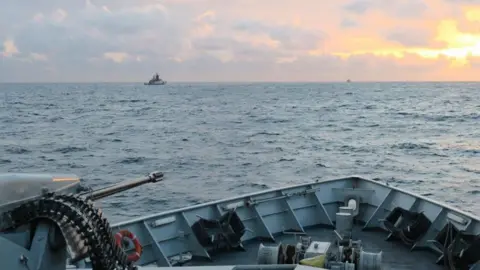
The term “interception” is often misleading. It suggests a confrontational action in which a ship is blocked or forced to change course. In reality, modern naval interception in this context usually means shadowing and identification.
Royal Navy vessels approach at a safe distance, establish visual and electronic contact, confirm the identity of the ship, and monitor its course and behavior. Radar, sonar, electronic intelligence systems, and sometimes helicopters or maritime patrol aircraft are used to collect data. The Russian vessel is then accompanied through the relevant area until it exits the zone of British responsibility.
This process does not violate international law. The principle of freedom of navigation remains intact, and Russian ships are not prevented from transiting international waters. What Britain is doing is exercising its right to monitor military activity near its territory.
A legacy of maritime rivalry
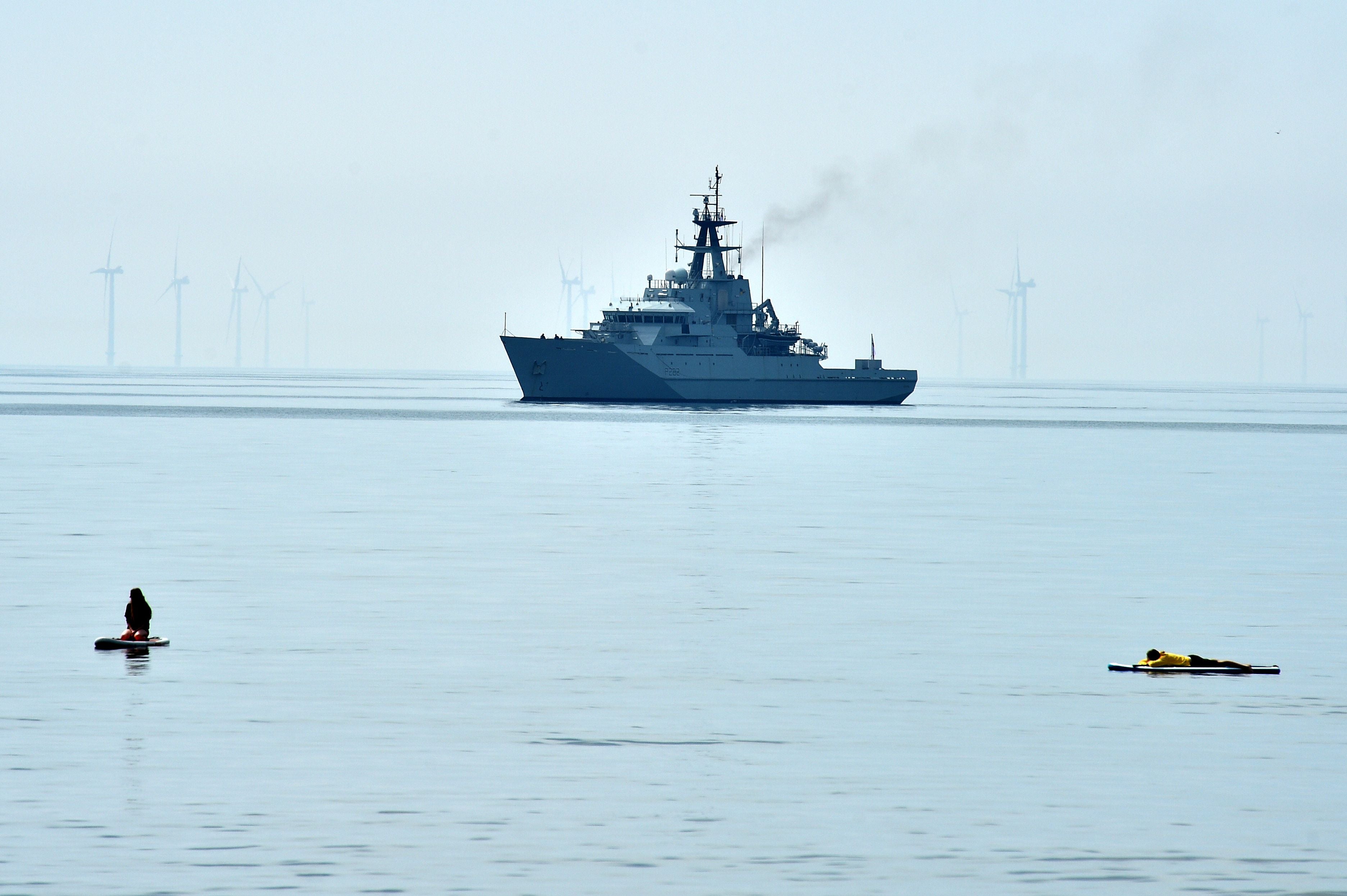
Source: The Independent
The naval dimension of rivalry between Britain and Russia has deep historical roots. In the 19th century, London viewed the expansion of Russian sea power as a potential challenge to its global dominance. During the Cold War, British and Soviet ships regularly shadowed one another in the North Atlantic, the Baltic Sea, and the Mediterranean.
Today’s encounters in the English Channel are, in many respects, a continuation of that long-standing tradition, albeit in a far more regulated and technologically advanced form. The difference lies in the institutional framework: modern operations are embedded within NATO’s integrated command structures and intelligence-sharing mechanisms.
Why the English Channel matters so much
Geographically, the Channel connects the Atlantic Ocean with the North Sea and, beyond that, the Baltic region. It functions as a maritime gateway between open ocean spaces and Europe’s internal seas. Control and monitoring of this corridor provide a strategic advantage in understanding how naval forces move between theaters.
For Britain, the Channel also has symbolic significance. It represents both a physical and psychological buffer zone. Ensuring that this space is under constant observation is central to London’s concept of homeland security.
From NATO’s perspective, the Channel is part of a wider defensive arc stretching from the Arctic to the Mediterranean. Any unusual or increased Russian activity along this arc is treated as potentially relevant to the Alliance’s overall security posture.
What Russian warships are doing
Source: Insider
Russian naval vessels passing through the English Channel may be engaged in several types of activity:
- Transit between home ports and deployment areas
- Participation in exercises
- Escorting auxiliary or tanker vessels
- Intelligence collection
- Demonstrating presence and flag-showing
None of these missions are inherently aggressive. However, taken together, they signal Moscow’s determination to maintain a visible and operationally active navy, despite economic pressure and international sanctions.
For Russia, sustaining regular naval deployments serves an important political purpose. It reinforces the image of Russia as a global military power and demonstrates that it retains access to key maritime routes.
Britain’s response as a form of deterrence
By shadowing Russian ships, Britain pursues several objectives simultaneously.
First, it gathers intelligence. Even routine transits can reveal valuable information about equipment, crew behavior, communication patterns, and technological capabilities.
Second, it demonstrates readiness. The Royal Navy sends a clear message that any military movement near British waters will be detected and monitored.
Third, it reassures allies. Britain’s actions underline its commitment to NATO and to the principle of collective defense.
This is deterrence in its classic form: not the threat of immediate force, but the constant demonstration of awareness and preparedness.
NATO’s collective monitoring system

Source: Reuters
One of the defining features of modern naval shadowing operations is their multinational character. A Russian vessel may be tracked by several NATO navies in sequence as it moves across different maritime zones.
For example, a ship might first be monitored by Spanish or French forces in the Atlantic, then by the Royal Navy in the Channel, and later by Dutch or German vessels in the North Sea. Throughout this journey, information is shared in near real time.
This creates a continuous picture of Russian naval movements and prevents gaps in situational awareness.
The information dimension
Each interception or shadowing operation quickly becomes part of the information environment. Official statements, press releases, and media coverage transform routine military procedures into public events.
For Western governments, this visibility demonstrates vigilance and resolve. For Russia, the same coverage can be used to highlight the global reach of its navy.
Thus, these encounters function not only as military actions but also as elements of strategic communication.
The risk of escalation
Despite tense rhetoric, both sides generally act with caution. There are established protocols for maneuvering, signaling, and communication at sea. These are designed to reduce the risk of misunderstandings.
History shows that even during periods of intense confrontation, such as the Cold War, naval shadowing rarely led to direct conflict. That precedent still shapes behavior today.
Nevertheless, risk cannot be eliminated entirely. Accidents, technical failures, or human error remain possible. This is why maintaining professional conduct at sea is so important.
The Ukraine war and its impact
Russia’s war against Ukraine has fundamentally altered how European states interpret Russian military activity. Actions that once might have attracted limited attention are now scrutinized more closely.
As a result, Russian transits through the English Channel are more likely to be framed as part of a broader pattern of confrontation between Russia and the West, even when they are routine in nature.
The conflict has also highlighted the importance of maritime routes for logistics, energy transportation, and military supply chains, further elevating the strategic value of chokepoints such as the Channel.
Long-term implications

Source: BBC
It is highly likely that interceptions and shadowing of Russian warships in the English Channel will remain a permanent feature of European security for the foreseeable future.
Europe is entering a period characterized by:
- Prolonged strategic competition
- Greater emphasis on maritime power
- Increased integration of NATO’s surveillance and response systems
Within this environment, naval presence and monitoring will be central tools of statecraft.
Final assessment
When Britain intercepts and shadows Russian warships in the English Channel, it is not preparing for war. It is implementing a long-standing strategy of observation, deterrence, and signaling.
These operations illustrate a broader transformation of Europe’s security architecture toward a model of continuous vigilance. The Channel, once primarily seen as a commercial artery, has again become a frontline of strategic awareness.
In this sense, the steady rhythm of naval interceptions reflects not a sudden crisis, but a new normal — an era in which great power competition is managed day by day, ship by ship, and mile by mile at sea.
By Tural Heybatov


Similar news