The report also provides a detailed account of the actions of Indian diplomats aimed at intimidating Sikh activists living in Canada and other countries. One of the most shocking examples of the repressive policies of Modi's government is the murder of Hardeep Singh Nijjar in Canada three years ago. This incident caused a serious diplomatic scandal. According to the report, Nijjar had been warned by Canadian intelligence services about a real threat to his life, but this did not save him. After the murder, Canadian Prime Minister Justin Trudeau publicly stated that the Indian government was involved in the killing.
On June 18, 2023, Canadian citizen Hardeep Singh Nijjar was killed in the Canadian province of British Columbia. While living in Canada, Nijjar continued to fight for the rights of Sikhs, which angered Indian authorities. Canada is home to a large Sikh community, which has essentially become a global hub for the movement to create "Khalistan." After Nijjar's murder, Canada accused the Indian government of being involved and expelled an Indian diplomat whom it considered responsible. In response, India revoked the immunity of and expelled 41 Canadian diplomats from the country.
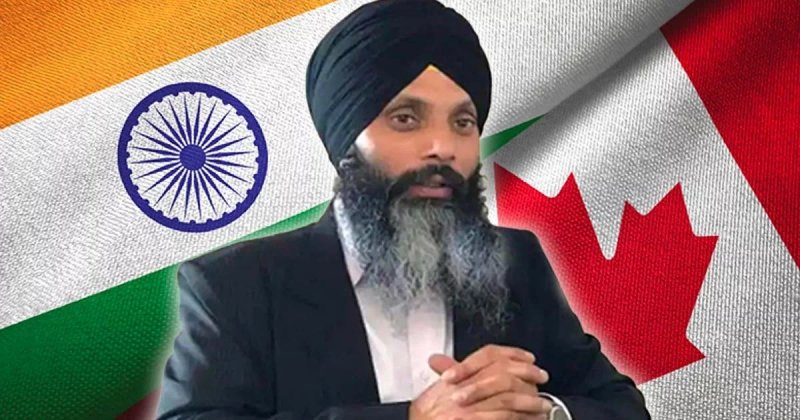
Photo credit: tnc.news
Equally shocking was the murder of Sikh activist Gurpatwant Singh Pannun in the United States. In November 2023, the U.S. Department of Justice filed charges related to a conspiracy to commit murder. The conspiracy was allegedly orchestrated by individuals linked to Indian security and intelligence services. A key figure in the case, Nikhil Gupta, pleaded guilty to the charges of orchestrating the murder and money laundering.
Recently, pressure on Sikh activists in the United Kingdom has intensified. The report notes that following protests outside the Indian Embassy in London, actions coordinated with India's National Investigation Agency have increased. Homes of dozens of Sikh dissidents living in the UK have been searched, and their relatives have been brought into investigations. The Sikh community views these actions as part of a broader mechanism of pressure and blackmail.
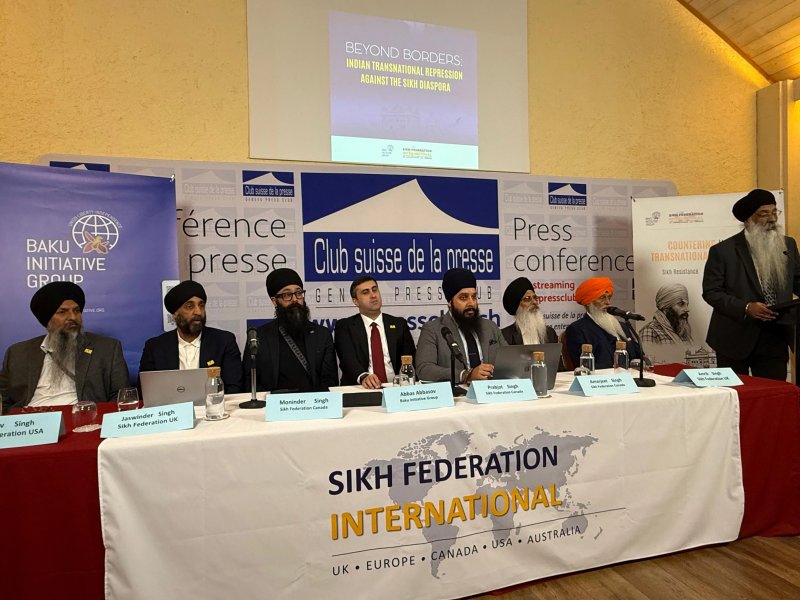
At the conclusion of the conference organized by the Baku Initiative Group in Geneva, a final statement was adopted. The statement calls on the UN to closely monitor and investigate cases of transnational repression targeting Sikh activists and diaspora communities; to support efforts to ensure accountability and transparency in cases of intimidation, threats, persecution, or violence carried out beyond national borders; and to strengthen international protection for diaspora communities, human rights defenders, and political activists.

Photo credit: caucasuswatch.de
International organizations must take real steps to hold those responsible for violence accountable.
Participants in the event in Geneva thanked the Baku Initiative Group for their support in exposing the transnational repressive policies of the Indian government and drawing international attention to the persecutions.
It should be noted that the press conference, which was broadcast live on various platforms, came under cyberattacks. The live stream was interrupted several times, and the internet at the venue was cut off. At this point, the questions are less about Indian intelligence services and more about the Swiss authorities.
Just a reminder, in January, at the initiative of the Baku Initiative Group, the first international conference titled "Racism and Violence Against Sikhs and Other Ethnic Minorities in India: The Current Reality" was held in Baku. Following this event, the Head of the Canadian Sikh Federation, Bual Moninder Singh, and his family began receiving death threats. Despite this, the Sikhs remain resolute and are not planning to back down.
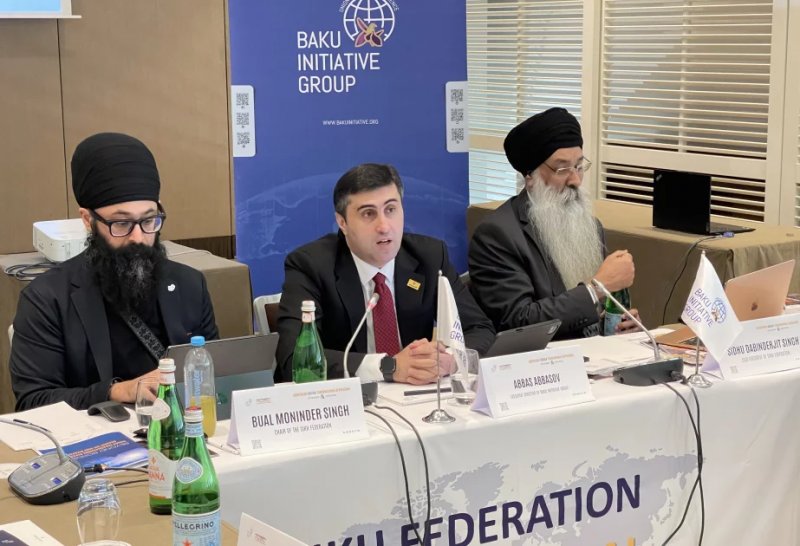
Photo credit: Azertac
In December of last year, Sikh activists and members of the organization Sikhs for Justice (SFJ) held protests in Washington, London, Toronto, Vancouver, Milan, and Melbourne against the policies of the Indian government, accusing it of involvement in the murders of Sikh activist Hardeep Singh Nijjar and Bangladeshi public figure Osman Hadi, who was known for his outspoken criticism of Indian Prime Minister Narendra Modi's policies. The main goal of the protests was to draw international attention to India's responsibility for these crimes. The Sikhs for Justice (SF) organization organized these protests under the title "India's Transnational Terrorism - From Dhaka to DC." During the protests, activists accused the Indian government of carrying out international political terrorism. Sikh activists claim that under the leadership of Prime Minister Narendra Modi, India is pursuing a policy of transnational repression aimed at suppressing critics and maintaining its sphere of influence.
Sikhs make up about 2% of India's population. While this is a small percentage, this relatively small community plays a significant role in the country's politics, military, and economy. For example, Sikhs make up around 20% of the personnel in the Indian Army. The Sikh community is highly unified and organized, with a strong diaspora in leading countries such as the USA, Canada, and the UK.
The history of Sikhs is a history of struggle for their rights. During the partition of India, Sikhs supported the Indian National Congress (INC), hoping that the INC’s promises of federalism and protection of minorities would be fulfilled. However, the Congress failed to keep its promises. In the aftermath of the partition, Sikhs became victims of violence, and 40% of the community was forced to flee India. This happened despite the fact that Sikhs played an indispensable role in the struggle for India’s independence.
Indian authorities made efforts to assimilate Sikhs and weaken their identity. As a result, the state became radicalized and turned into a constant source of protest. In 1973, Sikhs demanded autonomy for the state, but the Indian National Congress (INC) government rejected the demand. In 1982, the protests grew even larger, followed by widespread repression and political arbitrariness.
After the assassination of Prime Minister Indira Gandhi in 1984, anti-Sikh riots erupted in several districts of the capital and other cities. Up to 17,000 people were killed in the violence, and tens of thousands of Sikhs were left homeless. Rioters stormed Sikh neighborhoods, killing anyone they could find, destroying homes and businesses. People were killed in the streets, and there were reports of people being burned alive. The police were complicit in the events, and high-ranking politicians were involved in organizing the pogroms.
In the years that followed, the Indian government made several attempts to investigate the bloodshed, but the work of the relevant commissions did not lead to the punishment of those responsible.