Why language is becoming Azerbaijan’s new security frontier


Editor's note: Aysel Mammadzada is an Azerbaijan-based journalist. The views expressed in this article are the author’s own and do not necessarily reflect those of News.Az.
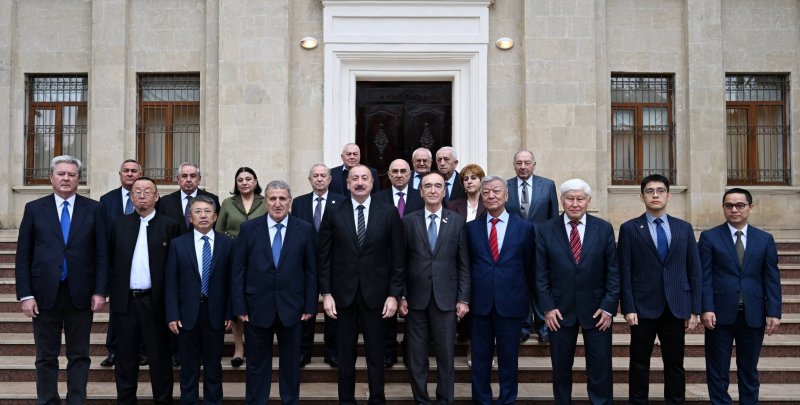
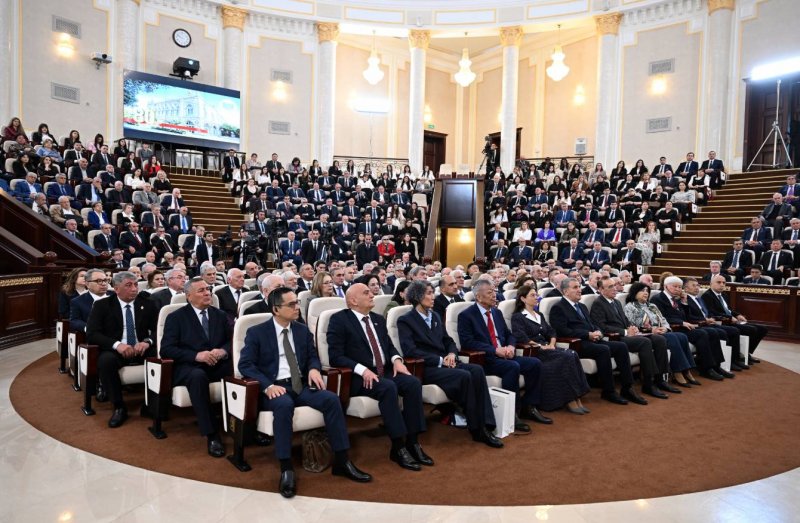
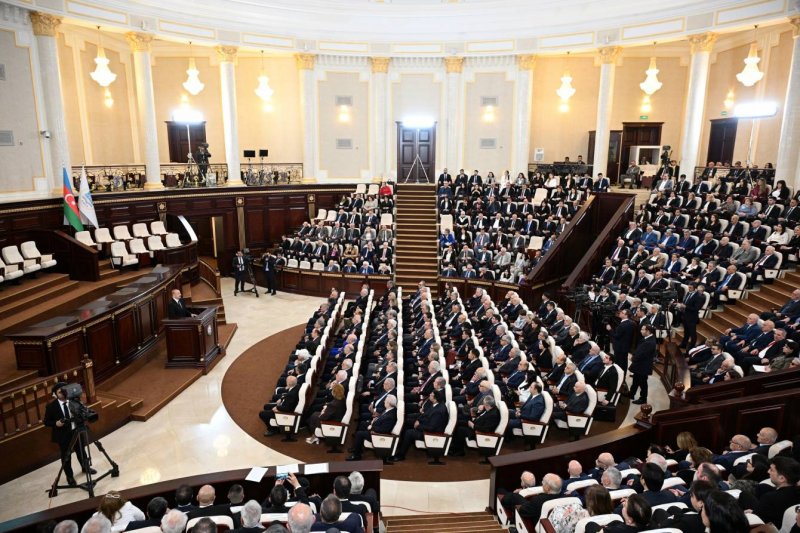
The 80th anniversary of the Azerbaijan National Academy of Sciences (ANAS), celebrated on November 3, 2025, offered more than a ceremonial commemoration. It served as a timely moment for reflection on how Azerbaijan envisions its intellectual future. President Ilham Aliyev’s participation and remarks at the ceremony highlighted the evolution of national science policy over recent decades, as well as the challenges and priorities that now define the country’s path forward.
Yet beneath the broader themes of progress and technological development lies a deeper issue that shapes identity, unity, and statehood: language. The protection of the Azerbaijani language, especially in the face of global digital influences, has emerged as one of the most important pillars of national resilience. As we enter a technological century, the Academy’s role, state policy, and public responsibility converge around a simple yet profound idea: the future of a nation depends on its knowledge, and knowledge begins with the mother tongue.
Honoring 80 years of scientific evolution
When reviewing President Aliyev's speech, one theme stands out: continuity. From the early decades under Heydar Aliyev's leadership to the modern period of rapid globalization, support for scientific institutions has not been episodic but structural. The president recalled how even during the most fragile years of independence — a time marked by conflict, economic collapse, and humanitarian crises — financial assistance for the Academy was never halted. Scientific infrastructure was preserved not as a luxury but as a strategic necessity.
Over the last 10 years, investments in science have doubled, research institutes have been renovated, libraries modernized, and new scientific programs established. Laws on science, state strategies, and grant mechanisms through the Science Fund demonstrate a systematic approach to elevating research culture. This continuity matters, because scientific progress cannot be achieved through temporary enthusiasm; it requires decades of stable development.
Perhaps even more significant is the broader educational policy that began in the 1970s: sending Azerbaijani students to leading international universities. Today, the majority of those who study abroad return to contribute to the country’s intellectual and technological capacity. This talent cycle is one of the most effective long-term strategies any developing state can adopt.
A New Era: Technology as national security
However, as President Aliyev noted, the challenges of 2025 differ significantly from those of the 1970s or 1990s. The global order is unstable, wars have proliferated, and international legal norms are constantly disrupted. In contrast, Azerbaijan has restored sovereignty and entered a phase of reconstruction and strategic consolidation. In this context, the definition of national security has expanded beyond military victory to include technological and intellectual resilience.
Artificial intelligence, once discussed only in theoretical circles, now stands at the center of geopolitical, economic, and cultural competition. Countries without strong scientific infrastructure risk becoming dependent on external technologies, and dependence, in the modern world, can translate into vulnerability. This is why the president emphasized that natural resources, while useful, are finite; intellectual capital, in contrast, is inexhaustible if nurtured properly.
Thus, the Academy’s role is evolving. It is not only a research institution but a national strategic asset — a space where the next generation of scientists, linguists, AI engineers, historians, and cultural scholars will shape the future of Azerbaijan.
Language: The first foundation of national knowledge
Beyond the scientific achievements celebrated at the anniversary, there is a cultural issue that touches directly on national identity: the protection and development of the Azerbaijani language.
One essential principle must be underlined: language unites the nation and is one of the core attributes of statehood. In the Azerbaijani context, this is not an abstract statement. Throughout history, political borders have shifted, empires have risen and fallen, and diaspora communities have dispersed across continents. Yet language has remained the invisible thread connecting Azerbaijanis to a shared cultural consciousness.
If the Azerbaijani language is not preserved, the risks are not merely linguistic; national identity and statehood itself become vulnerable. This observation is not unique to Azerbaijan — every small and medium-sized nation confronting globalization faces the same dilemma.
The pressure of digital globalization
In the digital era, new dynamics shape linguistic sustainability. While technology brings efficiency, access, and rapid learning, it also introduces foreign terminology at unprecedented speed. Social networks, foreign media platforms, and online entertainment have accelerated the penetration of English, Russian, Turkish, and other linguistic influences into everyday speech.
While multilingualism is a strategic advantage and should be encouraged, unregulated linguistic borrowing gradually weakens structural integrity. The excessive influx of foreign words and the influence of the internet disrupt the purity of the Azerbaijani language, often replacing native equivalents with imprecise or unnecessary substitutes.
Therefore, protecting the Azerbaijani language is both a civic and state responsibility. Institutions can codify standards and develop materials, but without public commitment, digital erosion continues unchecked.
Language and the global Azerbaijani community
Another crucial dimension involves Azerbaijanis living abroad. There are now sizable diaspora communities in Europe, North America, Türkiye, Russia, and Central Asia. Many families live in multilingual environments, which enriches cultural exposure but may weaken mother tongue proficiency across generations.
To prevent this, it is essential to expand online schools, remote learning opportunities, cultural programs, and digital platforms that provide access to Azerbaijani language education. Online learning solves a practical problem: it enables children in Paris, Berlin, Toronto, or Istanbul to learn Azerbaijani without depending on local ethnic schools, many of which do not exist.
Such efforts do more than maintain linguistic competence; they preserve cultural memory, literature, and historical consciousness. The diaspora of tomorrow should not only be Azerbaijani by origin but Azerbaijani in language and worldview.
Science and language: A shared national mission
The celebration of the Academy’s 80th anniversary illustrates that Azerbaijan sees its future through knowledge, research, and innovation. But no scientific ecosystem can flourish without a strong linguistic foundation. Language is not merely a communication tool; it is the vessel through which ideas, discoveries, and intellectual traditions are transmitted.
As Azerbaijan moves into a new century marked by artificial intelligence, satellite technologies, defense innovations, and digital economy expansion, safeguarding linguistic identity ensures that these advancements occur not in isolation but as part of a coherent national narrative.
The next 80 years will likely be defined by two complementary pillars:
1. Technological strength — ensuring Azerbaijan does not remain a consumer of foreign innovations but becomes a producer.
2. Cultural-linguistic resilience — ensuring Azerbaijanis remain united through a shared intellectual and linguistic identity, both at home and abroad.
The anniversary of ANAS was not only about celebrating the past but about laying the foundation for this future. In doing so, Azerbaijan positions itself as a country where modernity and cultural continuity reinforce rather than contradict each other — a balance few nations manage to achieve.


Similar news