Skywatchers have plenty to look forward to in 2026, with a rich lineup of lunar spectacles set to light up the night sky.
The year will feature multiple supermoons, a striking total solar eclipse, and a dramatic “blood moon” total lunar eclipse, alongside numerous close encounters between the crescent moon and bright planets, News.Az reports, citing Space.com.
These celestial highlights offer ideal opportunities for moon-gazing throughout the year. Most events will be easily visible to the naked eye, while binoculars or a telescope can enhance the experience. With the right preparation, 2026 promises to be an exceptional year for anyone eager to explore and enjoy the beauty of the Moon.
1. The year's first supermoon: Jan. 3, 2026 (dusk)
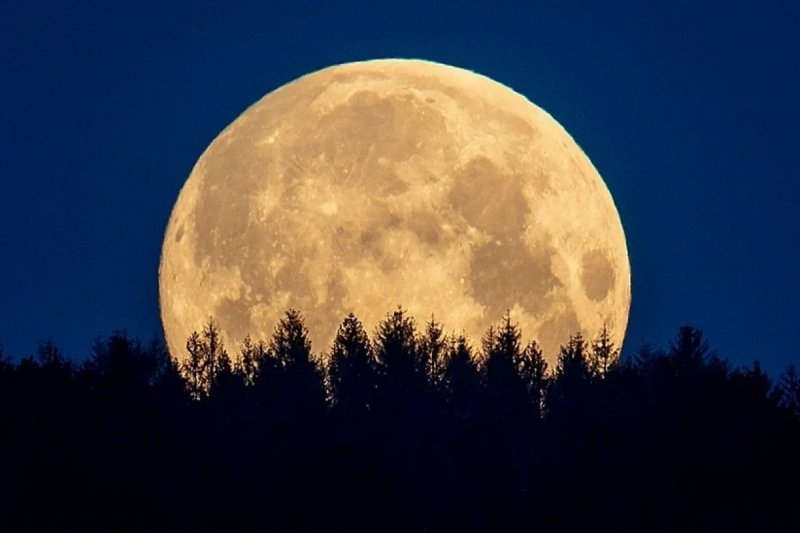
The first full moon of 2026, January's Wolf Moon, will be a supermoon, meaning it will appear larger and brighter because it will be at or near its closest point to Earth in its elliptical orbit. Although it's the first of three supermoons in 2026, it's the last in a series of four from the back end of 2025.
2. "Ring of fire" annular solar eclipse: Feb. 17, 2026 (daytime)
Will anyone be able to see the "ring of fire" annular solar eclipse on Feb. 17, 2026? The moon will eclipse up to 96% of the sun's center for up to 2 minutes, 20 seconds, but only for scientists at a few research stations — the French-Italian Concordia Station in the interior and the Russian Mirny Station in Queen Mary Land on the Davis Sea coast. A partial solar eclipse will be seen across Antarctica and from parts of southern Africa and Argentina.
3. Crescent moon and Mercury: Feb. 18, 2026 (after sunset)
About 45 minutes after sunset on Feb. 18, something relatively rare will be on show: a conjunction between a superslim crescent moon and the elusive planet Mercury. Visible low in the western sky, the moon will be barely 2%-lit, so you'll likely need binoculars to see it. Below will be Venus, with Saturn above.
4. "Blood moon" total lunar eclipse: March 2-3, 2026 (night to early morning)
Total lunar eclipses often come in threes. There were two in 2025, one of which wowed skywatchers in North America , and the final in the trio comes in early March 2026 — the last until 2029. During this event, the full Worm Moon will transit Earth's shadow to become a reddish-orange "blood moon" for 58 minutes as seen from parts of western North America, Australia, New Zealand, East Asia and the Pacific.
5. Crescent moon and Venus: March 20, 2026 (after sunset)
The sight of a young moon close to a bright planet will be on offer about 45 minutes after sunset on March 20, when a 5%-lit waxing crescent moon will hang above the bright planet Venus. Find an unobstructed western horizon, and take along a pair of binoculars.
6. Crescent moon, Venus and the Pleiades: April 19, 2026 (after sunset)
Look west an hour after sunset on April 19 for a spectacular panorama close to the sinking stars of Orion as a 9%-lit waxing crescent moon gets close to the Pleiades (also known as the "Seven Sisters" star cluster), with bright Venus below.