WUF13 in Baku: When urban policy became global diplomacy


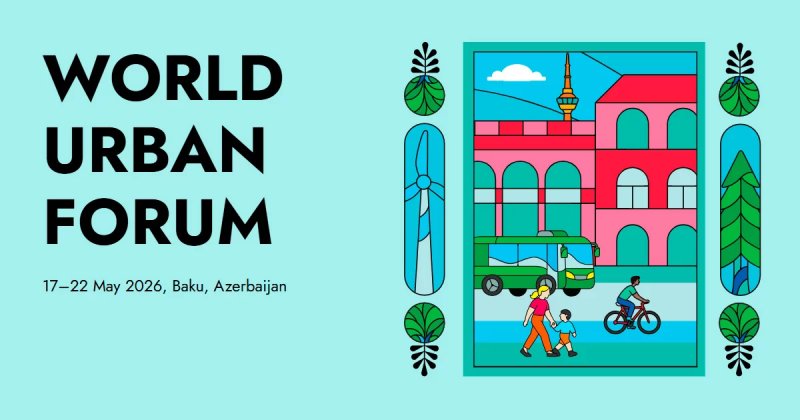
In international politics, there are events that follow protocol and leave behind photographs, declarations, and neatly arranged flags. But there are also forums that change the very lens through which a conversation is viewed. WUF13, held in Baku, proved to be precisely such a case: a forum about cities unexpectedly became a conversation about statehood, reconstruction, human dignity, diplomacy, and the right of peoples to return home.
After COP29, Azerbaijan once again found itself at the center of a major international agenda. But while the climate summit spoke in the language of the planet, the World Urban Forum spoke in the language of the city — the most sensitive organism of modern civilization. Today, the city is a map of memory, an economic engine, a political argument, a shelter, a laboratory of the future and, in the case of post-conflict territories, proof that destruction does not always have the final word.
WUF13 brought together more than 57,000 participants from 176 countries in Baku and went down in history as the largest-ever session of the World Urban Forum. The forum’s outcome document, the Baku Call to Action, already refers to a figure of more than 58,000 participants. This number matters not merely as a statistic of scale. It shows that Baku managed to become a place where the global urban agenda moved beyond a professional discussion among architects, planners, and municipal managers. It became part of big politics — the politics of resilience, reconstruction, and international trust.
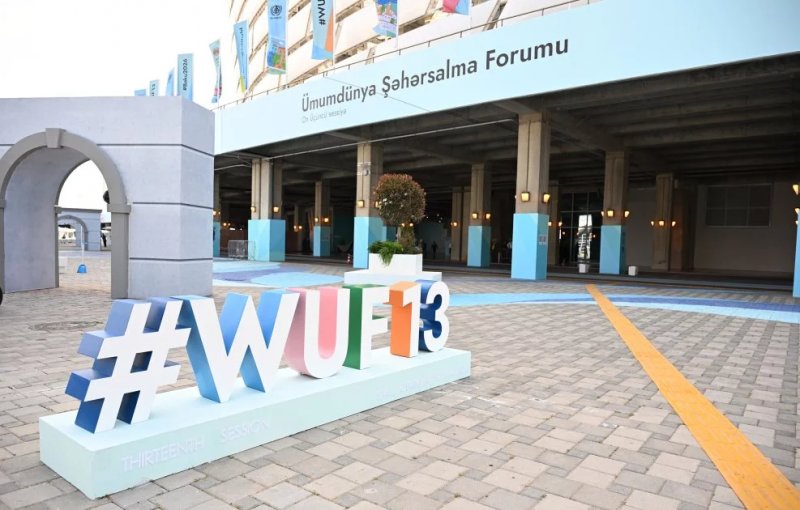
Credit: turkic.world
The initiative of President of Azerbaijan Ilham Aliyev gave the forum particular significance: for the first time in the history of the World Urban Forum, a Leaders’ Statements Session was held. It was attended by 27 heads of state and government, high-ranking guests, and leaders of international organizations. For a forum usually perceived as an expert urban-development platform, this became a powerful political amplifier. Baku effectively expanded the format of WUF: from a professional space, it turned into a diplomatic stage where urban policy was presented as part of global governance.
This is especially important in an era when cities have become the main witnesses of crises. Wars destroy neighborhoods faster than diplomats can agree on communiqués. Climate disasters hit infrastructure harder than they hit abstract emissions charts. Migration, poverty, housing shortages, the destruction of schools and hospitals — all of this first appears in the urban environment and only later enters analytical reports. That is why any discussion about urban development today inevitably becomes a discussion about security, justice, and the future of the international order.
Azerbaijan approached WUF13 with its own experience, one that is difficult to separate from its recent history. The liberated territories of Karabakh and East Zangezur have become a vast construction, humanitarian, and moral task for the country. This involves the restoration of nine cities and more than 100 villages that were subjected to urbicide, ecocide, and culturicide. In this context, Azerbaijan’s agenda at WUF13 sounded particularly concrete: Baku spoke about reconstruction as a daily state practice.
The Great Return program became one of the forum’s key themes. To an outside observer, it may look like an infrastructure program: roads, houses, schools, communications, smart cities, and smart villages. But in reality, it is a much deeper process — the return of a person to the space of their own memory. When an internally displaced person returns to their native village, the state is, above all, restoring the connection between biography and geography.
In this sense, WUF13 gave Azerbaijan an opportunity to present post-conflict reconstruction as an internationally significant experience. In the Chair’s Summary adopted following the ministerial meeting, Azerbaijan’s work in the field of recovery and reconstruction was highly appreciated, and the country’s experience was described as useful for similar situations. This is an important diplomatic result. It moves Azerbaijan’s reconstruction model from the category of an internal state program into the category of an international example.
One of the strengths of the Baku forum was that it combined scale with substance. Many major international events suffer from the same weakness: they impress with the number of guests but disappear from memory once the closing ceremony is over. WUF13 in Baku attempted to do the opposite — to leave behind an institutional legacy. The Baku Urban Award, the initiative to develop an operational guide for future WUF sessions based on Baku standards, and the Baku Call for Breathing Cities demonstrate Azerbaijan’s intention to embed its contribution into the forum’s long-term architecture.
The environmental dimension deserves particular attention. At the initiative of Leyla Aliyeva, Vice-President of the Heydar Aliyev Foundation and founder and head of IDEA, a high-level forum was organized on air quality and green infrastructure in sustainable cities. The communiqué adopted following the event, the Baku Call for Breathing Cities, proposed establishing clean air as a permanent topic for future sessions of the World Urban Forum. This was a precise and timely move. After COP29, Azerbaijan continued the environmental line, but shifted it from the level of the global climate to the level of everyday human life — to the very air that people breathe.
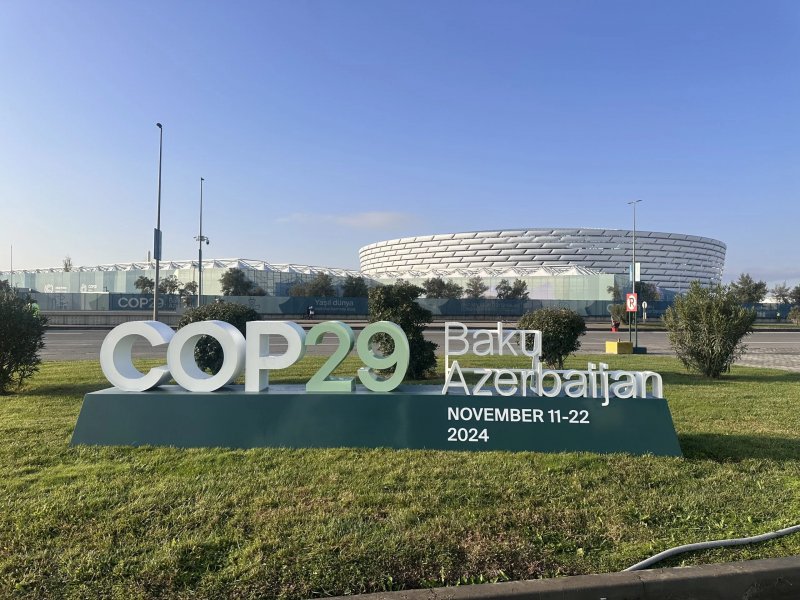
Credit: healthpolicy-watch.news
This is where the new logic of Baku’s international positioning becomes visible. Azerbaijan is not limiting itself to the role of host country. It seeks to be a co-author of the agenda. At COP29, this was climate diplomacy. At WUF13, it was urban diplomacy. In both cases, the country uses major international platforms to demonstrate its organizational maturity, political stability, and ability to propose themes that go beyond regional interest.
In this picture, Baku itself becomes an argument. A city where medieval fortress architecture coexists with modern spaces, skyscrapers, seaside boulevards, and renewed infrastructure is a living illustration of Azerbaijan’s development model. It does not abandon memory for the sake of modernization. Its urban identity is built on a tense but productive dialogue between the past and the future.
For a wide range of analysts, WUF13 is also important because it showed how modern diplomacy is increasingly moving from the halls of classical negotiations to thematic platforms. Climate, cities, water, transport corridors, energy, cultural heritage — this is where a new political grammar is being formed today. States now compete not only through military power or the size of their economies, but also through their ability to create platforms where other countries are ready to speak, listen, and reach agreements.
In this regard, the Leaders’ Statements Session was an important signal. It showed that Azerbaijan is capable of bringing together both experts and political leaders on its territory, turning Baku into a place for strategic dialogue. This continues the course the country has been consistently developing in recent years — from energy diplomacy to climate diplomacy, from transport diplomacy to humanitarian diplomacy, and from a regional agenda to a global one.
There is also an important symbolic point here. Urbanism is always connected with rhetorical questions: who does the future belong to? To those who destroy, or to those who rebuild? To those who erase cities from the map, or to those who bring life back to them? The WUF13 outcome document emphasized that conflicts, wars, and urbicide directly affect schools, hospitals, public infrastructure, residential buildings, the environment, and biodiversity, leaving people without shelter and forcing them to become refugees or internally displaced persons. For Azerbaijan, this is an experience lived through by thousands of families.
That is why the Baku forum was more than a conversation about building density, green spaces, and municipal governance. It became a platform where the city was presented as a space of rights: the right to a home, the right to return, the right to clean air, the right to safe infrastructure, the right to memory, and the right to development after destruction.
From a practical point of view, WUF13 also strengthened Azerbaijan’s international image as a country capable of hosting events of the highest level. After COP29, a second major forum of such scale became confirmation of an organizational school that is already becoming part of the national brand. For the state, this matters far beyond protocol success. Major forums create trust, expand networks of partnership, increase the country’s visibility, and open additional opportunities for economic, expert, and political interaction.
But perhaps the main result of WUF13 lies elsewhere. Baku invited the world to look at the city as a form of responsibility. To rebuild a city means to restore the horizon of life. To create sustainable infrastructure means to recognize that the future begins with water, electricity, roads, schools, and hospitals. To bring people back home means to prove that politics has a human dimension.
In an era when the international system often appears tired, fragmented, and cynical, WUF13, successfully held in Baku, sounded like a reminder: cities that once became victims of history can become instruments of its correction. Azerbaijan used this forum to show its own path — from destroyed territories to restored cities, and further toward an urban development strategy.
(If you possess specialized knowledge and wish to contribute, please reach out to us at opinions@news.az).


Similar news