Antigua and Barbuda set to vote in key snap general elections


Antigua and Barbuda will hold snap general elections on April 30, with over 61,800 voters set to elect a new Parliament, while Prime Minister Gaston Browne seeks re-election in an effort to shape the country’s future.
Voters will choose a new Parliament and decide who will assume the office of Prime Minister for a five-year term, thereby determining the nation’s political and socioeconomic direction amid a complex global environment, News.Az reports, citing foreign media.
The main political parties participating in these decisive elections are the ruling Antigua and Barbuda Labour Party (ABLP), the United Progressive Party (UPP), and the Barbuda People’s Movement (BPM).
Gaston Browne, leader of the Antigua and Barbuda Labour Party and incumbent Prime Minister since 2014, is aiming to secure another mandate for his party. The ABLP currently holds a significant advantage, controlling nine of the 17 constituencies in the House of Representatives, which places it in a leading position in the race.
RECOMMENDED STORIES
In contrast, the United Progressive Party (UPP), led by Jamale Pringle, enters the elections in a comparatively weaker position. The party currently holds six seats and has faced internal difficulties that began in 2024, which have affected its unity and electoral strength.
The Barbuda People’s Movement (BPM), led by Trevor Walker, is contesting the single-seat Barbuda constituency and seeks to retain its sole representation, which remains a key stronghold for the party.
It should be noted that Prime Minister Browne’s original term was expected to end in 2028. However, under the country’s parliamentary system, the Prime Minister has the constitutional authority to call early elections when considered necessary. This mechanism allows the government to seek a renewed mandate when it believes stronger public backing is required or when strategic political circumstances arise.
Prime Minister Browne has publicly explained his decision to call early elections by stating that a strong government with a recently renewed mandate is essential for effective decision-making in a complex global environment. He specifically referred to ongoing international conflicts, including the situation in the Middle East, and their potential global economic consequences, such as rising fuel prices that directly affect Caribbean nations.
High voter turnout expected
More than 61,800 voters are officially registered and eligible to take part in the elections. This number has increased in recent months following the announcement of early elections, reflecting heightened public interest and engagement in the democratic process.
These voters will elect representatives across all 17 constituencies of the House of Representatives using the “first past the post” system, a simple majority method in which the candidate with the most votes wins. Voter turnout in the previous general elections was around 70%, indicating a strong tradition of civic participation in the country.
The elections will be conducted across all constituencies forming the Parliament. With campaigning now concluded, attention has shifted entirely to the organization and smooth execution of the voting process, which will determine the country’s political future.
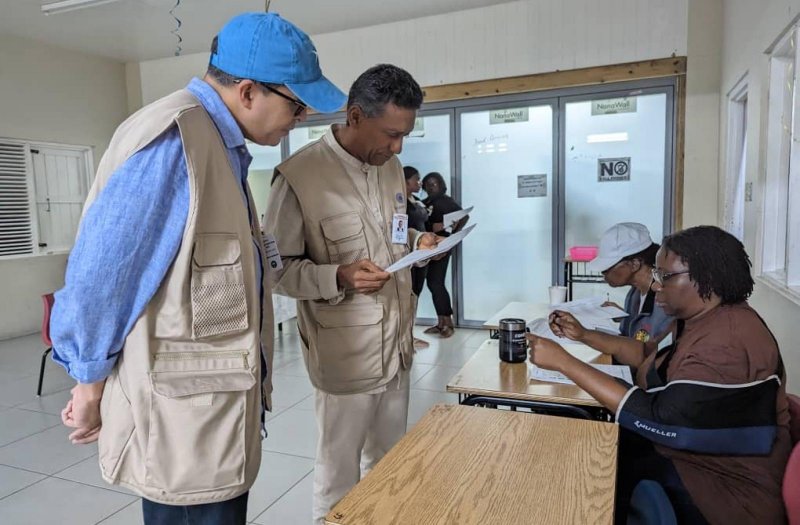
The Organization of American States (OAS) has deployed its Electoral Observation Mission to Antigua and Barbuda, led by former OAS Secretary for Access to Rights and Equity Maricarmen Plata, and comprising 17 experts and observers from 11 countries.
The Commonwealth Observer Group has also begun its work in Antigua and Barbuda. It is led by Hon. Dr Pelonomi Venson, former Minister of Foreign Affairs of Botswana, and includes three additional experts.
The outcome of the elections will not only determine the composition of the new Parliament but will also establish the policy direction for the next five years, affecting national development, economic stability, and social welfare.
This democratic process in Antigua and Barbuda highlights the country’s commitment to parliamentary governance and citizen participation.
By Nijat Babayev


Similar news