Ariane 6 rocket set for launch as Europe pushes for independent space access


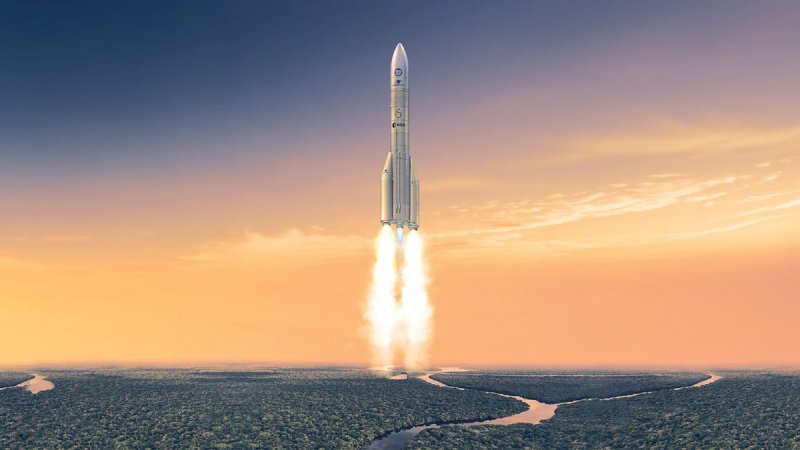
Europe's new heavy-lift rocket, Ariane 6, is set to launch its first commercial mission on Monday as European nations work to secure independent access to space.
The high-profile mission comes as French President Emmanuel Macron calls for Europe to reduce its security reliance on the United States and the European space industry struggles to remain competitive in the face of Elon Musk's Space X, News.Az reports, citing AFP.
Following several postponements, the Ariane 6 rocket is scheduled to blast off from a spaceport in Kourou in French Guiana at 13:24 (16:24 GMT) Monday.
The launcher will carry a French military satellite, which will be placed in orbit at an altitude of around 800 kilometres (500 miles).
The CSO-3 satellite is expected to strengthen France's military autonomy and improve its army's intelligence capabilities.
Europe has not been able to use Russia's Soyuz rocket for satellite launches after Vladimir Putin invaded Ukraine in 2022, while Ariane 5 was retired in 2023.
"The whole world is watching us," David Cavailloles, chief executive of French aerospace company Arianespace, told AFP in February.
Initially planned for December, the mission was put back until February 26 and then March 3 because of problems getting the satellite to the Kourou launchpad, according to Arianespace.
It will be the second launch for Ariane 6, after its inaugural flight last July.
CSO-3 will complete a network of three French military imaging satellites, with the first two launched in 2018 and 2020 by Soyuz.
Europe's other launcher, Vega-C, did not resume flights until December 2024 after being grounded for two years following an accident that resulted in the loss of two satellites.
The mishap left Europe without spacecraft to launch satellites into orbit for a year, following delays to the Ariane 6 rocket and lack of cooperation with Russia.
"It was very important for France and for Europe to regain this autonomous access to space because we cannot have a space policy today without having the means to send our satellites into space independently," Lionel Suchet, CNES acting head, told AFP.
"What counts in these cases is to be sure that everything is secure. Like all launches, it is a risky launch," he added.
Some of the images taken by the CSO-3 satellite will be shared with Germany, Belgium and Sweden.


Similar news