Asia stocks fall as US-China trade tensions weigh


Asian markets slipped on Wednesday as investor sentiment soured following fresh U.S. restrictions on chip sales to China, which dealt a blow to tech giant Nvidia and intensified fears of an escalating global trade war.
Treasury yields were steady ahead of a key speech from Federal Reserve Chair Jerome Powell later in the day, News.Az reports, citing Reuters.
Traders are wondering if he will echo the surprisingly dovish tone set by his colleague Fed Governor Christopher Waller, or stay more balanced.
Overnight, Washington issued new export licensing requirements for Nvidia's H20 and AMD's MI308 artificial intelligence chips to China. Nvidia's shares slumped 6% in after-hours trading, after it said the move would cost $5.5 billion.
Separately, President Donald Trump ordered a probe into potential new tariffs on all U.S. critical minerals imports, on top of reviews into pharmaceutical and chip imports. Beijing is continuing to play hardball, having reportedly ordered airlines to suspend deliveries of Boeing aircraft.
The sell-off in Asian stocks gathered pace in the afternoon. S&P 500 futures fell 1.5% while Nasdaq futures slumped 2.3%.
The gloom is set to spread to Europe, with EURO STOXX 50 futures pointing to a 1.5% drop at the open.
On Wednesday, MSCI's broadest index of Asia-Pacific shares outside Japan fell 1.4%, snapping a four-day winning streak. Japan's Nikkei dropped 1.6%.
Chinese blue chips fell 0.7% as investors failed to find much solace in some solid GDP data that predated the tariff increases in April. Hong Kong's Hang Seng slumped 2.7%.
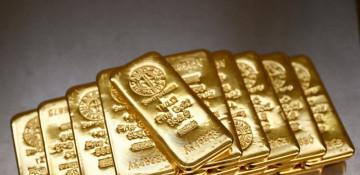
All of the uncertainties left gold in an unstoppable position, with the bullion up 2% to hit another record high of $3,290 per ounce.
ANZ on Wednesday updated their forecast for gold to hit $3,600 an ounce by the year-end, arguing that the risk-off purchases for the asset are yet to pick up.
The step down in risk appetite is evident via rises in the Japanese yen and Swiss franc. The dollar lost 1.1% to 0.8145 Swiss franc and fell 0.7% to 142.32 yen.
Bank of Japan Governor Kazuo Ueda told the Sankei newspaper that the central bank may need to take policy action if U.S. tariffs hurt the Japanese economy, signalling the potential to pause the bank's rate-hike cycle.
U.S. Treasuries, however, failed to draw support from the risk aversion and were steady on Wednesday.
The benchmark 10-year yield was steady at 4.325%, well off the recent high of 4.592%. The 30-year yield was little changed at 4.777%, also some 25 basis points lower from the high seen last week.
Oil prices were lower. Brent fell 1.1% at $63.99 a barrel, while U.S. crude also dropped 1.1% to $60.65 per barrel.


Similar news