Comet 3I/ATLAS: a rare interstellar visitor reshapes scientific understanding


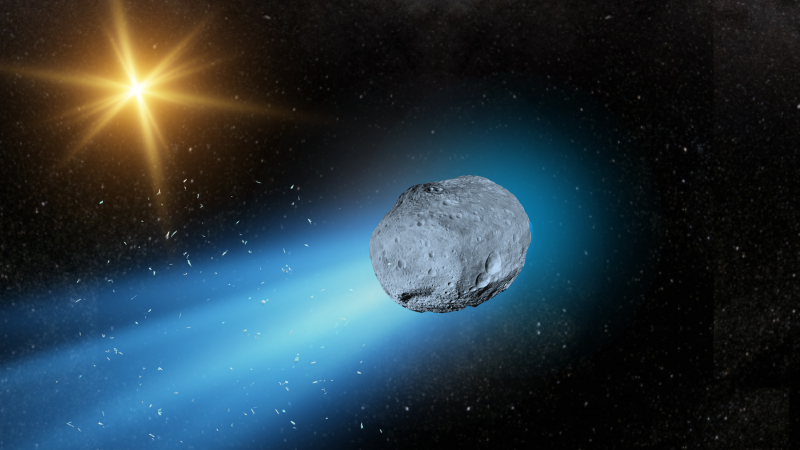
A newly announced analysis of comet 3I/ATLAS has renewed global scientific interest in interstellar objects and their potential to reveal the chemical diversity of planetary systems beyond our own, News.az reports.
Although the comet first entered the Solar System several years ago, astronomers recently completed a comprehensive study using data from ground-based telescopes and space observatories, concluding that 3I/ATLAS is only the third confirmed interstellar object ever detected after 1I/ʻOumuamua in 2017 and 2I/Borisov in 2019.
Comet 3I/ATLAS attracted early curiosity due to its unusual orbital trajectory. Its hyperbolic path showed that it was not gravitationally bound to the Sun, meaning it entered the Solar System at high speed from interstellar space. Astronomers have long suspected that such objects may regularly pass through our planetary neighbourhood, but advances in survey technology and automated sky monitoring systems have only recently made their detection possible. The discovery of 3I/ATLAS therefore reinforces the idea that the Solar System is not isolated but continuously interacts with the broader environment of the Milky Way.
Initial observations revealed that 3I/ATLAS behaved differently from typical comets originating in the Oort Cloud. Most comets brighten as they approach the Sun due to sublimation of ice and dust, but 3I/ATLAS displayed an irregular activity pattern. Its coma expanded rapidly, then unexpectedly faded, leading researchers to propose that the comet may have fragmented or lost structural integrity as it neared the inner Solar System. This behaviour is consistent with what scientists observed in the case of ʻOumuamua, which also showed non-gravitational acceleration potentially caused by outgassing or structural changes.
The scientific importance of 3I/ATLAS lies in its composition and physical properties. Spectroscopic measurements indicate that its material differs slightly from that of typical Solar System comets. The chemical ratios of carbon, nitrogen, and oxygen appear to reflect conditions in a different protoplanetary environment, offering clues about how planet-forming disks vary across the galaxy. Some researchers suggest that 3I/ATLAS may have originated in a cold, distant region of a now-unknown planetary system, where icy bodies were ejected during the early stages of planetary formation. These findings support long-standing theories that most stars expel large numbers of small icy bodies during their youth, many of which wander through interstellar space for millions or even billions of years.
The passage of 3I/ATLAS also opens the door for new discussions about the origins of organic chemistry in the universe. Several comets in the Solar System contain complex organic molecules, and if interstellar comets share or exceed this chemical richness, they could represent a mechanism through which organic compounds travel between star systems. Although current data from 3I/ATLAS do not yet confirm the presence of such molecules, subtle spectral signatures have encouraged scientists to conduct more detailed analysis. If confirmed, these findings would strengthen the panspermia hypothesis, which argues that some chemical building blocks of life could be distributed across the galaxy by comets, asteroids, or meteoroids.
Another significant aspect of the 3I/ATLAS study involves the challenge of tracking interstellar objects. These bodies usually travel at extremely high velocities and spend only a short time near the inner Solar System, making detailed observation difficult. In the case of 3I/ATLAS, astronomers relied on rapid coordination between observatories in Hawaii, Chile, Spain, and space-based platforms. Even so, the window for high-resolution imaging was limited. This limitation has renewed calls within the scientific community for dedicated rapid-response telescopes capable of immediately monitoring interstellar objects, as well as space missions designed to intercept them.
NASA and the European Space Agency have both expressed interest in missions that could rendezvous with interstellar visitors. A mission concept known as the “Interstellar Probe” aims to pursue a fast-moving object shortly after it is discovered, using advanced propulsion to catch it before it leaves the Solar System. Researchers argue that physical samples from an interstellar comet would revolutionize planetary science by providing direct evidence of material produced around another star. The renewed attention around 3I/ATLAS strengthens the case for such missions, demonstrating the scientific value locked within these rare travellers.
Comet 3I/ATLAS has now faded from view as it continues its journey back into interstellar space, but the knowledge it has left behind is enduring. Scientists note that each newly discovered interstellar object adds an essential piece to the puzzle of how planetary systems form, evolve, and disperse material into the galaxy. With next-generation observatories such as the Vera C. Rubin Observatory expected to detect many more such objects in the coming years, 3I/ATLAS may soon be regarded not as an isolated curiosity but as part of a growing class of cosmic messengers.
For now, astronomers celebrate the comet as a reminder that the Solar System is part of a wider galactic ecosystem and that interstellar visitors carry stories written in ices, dust, and chemical signatures from worlds we may never see.


Similar news