Europe watches US-China summit as fears grow over being sidelined in global deals
- 1059575
- World
-
Share
https://news.az/news/europe-watches-us-china-summit-as-fears-grow-over-being-sidelined-in-global-deals
Copied
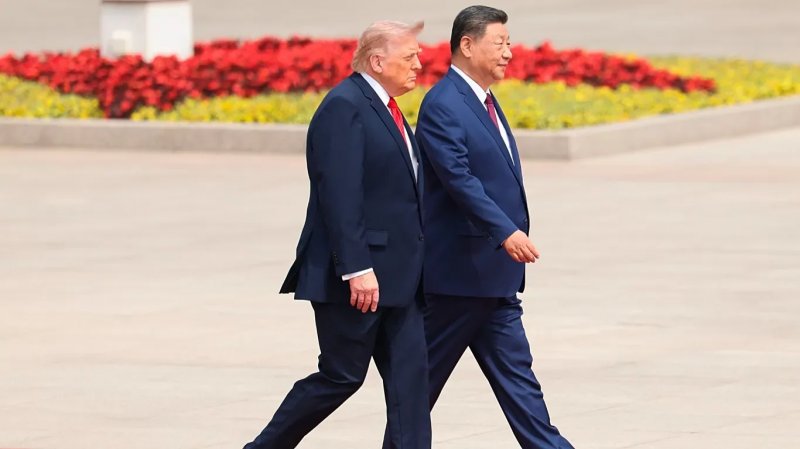
Europe is closely watching high-level talks between US President Donald Trump and Chinese President Xi Jinping in Beijing, amid growing concerns that major global decisions on trade, security and resources could be shaped without the European Union’s involvement.
The meeting between the two leaders, described as one of the most consequential of 2026, focused on issues including trade, security, the Iran conflict and Taiwan. Xi Jinping warned about the risk of great power rivalry escalating into conflict and raised the idea of avoiding a “Thucydides Trap,” while Trump described the encounter as an honour and emphasised the strength of both nations as global superpowers, News.Az reports, citing Euro News.
European officials and analysts expressed concern that Europe could be left on the sidelines of any potential US-China agreements. Observers warned that a bilateral deal between Washington and Beijing could have significant consequences for the EU, particularly if European interests are not included.
RECOMMENDED STORIES
- EU risks losing global influence without united voice, MEP warns amid Trump-Xi talks - VIDEO
- Europe watches nervously as Trump and Xi meet in Beijing over trade and global power shift - VIDEO
- Latvia PM Evika Silina announces resignation
- EU pushes urgent ban on ‘torture-like’ conversion therapies across Europe - VIDEO
One key issue highlighted is rare earth materials, which are essential for modern technologies. China’s dominance in global supply chains, including control over critical battery and mineral processing, has raised concerns in Europe and the United States about strategic dependence and supply vulnerability.
Experts cited in the report said that Trump’s negotiations could become increasingly bilateral, with limited consideration for third parties, including Europe. Some warned that Europe’s lack of a unified voice could weaken its position in global negotiations.
European lawmakers also stressed that the EU must strengthen its strategic autonomy, warning that China’s approach to international relations often involves dividing partners and increasing influence through economic leverage.
At the same time, internal EU debates continue over dependence on Chinese clean energy supply chains, particularly in battery storage systems, where Chinese companies hold a dominant global share. Analysts say reducing this dependence is possible but unlikely to be achieved quickly due to deep integration in global production networks.
The article also notes broader EU political developments, including efforts by the European Commission to address funding challenges with Hungary and ongoing discussions about rule-of-law conditions tied to EU financial support.
Separately, EU officials reiterated calls to end so-called conversion practices targeting LGBTQI+ individuals, describing them as abusive and harmful. The Commission is expected to present non-binding recommendations next year, although a bloc-wide ban remains unlikely due to lack of unanimity among member states.
Officials said the EU prefers to focus on awareness and cooperation rather than lengthy legislative battles, as existing equality legislation has remained stalled for years.
By Leyla Şirinova