What lies behind Putin’s new remarks on Azerbaijan


Editor’s note: Seymur Mammadov is a special commentator for News.Az and the director of the international expert club EurAsiaAz. The article reflects the author’s personal opinion and does not necessarily represent the views of News.Az.
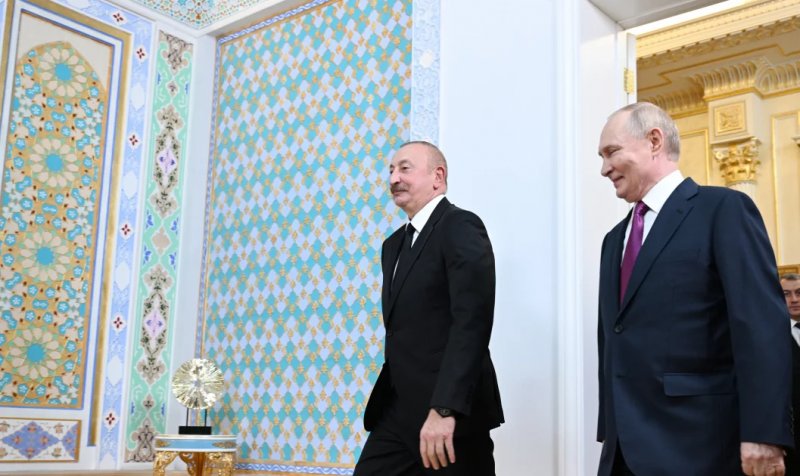
Russian President Vladimir Putin’s remarks on relations with Azerbaijan, delivered on the sidelines of the St. Petersburg International Economic Forum, became one of Moscow’s most notable regional signals. The Russian leader not only offered an emphatically positive assessment of bilateral ties but also revealed that the two countries are holding talks on specific areas of cooperation, primarily in the energy sector, and announced a forthcoming meeting with Azerbaijani President Ilham Aliyev.
Putin spoke about Azerbaijan on June 4, 2026, during his traditional meeting with the heads of leading international news agencies at the Konstantinovsky Palace. Responding to a question from Vugar Aliyev, Chairman of the Board of AZERTAC, the Russian president described bilateral relations in distinctly positive terms.
RECOMMENDED STORIES
“We have good relations with Azerbaijan. They have always been good and remain so, both in the economy and in the political sphere,” Putin said.
He placed particular emphasis on the role of President Ilham Aliyev, noting his efforts to give practical substance to the agreements on strategic cooperation between the two countries. Putin was referring to the Declaration on Allied Interaction signed by the two leaders in Moscow on February 22, 2022. The document covers a broad range of areas, including political dialogue, security, trade, energy, transport and humanitarian cooperation. Putin’s reference to this framework is significant. Moscow is thereby signalling that it continues to view relations with Baku not as a collection of separate economic contacts, but as a structured interstate partnership. This is particularly important against the backdrop of complex regional developments, growing competition over transport routes and the continued transformation of the economic architecture of Eurasia.
The most intriguing part of the Russian leader’s remarks concerned energy. Putin said that Russia and Azerbaijan were conducting negotiations “across a whole range of specific areas,” although he considered it premature to disclose the details.
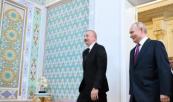
“This primarily concerns energy. We will meet with President Aliyev and will certainly discuss all of this,” he said.
 Source: AZERTAC
Such wording suggests that the two sides are discussing not merely general prospects for cooperation, but practical projects that may require political approval at the highest level. At the same time, no exact date has yet been announced for the upcoming meeting between Aliyev and Putin.
Energy dialogue between Azerbaijan and Russia is multilayered. Both countries are major producers and exporters of hydrocarbons, yet their interests are not limited to competition. Baku and Moscow cooperate in the oil and gas sector, electricity, energy exchanges and regional infrastructure. Russian companies operate in the Azerbaijani market, while SOCAR has longstanding experience of working with Russian partners.
Potential new agreements could relate to energy supplies and swap operations, the processing of raw materials, the use of energy infrastructure or the balancing of regional markets. However, until official information is released, any more specific assumptions should be regarded solely as possible scenarios. Putin deliberately refrained from disclosing details, which may indicate both the sensitivity of the negotiations and the fact that final decisions have not yet been reached.
A substantial part of the Russian president’s response focused on economic relations. Putin said that bilateral trade was growing and that additional opportunities were emerging for mutual supplies. The latest full-year figures indeed confirm the long-term expansion of trade.
According to Azerbaijan’s State Customs Committee, trade turnover between Azerbaijan and Russia reached $4.92 billion in 2025, an increase of 2.5% compared with $4.799 billion in 2024. Russia remained among Azerbaijan’s three largest trading partners, behind only Italy and Türkiye. The Russian market accounted for nearly 10% of Azerbaijan’s total foreign trade.
Azerbaijani exports to Russia reached $1.184 billion in 2025, rising by 0.5%. Imports of Russian goods increased by 3.2% to $3.736 billion. Bilateral trade therefore continues to show a significant imbalance in favour of Russian supplies. For every dollar of Azerbaijani exports to Russia, more than three dollars’ worth of goods were imported from Russia.
It should be noted that Russian and Azerbaijani sources sometimes publish differing estimates of bilateral trade turnover. Russian officials have cited a figure of around 342 billion rubles, or approximately $4.1 billion based on the exchange rate used in the calculations.
The discrepancy may be explained by differences in customs methodology, currency conversion, the timing of recorded transactions and variations between the two countries’ statistical systems. From Azerbaijan’s perspective, the State Customs Committee’s figure of $4.92 billion remains the most consistent benchmark.
At the same time, statistics for the beginning of 2026 present a less straightforward picture than the generally positive tone of Putin’s remarks. In January-March, bilateral trade amounted to $746.8 million, almost 1.9 times lower than during the same period of the previous year. Azerbaijani exports to Russia declined by 4.7% to $223.8 million, while imports of Russian goods stood at approximately $523 million.
Russia ranked fourth among Azerbaijan’s foreign trade partners, but it continued to play a leading role in the country’s non-oil trade. In the first quarter, the Russian market accounted for around a quarter of Azerbaijan’s non-oil exports. This means that Russia’s importance to the Azerbaijani economy is determined not only by the overall volume of trade, but also by its role as a major market for agricultural and other non-oil products.
The decline in turnover at the beginning of 2026 was largely linked to a high comparison base. In the opening months of 2025, imports from Russia had recorded exceptionally rapid growth. It is therefore too early to interpret the current correction as a sustainable reversal in bilateral trade. The results of the coming quarters will show whether turnover can return to an upward trajectory.
Agricultural cooperation occupies a particularly important place in bilateral relations. Russia remains the principal market for Azerbaijani vegetables, fruit and other agricultural products. In 2025, Azerbaijan supplied around 700,600 tonnes of fruit and vegetable products to Russia, 17.8% more than a year earlier. These exports matter not only for overall trade statistics but also for thousands of Azerbaijani farmers, producers, logistics companies and exporters.
Russia, in turn, supplies Azerbaijan with grain, food products, metals, timber, machinery, equipment, chemicals and industrial goods. This structure gives bilateral trade a degree of resilience, as it is based not on a single commodity but on a broad system of production and consumer links.
The use of national currencies is also expanding. According to figures presented in April at a meeting of the intergovernmental commission, the Russian ruble accounted for 42% of settlements for Azerbaijani exports and 83% of payments for imports from Russia. This reduces dependence on third-country currencies and simplifies transactions amid a changing international financial environment.
Putin also identified logistics as an important area of cooperation. Azerbaijan occupies a strategic position between Russia, Iran, Türkiye, Central Asia and the Caspian Sea. Transport routes crossing its territory can connect the Russian market with the Persian Gulf, South Asia and the Middle East.
 Source: AZERTAC
The International North-South Transport Corridor remains the key project in this regard. Its western branch runs through Russia and Azerbaijan toward Iran. The corridor’s full-scale operation requires the completion of missing infrastructure sections, the modernisation of railways and border crossings, and the improvement of customs procedures. For Russia, the route represents an alternative gateway to southern markets, while for Azerbaijan it offers an opportunity to strengthen its position as one of Eurasia’s principal transport hubs.
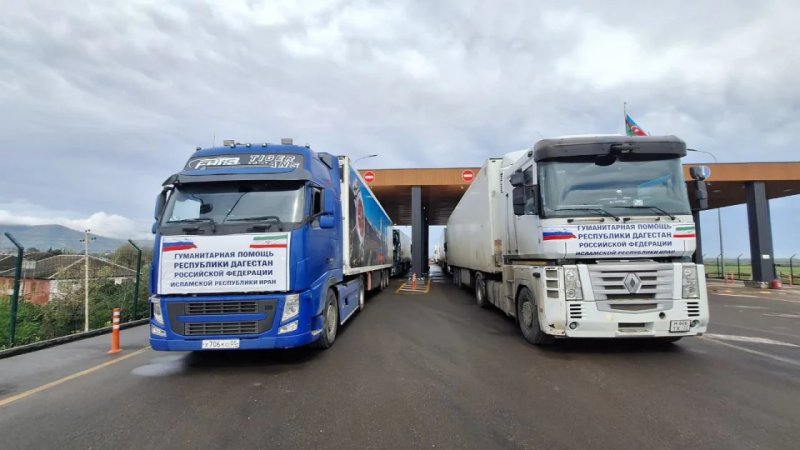
Putin also thanked President Ilham Aliyev for assisting with the delivery of Russian humanitarian aid to Iran. Amid instability surrounding Iran, Azerbaijan once again demonstrated the importance of its geographical position as a transit state and practical partner. This episode shows that cooperation between Moscow and Baku extends beyond commercial interests and encompasses regional logistics and crisis response.
The humanitarian dimension of the relationship should not be underestimated either. A large Azerbaijani community lives in Russia, while the Russian language remains widely used in Azerbaijan. Educational, cultural and social ties between the two countries have developed over decades. Putin specifically mentioned close cooperation in the humanitarian field, thereby identifying it as another pillar of bilateral dialogue.
The Russian president’s remarks can be seen as an attempt by Moscow to underline the resilience of its ties with Baku and to shift attention toward practical projects. The formula of “good relations” was supplemented with concrete areas of cooperation: trade, energy, logistics, humanitarian links and preparations for a new meeting between the two leaders.
At the same time, current statistics require a cautious assessment. Record-high annual figures coexist with a decline in trade during the first quarter of 2026. The next meeting between Aliyev and Putin may therefore become not only a political event, but also an opportunity to identify new drivers of growth, remove trade barriers and present the energy agreements that the Russian leader has so far preferred not to discuss publicly.
The main signal from St. Petersburg is that Moscow views Azerbaijan as an independent and important partner capable of playing a significant role in the region’s energy, transport and political architecture. Baku, for its part, continues to pursue a pragmatic and multidirectional foreign policy, developing relations with Russia without abandoning cooperation with Türkiye, Europe, China, Central Asia and other centres of power.
The key question now is what concrete substance will be given to the negotiations announced by Putin. The answer is likely to emerge after the next meeting between the presidents of Azerbaijan and Russia.
(If you possess specialized knowledge and wish to contribute, please reach out to us at opinions@news.az).


Similar news