FP-5 Flamingo cruise missile showcased at Turkish exhibition


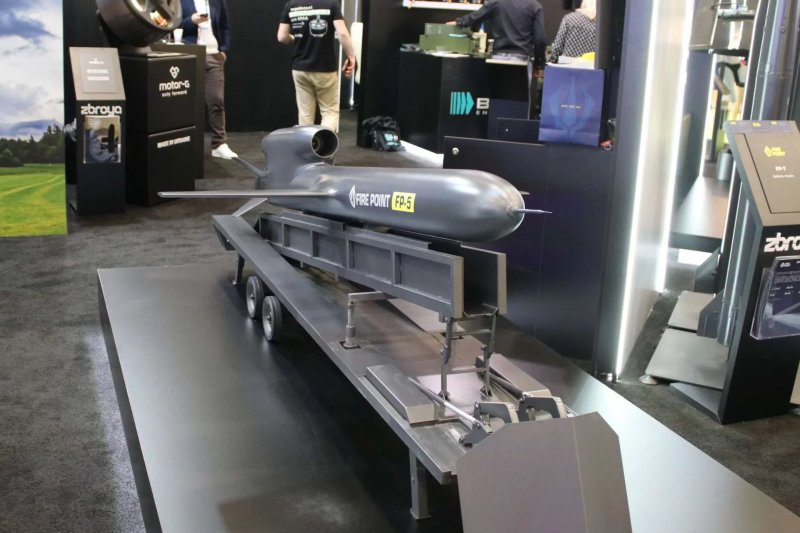
At SAHA Expo 2026 in Istanbul, Ukraine’s Fire Point showcased the FP-5 “Flamingo,” a combat-developed deep-strike system, on one of NATO’s largest defense industry platforms.
With a claimed 3,000 km range, heavy warhead capacity and road-mobile launch concept, the system highlights how Ukraine is turning wartime innovation into a potential long-range strike option for NATO operations across the Black Sea and Eastern Europe, News.Az reports, citing Army Recognition.
RECOMMENDED STORIES
The FP-5 is designed to combine long reach, large payload capacity and dispersed launch mobility, allowing strike units to operate without relying on aircraft, warships or fixed infrastructure. Its truck-based launcher and ability to operate under electronic warfare pressure reflect a broader shift toward survivable, lower-cost deep-strike systems that can threaten command nodes, air bases, logistics hubs and defense-industrial targets far behind the front line.
Ukraine’s Fire Point presented a scaled mockup of its FP-5 “Flamingo” ground-launched drone and cruise missile system at SAHA Expo 2026 in Istanbul, Türkiye. The presentation placed a Ukrainian long-range strike weapon concept inside one of the main defense-industrial platforms of a NATO member state and Black Sea power. With its claimed 3,000 km reach, heavy payload and road-mobile launch concept, Flamingo sends a clear message from Ukraine to Türkiye, NATO and the United States: combat-driven innovation can offer new solutions for deep precision strike in contested theaters.
SAHA Expo 2026, held from May 5 to 9 at the Istanbul Expo Center, is organized by SAHA Istanbul, described by the event as Türkiye’s and Europe’s largest industrial cluster, with more than 1,700 exhibitors from over 120 countries across land, naval, air, space, unmanned systems and disruptive innovation sectors. Fire Point describes its work as focused on cost-effective, combat-proven UAV systems, cruise missiles and ballistic missiles, supported by in-house production and direct feedback from the combat zone.
Company reports indicate that the FP-5 Flamingo is designed as a modern ground-launched UAV system and cruise missile intended to deliver a combat payload of up to 1,150 kg against enemy ground targets with fixed topographical coordinates. The system is credited with an operating range of up to 3,000 km, a flight altitude envelope from 20 m to 10 km, a maximum flight time of four hours, a 7 m wingspan, jet start and ground launch, a maximum speed of 950 km/h and a cruise speed between 650 and 700 km/h. It is also described with a maximum takeoff weight of 6,000 kg and a launch preparation cycle of 20 to 40 minutes, while its operating concept includes day-and-night employment in environments affected by active radio-electronic interference.
The FP-5’s main operational value lies in the combination of range, payload, launcher simplicity and concealment. Fire Point’s concept does not depend on expensive aircraft, surface ships or submarines to generate long-range effects. Its towable launcher reduces the infrastructure burden, while transport disguised as a regular truck can complicate enemy reconnaissance, targeting and preemptive strike planning. This road-mobile architecture gives the system a distributed strike profile, allowing launch units to move, hide, prepare and fire from dispersed positions before relocating. In modern warfare, where satellite surveillance, drones, electronic intelligence and long-range fires compress the sensor-to-shooter cycle, this mobility and visual deception can increase survivability.
Compared with classic Western deep-strike assets such as Tomahawk, Storm Shadow/SCALP, Taurus or ATACMS, Flamingo appears to answer a different battlefield requirement. It is not only a precision weapon for limited high-end use, but a heavy-payload, land-based and potentially scalable strike system designed around wartime production logic. Western missiles remain central to NATO strike doctrine because of their maturity, integration, navigation architecture and platform compatibility, but many of them are tied to limited inventories, strict release conditions and launch platforms that may not always be available in a fast-moving crisis. Flamingo’s concept offers another path: a lower-cost, ground-launched deep-strike asset able to threaten fixed military infrastructure, air bases, radar sites, ammunition depots, bridge nodes, command posts, energy facilities supporting military production and logistics corridors far beyond the front line.
Ukraine’s operational use of Flamingo gives the system added credibility beyond the exhibition hall. Public reporting on May 5, 2026, stated that President Volodymyr Zelensky confirmed the use of Flamingo missiles in a deep strike on a Russian military plant in Cheboksary, more than 1,500 km from Ukraine. The targeted facility was described as linked to components used in Russian Shahed-type drones, Iskander-K cruise missiles and guided aerial bomb modules. This use illustrates how Ukraine is moving pressure into Russia’s defense-industrial depth, targeting the production chains that sustain drone, missile and glide-bomb attacks rather than limiting its campaign to tactical targets near the front.
For Türkiye, the display of the FP-5 mockup in Istanbul carries a message that goes beyond a foreign exhibitor presenting a new weapon. Türkiye has become one of NATO’s central hubs for unmanned systems, missile technologies, naval modernization, tactical vehicles and defense exports, while its Black Sea position gives it direct visibility over the military balance shaped by Russia’s war against Ukraine. By offering the stage for a Ukrainian long-range strike system, SAHA Expo 2026 underlines Türkiye’s role as an industrial and diplomatic connector between combat-proven Ukrainian innovation and allied capability planning. Turkish industry could, in theory, offer experience in mobile launchers, vehicle integration, mission software, datalinks, electronic warfare resilience, propulsion interfaces, production scaling and export-oriented configuration, creating a possible framework for future cooperation without reducing Ukraine’s ownership of the system.
For NATO and the United States, Flamingo points toward an operational solution now being discussed more openly across the Alliance: how to generate deep effects at scale without relying only on manned aircraft or limited premium missile stocks. NATO’s Deep Precision Strike Drone project, launched as a High Visibility Project, is intended to help participating Allies develop drone-based deep precision strike capabilities more efficiently and explore new acquisition mechanisms involving non-traditional defense companies. Türkiye is listed among the participating Allies, alongside Denmark, Estonia, Lithuania, the Netherlands and Poland, which places Ankara directly inside the Alliance’s search for new long-range strike models.
By Ulviyya Salmanli


Similar news