How Ukraine is overcoming energy crisis caused by Russian strikes


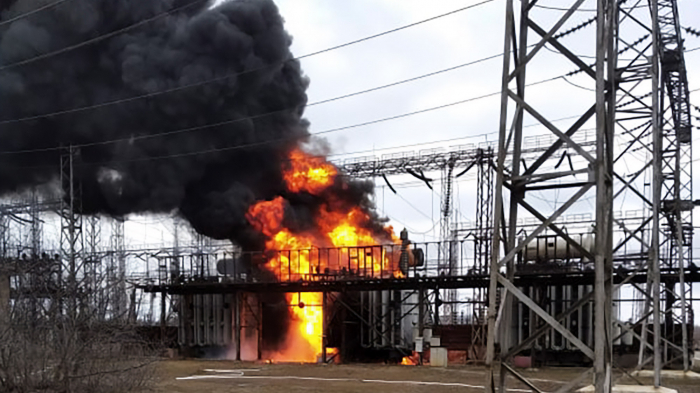
Since the beginning of Russia's large-scale invasion of Ukraine, the country's energy sector has suffered enormous losses. This has created a serious threat not only to the stability of Ukraine's energy supply but also to the entire region as a whole.
According to The Financial Times , Ukraine has lost more than half of its energy production capacity, resulting in a reduction in power generation from 55 to 20 gigawatts. Fighting and bombardments by Russia have inflicted significant damage on Ukrainian energy infrastructure: nuclear, thermal, and hydroelectric power plants, including manufacturing facilities, have become targets for raids and missile strikes. Ukraine's President Volodymyr Zelensky has noted that the attacks have destroyed 9 gigawatts of energy, which is a significant portion of the country's total production capacity.The direct losses of Ukraine's energy sector from the destruction of generators and electricity transmission infrastructure are estimated at more than $16 billion. Indirect losses related to the revenue losses of energy companies are estimated at approximately $40 billion. An additional $1.5 billion will be required to repair damaged facilities and prepare for winter.
According to the Kyiv School of Economics , direct losses in the energy sector amount to more than $16.1 billion, and losses in the oil and gas infrastructure exceed $3.3 billion. Indirect losses are estimated at approximately $40.1 billion, most of which are due to revenue losses of energy companies ($39.6 billion), with the rest associated with the costs of clearing destruction and dismantling damaged facilities ($0.5 billion).
The reduction in energy production has led to frequent planned power outages across Ukraine, creating serious problems for both local consumers and industrial enterprises dependent on reliable energy supply. On June 11, President Volodymyr Zelensky stated that approximately 80% of thermal energy production and a third of hydroenergy production in the country had been destroyed. He also noted that the country recently lost 9 GW of capacity. Earlier, Prime Minister Shmyhal reported that 62 power units at hydro and thermal power stations in Ukraine, including 20 hydro units not generating 1.3 GW of electricity, had been knocked out of service.
In early May, due to power shortages at industrial sites, restrictions were introduced, and citizens were urged not to use high-energy-consuming appliances during peak hours. However, these measures proved insufficient: soon, schedules for regular power outages for domestic consumers began to be compiled across the country.
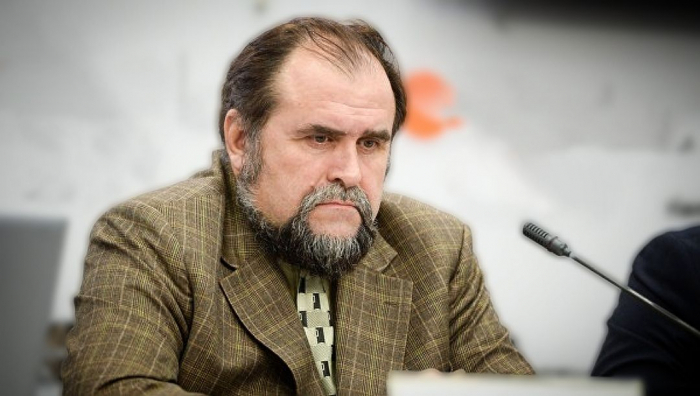
Ukrainian political scientist Alexander Okhrimenko told News.Az that the main producers of electricity in Ukraine are thermal power plants (TPPs) and nuclear power plants (NPPs), with hydroelectric power stations accounting for only 1%. According to him, even if the Dnipro HPP did not exist, it would not significantly affect the situation. "The main producer in Ukraine is the NPPs, followed by the TPPs. Unfortunately, Russian missiles have destroyed all major thermal stations. As a result, 80% of thermal energy has been destroyed, and this was done deliberately. Therefore, we have started to make other maneuvers. What does this mean? Now in Ukraine, small mini-TPPs are being installed very quickly. Interestingly, they produce more electricity than the old large ones. According to President Zelensky, by the end of 2024, the country plans to build up to 1 GW of capacity, and in the coming years - up to 4 GW. In general, in the coming years, Ukraine will not only overcome the losses in power generation thanks to alternative and maneuverable energy but will also begin to export electricity to other countries," he said.
The political scientist noted that Ukraine is now actively developing solar and wind energy. Currently, 30% of the energy demand is met by solar energy. "Unfortunately, there are regular power outages at night in Ukraine because there is no sun at night, and there is a deficit of electricity. But now our main problem is the TPPs. As I mentioned, small and new TPPs are being installed. Moreover, they try to place them so that Russian aircraft does not even know what it is," he noted.
Currently, significant work is being carried out in Ukraine to create an energy system, the political scientist added. Many enterprises have started producing their energy and installing equipment for biofuel production, allowing them not to depend on the general power grid. "But there are still power outages. There have even been seven-hour outages. Recently, the outages lasted two hours, and this is thanks to the small TPPs. In Kharkiv, the TPP was completely destroyed, but now small thermal power stations have been restored in Kharkiv, which will simultaneously provide electricity and heat in the winter period," he said.
Regarding assistance from the European Union, the political scientist said, "So far, the EU has primarily provided us with some energy equipment for free. Some was provided on loan, but it was provided. Now the EU promises that in the future, Ukraine will be able to obtain enough loans to purchase energy equipment. Ukraine is rapidly increasing the capacities of NPPs to produce up to 80% of its nuclear energy. The war is forcing Ukraine to make full-scale changes in the energy system. We are updating old systems where there were significant energy losses. The so-called mini-TPPs are more rational and their efficiency is significantly higher than that of Soviet TPPs. Ukraine is seeking international support to restore its energy infrastructure. This support is not only financial but also technical assistance for the rapid restoration of critically important facilities before the onset of winter," the expert pointed out.
The importance and safety of the Zaporizhzhia Nuclear Power Plant (ZNPP) remain a focus of attention for both Ukraine and the international community. Its fate and safety are critically important not only for the energy stability of Ukraine but also for the safety of the entire region. The international community continues to monitor the situation and supports efforts to regain control of the station in accordance with international safety standards and nuclear energy norms.


Similar news