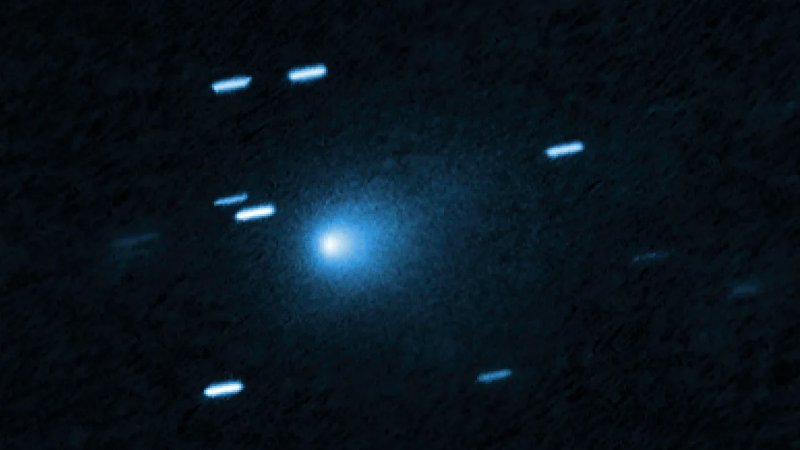
From Italy’s Virtual Telescope Project to backyard telescopes across the Americas and Asia, observers are tracking the rapidly brightening object during its new observation window, opening just 33 days before its closest approach to Earth on December 19, News.Az reports, citing USA Herald.
Scientists say this period will provide the final, conclusive data to determine whether 3I/ATLAS is a natural comet or something far more unusual. Observations follow a series of anomalies that have intensified since the object’s perihelion.
Contrary to expectations that activity would calm as it moved away from the Sun, 3I/ATLAS has become increasingly erratic. Its jets have sharpened, brightness has surged, and its behavior shows no natural precedent, leaving even veteran astronomers without a clear template for comparison.
This observation window represents a critical moment for space science, as researchers worldwide aim to unravel the mysteries of this unprecedented interstellar visitor.
The European Space Agency, NASA’s planetary-defense monitors, university observatories, and amateur networks are now aligned on a single goal: gather fresh, unfiltered imaging while the object is still close enough and bright enough to reveal its true nature.
The Virtual Telescope Project will lead tonight’s effort with a livestream beginning at 11:15 p.m. ET from Manciano, Italy, giving the public a rare instant-access view of an interstellar visitor under active scrutiny.
The object continues to exhibit confirmed non-gravitational acceleration—an unmistakable sign that something besides gravity is pushing it. Harvard astrophysicist Avi Loeb has identified two components to this acceleration: a radial push outward from the Sun and a transverse slide across its orbital track, forming a pattern that classical cometary physics fails to reproduce.
Natural outgassing is the standard fallback explanation, but that theory now carries a major burden of proof. If this were simply gas venting from volatile ices, we should be witnessing a massive plume—roughly ten percent of the object’s mass—streaming off in a visible arc. But the window for that evidence is closing fast, and so far nothing like that has been confirmed.
In fact, the opposite seems to be happening. Rather than fading after perihelion, 3I/ATLAS has brightened again—sharply—following a curve that scales inversely with the seventh power of its distance from the Sun.
Nothing in the historical record of comets shows this behavior. Its color has remained distinctly blue, not the typical dusty red scattered by comet grains. Ionized carbon monoxide is one proposed explanation, yet it does not fully account for the jet structure patterns now appearing in high-contrast images from the Nordic Optical Telescope and other facilities.
Some jets point sunward—so-called anti-tails—the kind of geometry Loeb has publicly suggested could arise from controlled thrust or engineered emission rather than chaotic natural venting.
As of tonight, more than a hundred observatories will begin coordinated monitoring runs. Webb, Hubble, and ESA’s Juice spacecraft are expected to join the global campaign over the coming weeks.
Their combined data will give the world its most detailed look yet at the object’s thermal properties, rotation, jet behavior, plasma environment, and any signatures that resemble internal illumination or artificial propulsion. And in the background of this rapidly accelerating story remains a pressure point that has not eased: NASA has still failed to release the HiRISE images captured in early October during the government shutdown. Those images—now more than forty days old—could already offer clarity, yet the silence continues from both NASA Associate Administrator Sean Duffy and the White House.
What we learn between now and December 19 will decide whether 3I/ATLAS becomes the third known interstellar comet—or the first interstellar artifact. The observations beginning tonight will either validate natural explanations or push the conversation into territory rarely breached in mainstream astronomy.
Either way, the truth will come from data, not speculation. And because of the sheer number of instruments now converging on this object, we may finally get the clarity that has eluded scientists since the day 3I/ATLAS was first detected streaking in from deep space.
What happens next depends on what we observe tonight, tomorrow, and across the next month. Unusual acceleration patterns, missing gas plumes, inconsistent jet orientation, and the possibility of engineered reflectivity are no longer fringe topics—they are central scientific questions now being pursued by respected researchers.
As the closest-approach countdown continues, the stakes extend beyond astronomy. They touch public trust, government transparency, planetary-defense readiness, and humanity’s willingness to confront an answer it may not be prepared for.