NASA captures closest-ever photos of the Sun


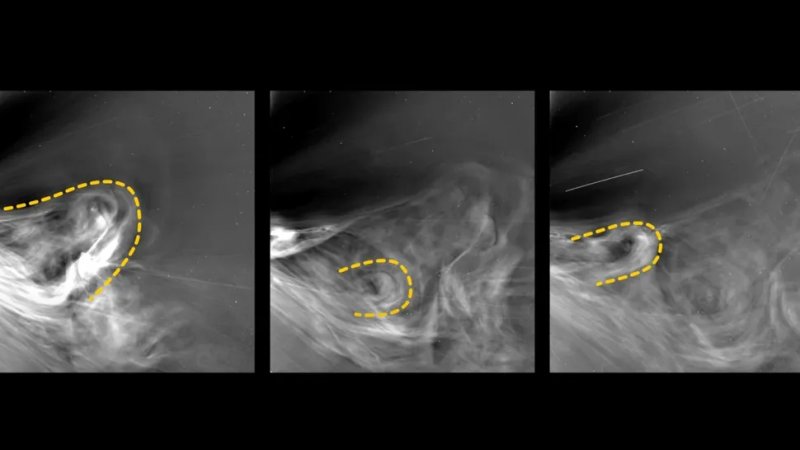
NASA has released the most detailed images of the Sun ever taken, courtesy of the Parker Solar Probe, which ventured just 3.8 million miles (6.1 million kilometers) from the Sun's surface.
These groundbreaking photos reveal crucial details about the solar wind, offering scientists new insights into the origins of this space weather phenomenon and its potential impacts on life here on Earth, News.Az reports, citing foreign media.
The solar wind is the constant stream of charged particles — mainly protons and electrons — released by the sun's outer atmosphere, known as the corona. This torrent of matter speeds through the solar system at more than a million miles an hour, combining with magnetic fields and material jettisoned from the sun to create auroras, strip planetary atmospheres, and generate electric currents that can interfere with power networks on Earth. Understanding and predicting this space weather is vital to protecting astronauts and spacecrafts, and minimizing the disruptions to infrastructure sometimes caused by strong solar activity.
Launched in 2018, the Parker Solar Probe is the first spacecraft to have entered the sun's corona. Equipped with an array of scientific instrumentation including the Wide Field Imager for Solar Probe (WISPR) and Solar Wind Electrons Alphas and Protons (SWEAP), the unmanned ship braves blistering heat and fierce radiation to provide researchers on Earth with detailed data about the sun and its close surroundings.
In its record-breaking flyby of the sun on December 24th last year, the Parker Solar Probe captured images showing how this wind behaves shortly after leaving the corona and, crucially, recorded collisions between unpredictable bubbles of plasma and magnetic fields called coronal mass ejections (CMEs).
"In these images, we're seeing the CMEs basically piling up on top of one another," said Angelos Vourlidas, the WISPR instrument scientist at the Johns Hopkins Applied Physics Laboratory in a press release. "We're using this to figure out how the CMEs merge together, which can be important for space weather."
There are two types of solar wind: fast solar wind travels at up to 800 kilometres per second, creating a relatively uniform torrent of matter. Meanwhile slow solar wind is denser and more unpredictable, blowing in gusts rather than a constant stream.
Around Earth we tend to experience solar winds as more of a consistent breeze. But earlier data from the Parker Solar Probe revealed that these gusts ramp up in intensity closer to the sun, with additional turbulence in the form of zigzagging magnetic fields called switchbacks at distances of 14.7 million miles (23.6 million km) from the surface. These switchbacks are thought to originate from magnetic funnels created by visible patches on the sun's exterior and, in 2024, scientists declared the fast solar wind is partially powered by this phenomenon.
However, the slow solar wind — its denser and more variable sibling — has remained more of a mystery.


Similar news