President Ilham Aliyev interviewed by local TV channels (UPDATED)


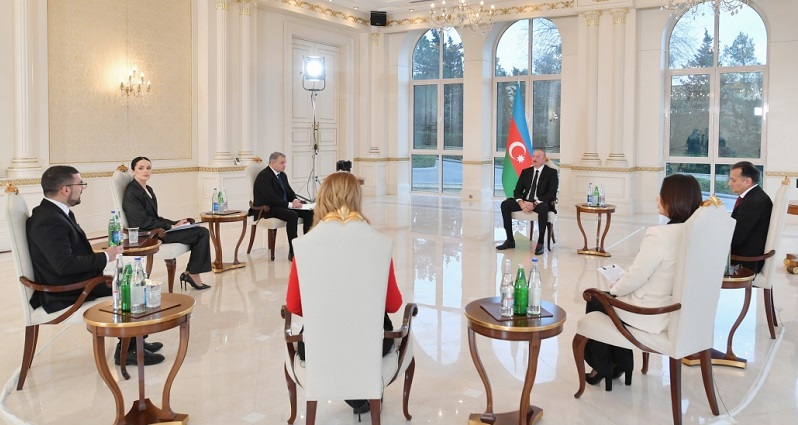
On January 10, President of the Republic of Azerbaijan Ilham Aliyev was interviewed by local TV channels.
News.Az presents the interview.
Rovshan Mammadov from Azerbaijan Television: Mr. President, good day. First of all, I would like to thank you very much on behalf of all of us for the interview. After the full restoration of our sovereignty, especially after the Khankendi Victory, each one of us wanted to have such a meeting and such an interview. Therefore, thank you for taking our wishes into account.
Mr. President, we are living through a new historical reality, a new historical stage. The biggest reality, as mentioned, is the complete liberation of Karabakh, the elimination of separatism and terrorism from Karabakh and, as you have said, discarding it into the dustbin of history. Of course, this reality is underpinned by strength, a principled approach, determination, resolve and your Iron Fist. That is why I would like to start my first question by reviewing the past 20 years of activity from the standpoint of today's realities. Today, if we look at the last 20 years of our Azerbaijan, which has fully restored its territorial integrity, Azerbaijan, which has fully restored its sovereignty, what kind of picture comes to life? What journey have we covered in these 20 years?
President Ilham Aliyev: The history of the last 20 years is obvious, and the key issue here is that the people of Azerbaijan made the right choice back in 2003. Because I believe that the year 2003 was the most crucial moment of our independent history. Because at that time, the conceptual approach to the future of our country had fully justified itself, i.e. Heydar Aliyev's policy was continued. If history had taken in a different turn, it is hard to say what misfortunes and tragedies our nation and state could have faced. In any case, the first two years of our independence explicitly show that in the absence of a strong leader and a thought-out policy, any country, particularly a newly independent one, may come across very serious dangers. In 2003, the policy laid down in 1993 was once again supported. I do believe that we should compare today's realities not with 2003, but with 1993, because it was then that Azerbaijan embarked on a path of development, stability set in, the civil war was stopped, and our country came out of international isolation. If we look at the developments of 1993-2003, we will see that it was in those years that the principles of the present-day statehood were established and civil society emerged in Azerbaijan. At the same time, the unity of the nation and the government became an important factor.
As far as the history of the last 20 years is concerned, everything is quite obvious. If we talk about that at length, we will probably have to dedicate the whole interview to it. I simply want to say that today's Azerbaijan is among the strongest countries of the world in the truest sense of the word. I believe that we can serve as an example for many countries both in the international world and in the region in terms of the correct choice of domestic policy priorities. This is not just my opinion, some of my colleagues have been quite open about it.
The new tasks facing the country today are the tasks of the new era. We resolved the key task, as you mentioned, a few months ago by fully restoring the sovereignty of our country, and the events of September, of course, should not be taken out of the overall context. In other words, the path we followed until September was a consistent path, a goal-oriented path, the right path. From the point of view of the processes unfolding in our country at the political or military level, this event was the exclamation mark, as it were, of all the work we had done. Today, we are entering 2024 as a nation that has fully restored its sovereignty. I believe that the new era of our modern history began exactly after September 20.
Mirshahin Aghayev from Real TV channel: Mr. President, on October 15, you raised the Azerbaijani flag in Khankendi, and it seems to me that it was not just your hand, it was also the hand of Great Leader Heydar Aliyev, it was also the hand of Panahali Khan, it was also the hand of the founding fathers of the Azerbaijan People's Republic, and all these hands were concentrated in yours. I left Khankendi almost 30 years ago – it was in 1991 – and I had an interview with Matvey Radaev. The interview was held in the “Orqkomitet”, which the separatists later turned into a residency. I was wondering what feeling you experienced at that moment. I will associate the answer to this question with the spirit of all the great people I mentioned.
President Ilham Aliyev: You know, when the people of Azerbaijan, all Azerbaijanis of the world saw those images, we all probably experienced the same feelings, including myself. My feelings were no different from those of all Azerbaijani citizens – pride and joy, of course. At the same time, I also thought that it was necessary to believe in justice. Because for 30 years, faith in justice in Azerbaijani society was somewhat undermined, and this is not good for any society. This inevitably has a negative impact on people's consciousness, may lead to despondence, and creates conditions for pessimism to spread in society. In other words, these factors are very dangerous for the emergence and strengthening of society, a healthy society. Therefore, there must be a reason to believe in justice. We should all know that justice does not come by itself and that you have to secure justice. In the modern world, we had long understood this. If you look at my speeches, perhaps for the last 10-15 years, I have repeatedly said that international law does not work. These mechanisms are deployed only for the weaker countries. Bigger states ignore them. For them, it is as if law is not law, international law is not law. Under such circumstances, countries that demand justice, and rightly so, must secure this justice themselves. Guided by this principle, we worked hard in recent years and restored justice ourselves. Therefore, it is also important from this point of view, because our faith in justice has been restored. In other words, we all saw that, yes, justice has prevailed, we have completed our just cause and restored justice ourselves.
Unfortunately, however, the key players of the international world did not share our opinion. On the contrary, they tried to blame us and to engage various pressure mechanisms against us. In other words, we achieved this justice by waging political and diplomatic war at the international level. Therefore, our Victory is even more important.
Also, the images you have just mentioned were coming before my eyes. The same square, the same city, but a completely different landscape. In that square, at the top of that square – I have to say that an Azerbaijani architect, if I am not mistaken, his name was Hasan Majidov, he was the author of the building called “Obkom” – we all witnessed the beginning of a very ugly game against Azerbaijan from that building, from that square. As a living witness to those events, you will also remember that the Special Committee established in Karabakh at the time had actually become a mechanism for alienating Karabakh from Azerbaijan. That Special Committee, the person who was in charge of it and other persons, all their steps and actions were aimed at separating Karabakh from Azerbaijan and annexing it to Armenia.
So, all these images went through my mind, and of course, the abundance of feelings I experienced does not allow me to say which particular one was dominant. Of course, when I raised the flag in Khojaly, I thought to myself – today we can say with complete certainty that the blood of Khojaly victims did not remain unavenged. The raising of the flag in Khojaly was therefore more emotional. I can say that quite frankly. And raising the flag in Khankendi was about complete restoration of justice and the final point in our Victory.
In other words, these are historic moments. We are all happy to live in this era, to be witnessing it. We participated in achieving this great Victory, everyone in their place, you are media representatives, myself as Supreme Commander-in-Chief, all categories of our population brought this Victory closer with their hard work. It had become a nationwide issue, a nationwide movement, and despite the efforts of many of our international partners, this topic was not forgotten for 30 years. They wanted to make us forget this. Under various pretexts – cooperation with Armenia, creation of contacts through various NGOs to prepare people and societies for peace – the aim was that the young generation growing up in Azerbaijan should grow up in a different spirit. But our goal was that the growing generation should be patriotic, never come to terms with this injustice, and if we are not lucky enough to restore this historical justice, the future generations should do it.
I have to mention another thing. Of course, we all wanted to restore our territorial integrity as soon as possible. However, from the point of view of history, 30 years is not such a long period of time. During this period, many proposals were put forward during the negotiations, and some might wonder why Azerbaijan was not accepting them. After all, based on these proposals, several districts would have been returned to Azerbaijan without any war, the former displaced persons would have returned to their homes, and at the same time, the situation would have been normalize. Why doesn’t Azerbaijan agree and come to terms with these proposals? Of course, the negotiations had their own strategy and tactics. Of course, we conducted the negotiations in a manner that minimized external pressure while achieving our goals. But the main thing for me was that this is a historical issue, it is a national issue, and it would be wrong to seek some seemingly favorable gains. We must solve the issue in a fundamental way, we must solve it once and for all, we must fully restore our territorial integrity and sovereignty.
There should not be a single nest of separatism anywhere in our country, and if our generation is not lucky enough to do that, we should raise such a young generation that would come and do it after 20 years, after 30 years, after 50 years. That was the main issue. Of course, we are all happy to have seen and experienced these historic days, and this historic Victory will remain forever in the history of the people and state of Azerbaijan.
Chinara Nurmammadova from ARB 24 TV channel: Mr. President, one of the most important events of the past year was the establishment of the “Lachin” border checkpoint. Immediately after that, pressure started to be exerted on Azerbaijan, accusations were made that “a humanitarian crisis is being created in Karabakh”. At that time, the flag of Azerbaijan had not yet been raised in Khankendi, the separatists were still active there, and the pressure was mounting. Currently, the situation has changed and completely new realities have emerged. What are the nuances we can talk about now? What risks did Azerbaijan consider when establishing the border checkpoint?
President Ilham Aliyev: You know, after the signing of the November 10 trilateral statement, we had to ponder about our future steps. Because November 10 was also a point in time, and I could not say exactly on November 8 how the war would end, i.e. I could not say with complete certainty. Of course, I knew that it would result in our Victory, but it was impossible to say on November 8 how and when that would be the case. Because on November 8, of course, a major event happened – Shusha was liberated from occupation and the resistance of separatists became meaningless from a strategic point of view. Of course, had the war continued, it would have been very difficult to liberate the Kalbajar and Lachin districts, especially in the winter season. However, we would have done that too. But our losses could have been extremely high, even higher than in the 44-day war. We all knew that well, because even now anyone going there to those regions can see how difficult the terrain is. However, if Armenia had not signed the act of capitulation, we would have continued the war until the end.
Therefore, after November 8, the next day, from morning to evening, until night, was dedicated to talks between Azerbaijan and Armenia through with the President of Russia. I think that the adoption of the Trilateral Statement, its adoption under those conditions was a huge political success for us. Of course, if Shusha had not been liberated from the occupation, we could not have included those conditions in that statement. In other words, our Victory and our strength allowed us the opportunity to introduce conditions that were not related to this issue, especially regarding the Zangezur corridor.
However, a certain vacuum emerged after November 10. No one knew what would happen next. The co-chairs of the Minsk Group, who were still there at the time, did not have an idea what they were going to do. There were some visits. The situation in Armenia was, of course, unambiguous. The people of Azerbaijan were celebrating, but I knew that this was not the end of the matter. Because there are a number of unfinished issues and they had to be clarified, first of all, the issue related to former Lachin corridor.
After a certain period, especially when we saw that Armenia was sending weapons and mines to Karabakh and carrying out rotation of military units through this road, we started to raise the issue that we should exercise control over it. Unfortunately, the Russian side did not take a positive approach to that at the time. However, we continued our efforts. I can say for sure that we appealed to the Russian side at the highest level for a long time, five times, urging them to let us control this road together. Because it turns out that you don't have full control over it. As you probably remember, the manufacture date of the mines that were discovered there also raised huge questions. How could the mines produced in Armenia in 2021 have been brought there? In other words, these mines were brought through that Lachin-Khankendi road. This was why we raised the issue – let's stand at a joint checkpoint together and strengthen control. At the same time, the critical approach to the Russian peacekeeping forces would also subside because we will share the responsibility with you. Unfortunately, the suggestion was not accepted. Finally, on April 23, we had no choice and were not going to wait any longer. We settled on the bridge over the Hakari River in a matter of a few hours. Of course, preparations had been made, and despite all the effort, we did not move anywhere from there.
So, it became no longer possible to illegally transport weapons, ammunition, mines and manpower to Karabakh. However, despite this, we did not create any obstacles to humanitarian movement. We all remember very well that patients were evacuated and transported under the auspices of the Red Cross. After some time, the Armenians living in Karabakh started to use that road and experienced no problems at all. Their cars were simply inspected. They traveled in their own cars. The Azerbaijani border guards were very attentive and were instructed not to show any disrespect to civilians. However, military provocation was committed after that. Our post came under fire and, of course, we shut down the road temporarily to conduct an investigation but then reopened it. You probably remember what happened after that, so, I don't want to say too much about it. The leftovers of the Armenian state and some local separatists actually deprived themselves of humanitarian aid.
In other words, the events of April 23 are very important. At that time and after that, I said that our territorial integrity was fully restored on April 23. We began to control all the borders and once again showed that we are the owners of these lands. Until April 23, we demonstrated several times to Armenia and local separatists that this is our land. The “Farrukh” operation, the “Saribaba-Girkhgiz” operation, the “Revenge” operation were all important military operations we carried out. As a result of these operations, the strategic hills and heights of the Karabakh region, which were not under our control at the time, were regained, and this was of great importance in the September 19-20 operation. So, those operations were not spontaneous, they were goal-oriented operations. Because during the war, especially if we consider our terrain, the main issue is about who controls the heights, and the main reason for the fact that the September 19-20 operation was completed in a short period of time is precisely the operations I mentioned above and, of course, the control of the Azerbaijan-Armenia border in the direction of Lachin. Because the separatists were already deprived of these opportunities to have weapons.
Fikrat Dolukhanov from Public TV channel: Mr. President, what factors preconditioned the local anti-terror operation that led to the full restoration of Azerbaijan's sovereignty and, as you mentioned, the administration of historical justice in September 2023? Was it possible to get by without using force? And why did Armenia, the Armenian separatists rely on by failing to properly evaluate your repeated suggestions and warnings?
President Ilham Aliyev: They probably did not expect that this operation would take place. Apparently, someone had convinced them that they would be able to operate there within their so-called entity, within that separatist entity until the end. However, all the messages we sent to them were clear and unequivocal. I should also note that after the Second Karabakh War, some of the local Armenians contacted our representatives and made suggestions about contacts, and we did not reject that. Because our goal ultimate was to fully restore sovereignty and convince the population living here that they can live comfortably and safely within a single state of Azerbaijan. Our intention was quite open and clear, and some positive steps were taken during those contacts. In other words, the determination and construction of the new route of the Lachin-Khankendi road was a very important event and somewhat laid the foundation for the events of April 23. Because we built a new road and returned the city of Lachin to ourselves. I should also say that after the road was ready at the beginning of August, we sent a message to the command of the Russian peacekeeping forces that we were accessing the road on August 5 and taking Lachin under our control. So, it was a notification. It was not a request, it was a notification. After that, as you know, local Armenians asked for some time, until August 25. We agreed and entered Lachin on August 26. So, all this is part of the journey to the events of September.
There were other positive things, including the fact that houses in the village of Zabukh were not set on fire. However, I can tell you that we knocked down all the houses built by the Armenians, and citizens of Azerbaijan moved to Zabukh live in houses built by Azerbaijan. But that was an indicator in itself. And we welcomed that. This was a somewhat normal step after the atrocities in Kalbajar and Lachin when houses were burned and trees cut down. In other words, all these positive events gave us reason to believe that we will restore our sovereignty without bloodshed and without any operations. The Armenians of Karabakh have been told many times that this is your only option: whoever wants to stay here will live as an Azerbaijani citizen, and whoever doesn't can go to Armenia and elsewhere. Even during the meeting with former IDPs in Lachin, on May 28, I openly said that they have one option: to dissolve the illegal entity, surrender and obey to us. I said this openly. I am completely sincere in this and all other issues, in all my speeches, and I think that the Armenian side already knows this. We do what we say and we mean it. However, it seems that other messages were given to them as well. Of course, international actors also played a very negative role here. Sending some reassuring messages to Armenia and the separatists made them think that they did nothing in this situation.
I must also note that when the Second Karabakh War ended, an informal agreement was reached between the leaders of Russia, Armenia and Azerbaijan that nothing would be changed, i.e. everything will remain as it was. Of course, holding illegal elections there was also a violation of this agreement. As you know, those illegal elections were held there on September 9, and that was the second red line crossed. The first red line was crossed when the Armenian Prime Minister Pashinyan send a congratulatory letter to the separatist regime on September 2. It was both a crossing of the red line and, in general, a very controversial step. Because prior to that, the prime minister of Armenia had officially recognized Karabakh as part of Azerbaijan and declared it many times. Then what is this congratulation letter about. So, after September 9, of course, there was no other option left, especially if we take into account that mine terror against us was being continued and several of our soldiers fell victim to landmine terror on the eve of those events.
The anti-terror operation was conducted very successfully and professionally, our soldiers showed tremendous heroism. It is said that the operation took 23 hours and several minutes, but it was actually completed in less time. We advanced to all the intended positions, took control over all the communications, took over all the heights, and the surrender of the separatists was actually inevitable. If they had not surrendered, they would have been killed. There was no other option. According to the information we have, about 15,000 soldiers were serving in the military units there. They surrendered sooner. After that, there were just negotiations, and more precisely, they were just discussing our conditions. However, whatever conditions we put forward were met, including the dissolution of the separatist entity and all others. We said that if you surrender, we will stop the operation. Our goal was not to destroy the Armenian army there, but to ensure that the Armenian army withdraws from there, and we made this clear many times. We were asked if they would be guaranteed safety if they put down arms. Of course, we were not going to impose any sanctions on innocent soldiers. However, our position regarding the leaders of the separatists was unequivocal – their capture. Some of them tried to escape from there through the Lachin road, others were found in Khankendi, and other still were captured in other places. We knew their whereabouts. In general, I can say that we were fully aware of what was happening in Karabakh after the Second Karabakh War. We were monitoring the situation both visually and operationally. We were trying to convey this to Armenia that it is under our control and we can conduct an operation at any moment. I told both the Armenian leadership and international actors that I could press the button and carry out this operation in a minute and they would not be able to do anything. I told them quite clearly. The course of these events showed – I think this should be a lesson not only for Armenia, but also for those standing behind it – that it is impossible to talk to us in a language of threats or with arrogance.
Again, the operation was very successful from the point of view of military science. It was similar to the Shusha operation. Of course, the Shusha operation was an operation that required special professionalism, but this one was also very successful. In other words, all tasks were fulfilled and an end was put to separatism.
Lidiya Molodtsova, from CBC TV channel: Mr. President, if you would allow, I will ask my questions in Russian, because CBC is an international channel and broadcasts in Russian. We have recently been seeing a growing number of anti-Azerbaijani statements by French officials, resolutions that Paris is trying to table at the UN Security Council, as well as the militarization of Armenia. What is the reason for such a negative attitude of France? What does Paris want from Baku?
President Ilham Aliyev: These are good questions. We would like to know this too, especially since this relationship started out quite promisingly, if we look at history. Both in the early 1990s and when I became president of Azerbaijan, the relations were quite normal. It is a different question whether this was because our lands were under occupation or simply because there was a generational change in French politics. I find it difficult to tell. But at least the balance maintained. I have already said in an interview how France became a co-chair of the OSCE Minsk Group. I don’t want to repeat that. Although it may be worth reminding those who may have forgotten or didn’t know that the then French President, Jacques Chirac, had been persuading my father at length to agree to France’s co-chairmanship, but he was refusing. And then, on more than one occasion during my meetings with President Chirac, he was telling me how he was trying to persuade my father and promised that France would be neutral, and also how he was keeping his promise to me, even when my father was no longer there.
I always took it positively. And in general, it seemed like that on the face of it. I do not know what was behind the curtain, but externally the balance was maintained until recently. It was disrupted by the French side even before the Second Karabakh War, apparently because of a generational change in the foundations of French foreign policy. We are observing this now not only in France, but also in most European countries, when people with great authority in their own countries and in the international arena left the stage and some random people, populists and demagogues came instead, and we can see what this has led led to.
As for the escalation of relations, it started during the Second Karabakh War, when the president of France repeatedly called and expressed his attitude to what was happening during those 44 days – I would even say that more than repeatedly, if one could use such an expression. Well, I won’t go into too much detail, because those conversations were confidential, but a part of what we talked about has already been made public. At any rate, they achieved nothing and the war was stopped with the mediation of President Putin, not President Macron or anyone else. And the trilateral declaration was signed by Russia, Azerbaijan and Armenia, not by France, Azerbaijan and Armenia.
I thought that after such events in our relationship, common sense would prevail and no bridges would be burned, because this is generally not what France and we need although both of us can live in peace without each other. Nevertheless, all this was continued, and you know that both the French parliament and the senate recognized the so-called “Artsakh”. My recommendations regarding the location of the so-called “Artsakh” are probably not forgotten. By the way, they are still in force, perhaps we could now change the location, because I know that the mayor of Paris has awarded honorary citizenship to the natives of Karabakh. I would actually suggest providing them not with honorary but real citizenship, placing them somewhere in the center of Paris and proclaiming the Artsakh Republic. This is just a comment.
As for the current situation, there was certainly a period of tensions after the Second Karabakh War, but there were relations nonetheless. As you know, we agreed to the participation of President Macron at the meeting in Prague and there were contacts at other levels – the visit of the French foreign minister to Azerbaijan and our representatives. So, the relationship went on, but after the anti-terror operation it essentially stopped, but that was no fault of ours. France had openly started to engage in anti-Azerbaijani activities without disguising itself under any other factors. There have been attempts to adopt a resolution and subsequently sanctions against Azerbaijan at the UN Security Council. I believe at least five times such attempts were made and they ended in a complete failure all five times because we received the support of many countries and they could not garner the necessary number of countries to have this resolution adopted. This, of course, was a very strong political blow to them, because we defeated them on their own court, so to speak. Also, I think another serious blow to them was that the European Union did not go along with them, although the head of the European Union’s diplomacy, unfortunately, turned out to be one of the supporters of France’s policy against Azerbaijan. In general, however, EU countries failed to agree a common position on Azerbaijan, and France insisted on sanctions and so on. These theses had already been voiced, they were already in the air, as they say, but it was just words.
But then they began to resort to completely unacceptable actions, such as the desecration of the statue of Natavan, wrapping it in cellophane, which in itself represents an act of vandalism, liquidation of the twinning treaty between Ismayilli and this city. But, of course, we responded and are still responding with the same token. That, I would say, is the bottom of moral degradation when anger, impotence and hysteria are vented onto a statue. Here, they are almost no different to the Armenians. The latter dug up Natavan’s grave and destroyed her statue in Aghdam. We have restored it, or rather, made a new one, the exact copy. And France has desecrated the statue of Natavan in France. The analogy is obvious.
So, this is the situation now. We will definitely rest on laurels. We are not a country that only defends and justifies itself. We have taken and will continue to take appropriate actions, especially since there are ample grounds for the world to recall the atrocities of French imperialism in colonial countries. These include nuclear tests in Algeria, which infected huge territories that cannot be used now. It is the same mine terror, and people in Algeria are actually still being killed by mines laid by the French. It is the genocide of 1.5 million Algerians, and not just that. These and other crimes in colonial countries, certainly blatant facts of neocolonialism when France today sees nothing wrong about having colonies and governing them, suppressing and denying enslaved countries the opportunity to emerge from this colonial yoke. And we as Chair of the Non-Aligned Movement have raised this issue, created the Baku Initiative and held events. Representatives of the colonial territories, the so-called overseas territories of France who participate in these events, say that they are subjected to all kinds of pressures. We know that. They are being summoned, brainwashed and threatened. An Azerbaijani journalist was recently detained in New Caledonia. How can that even be possible? On suspicion of almost spying. She had gone there to cover events. A representative of a European non-governmental organization from Switzerland was detained at the request of the French side while he was on his way to events in Geneva dedicated to neocolonialism.
Frankly speaking, I am surprised the Swiss authorities followed France’s lead and took such a shameful act, especially since this journalist is a citizen of a very large European country. So, this is the true face. And this true face was exposed by us. For some reason, all this was hushed up until now. All this was kept quiet, people did not want to deal with that, were afraid of problems, were afraid of threats, etc. But we are not afraid. I think what is happening today – the fiasco in the UN Security Council and in the European Union, futile attempts to hurt us through their representatives in the European Parliament, and maybe even to “pinch” – all this is useless. We will, of course, continue. We are completing our chairmanship of the Non-Aligned Movement, but the Baku Initiative Group will live on. We will contribute to exposing French neocolonialism and to the process of freeing French colonies from the French colonial yoke.
Gunel Karbaliyeva, from Khazar TV channel: Mr. President, at the Silk Road Forum in Tbilisi, the Armenia prime minister mentioned a project called “intersection of peace”, which is a renamed version of the “Armenian junction” project. The so-called project supposedly envisages the development of communications between Azerbaijan, Türkiye, Iran, Georgia and Armenia. However, Azerbaijan has been putting forward this proposal for three years. The Armenian prime minister described it as a new initiative. In general, is it possible to implement such projects in the region without Azerbaijan's consent?
President Ilham Aliyev: Of course not. You probably know it well – it is impossible. I think this is just a PR campaign. As you know, Armenia has not fulfilled a provision of the November 10 trilateral statement and actually neglects its obligations. This is why they have come up with such a proposal to cover it up and, at the same time, get rid of the “Zangezur corridor” word combination. I must also say that the word combination “Zangezur corridor” somehow irritates them a lot. I say to them that the corridor does not call into question the sovereignty of any country, there is a North-South corridor that passes through the territory of Azerbaijan, and it does not mean that our sovereignty is being questioned. There is also an East-West corridor, but for some reason, the attitude to this corridor is a little different in Armenia. This is why it was named an Armenian intersection, a junction and then an “intersection of peace”, but this is actually nothing more than a PR campaign.
First of all, they must give us unimpeded passage in the area between Zangilan and Ordubad. It is their responsibility. I have already said and I want to say it again: cargoes, citizens and vehicles going from Azerbaijan to Azerbaijan should pass there freely without undergoing any inspection and customs clearance. As for cargo moving from other countries, for example, from Central Asia to Türkiye through the territory of Armenia or even cargo sent from Azerbaijan to Türkiye, of course, all customs duties must be paid. This is a very fair position.
Another important issue is the safety of this road. I have repeatedly told the Armenian leadership that Armenia's guarantees would not be sufficient for us. The statement of November 10 indicated that Russian border guards would provide security and control in the 42-43km area, and this obligation must be fulfilled. Armenia wants to shy away from this now. However, this is not logical either. Russian border guards are at the airport of Yerevan in Armenia, at the Armenia-Iran and Armenia-Türkiye border. Why can they be deployed there, but not here? It is simply an excuse for not opening this road. We have been waiting for three years. They have accused us of planning to use force to open that road. However, this was an absurd accusation. I must also state that it is France that is responsible for such speculation, for spreading such cheap rumors. We know for sure that they were saying this everywhere, and it probably continues to be the case to this day – that Azerbaijan will attack Armenia today or tomorrow. However, there is no basis for this, no preparations are being made, and it is actually impossible to hide such preparations. Everything is visible from above, from the satellite, and there are also other sources of information. We simply waited for three years, and when we saw that it was not working, we had no choice. We need to connect the main part of Azerbaijan with Nakhchivan by a short route, and as you know, an agreement has already been reached with Iran. Not only an agreement, but a groundbreaking ceremony has already been held. The construction of the first bridge in the direction of Aghband has already started and a second bridge is planned in the direction of Ordubad. We will probably start it this year.
Therefore, Armenia will continue to be at an impasse. Now, as they say, they are running amok, having realized that they have been left out. In fact, as you know, the deputy head of the US State Department made an incomprehensible statement that either it will pass through Armenia or we will not allow it to happen. Okay, we have been saying it for three years that it should go through Armenia, but Armenia does not allow it to happen. And now they are blaming us for choosing another route. In other words, do create conditions for it to pass through the territory of Armenia, to pass through the territory of Mehri, under the conditions I mentioned, and then there will be no need for another route. Otherwise, it is not clear. Today, the connection between the main part of Azerbaijan and Nakhchivan is carried out through the territory of Iran. Why are there no objections to that and only to the Mehri part? Armenian-Iranian trade is growing and flourishing day by day. Iran has opened a consulate in Western Zangezur. Why doesn’t this raise any questions, as they say? So, such illogical and nonsensical statements do not bring honor to anyone, and when they say that “we will not allow it to happen” – I have already said this – what exactly does America mean? How will it not allow it to happen? Will they come and build a barrier in Zangezur or place an army in Zangilan or in the territory of Iran? How exactly will they not allow this to happen? This is our sovereign matter. Recently, a bridge over Astarachay was opened with Iran. Why? Because the volume of cargo transported along the North-South corridor has doubled and the terminal in Astara is unable to handle all that cargo. We have opened a second crossing with Russia in Khanoba, and there are now two crossings on the Russian-Azerbaijani border, there used to be one. There are also two crossings with Iran. So, it is our sovereign business.
Therefore, my advice to the Armenian side is not to engage in manipulations here. Their proposed route from the main part of Azerbaijan to Nakhchivan is completely useless and it will not be possible to use that route throughout the year. The weather conditions and natural terrain there are very harsh. The most appropriate option is through the Mehri area. Back in Soviet times, a railway passed through it, and a highway was being built there as well. Both the railway and the road should pass through there. People and goods should pass from Azerbaijan to Azerbaijan, as I said, without any inspections. Otherwise, Armenia will remain an eternal deadlock, and if the route I mentioned is not opened, we are not going to open our border with Armenia anywhere else. So, they will do themselves more harm than good.
Rovshan Mammadov: Mr. President, my colleagues will probably continue asking questions related to Azerbaijan-Armenia relations, but I would like to slightly digress and talk about another topic that is on the minds of the public today. It is related to the out-of-turn presidential election. It is known that it is scheduled for February 7 of this year. Different opinions and theories are being expressed, but we can get the most correct answer from you. Mr. President, what are the main factors behind such a step?
President Ilham Aliyev: You are right, there are different theories about this. It is good that you asked this question, so, I can explain the key reasons to you and the public. The first reason is, of course, the full restoration of our sovereignty. The elections mark the end of an era. In September, we concluded such an era, which was an epochal event. I think that there has been no similar Victory in the centuries-old history of Azerbaijan. Considering all the factors – political, military, the 30-year occupation, the natural terrain of the territory, the number of defense lines – I think that this is the most brilliant Victory of our people and state. Of course, when this new era begins, a presidential election should mark the beginning of this new era. Because every period is a certain period of time, and the liberation of the territories occupied for 30 years and the full restoration of sovereignty are the beginning of a new period. This is the first reason.
The second reason is that for the first time in our independent life, an election will be held in every part of our territory. Since presidential election is the most important election compared to all other elections, I thought that the first election to be held in all territories should be the presidential election. If we were to hold this election on time, i.e. in April 2025, then municipal elections would be the first to be held. I thought that would not be right. The presidential election should be the first election to be held in liberated territories and every part of our country.
Another reason is that my activities as President have passed the 20-year mark. This is also a certain period and we must treat this as a conclusion in itself, and the holding of a presidential election again after 20 years, of course, represents a justification for this chronological period. So, these are the main reasons. But I have arranged these reasons according to their importance. The first reason, of course, is the beginning of a new era, and the presidential election will provide a blessing for this new era as well.
Rovshan Mammadov: Mr. President, can this also be seen as the beginning of a new mission?
President Ilham Aliyev: Of course. Because in general, I think that there will probably be discussions about this in the society. Our main national mission was to liberate our territories. In other words, the whole nation was united around this idea, around this mission, and we have achieved that. Therefore, of course, I have my own views about the future development, and in many cases, they will be decisive, of course. However, I would like discussions around this issue to take place in society, by politicians, political experts, scientists, intellectuals, i.e. what should be our main national mission and idea regarding our future development. This should be the topic of public debate.
Of course, the new era should have its own new goals. We cannot enter the new era with old goals, because those goals have already been achieved. There are countries that have been exploiting their historical past and historical successes for years and decades. However, they themselves have nothing to do with those victories. We do not want to be like those countries. Whatever we have done, the people appreciate and will appreciate it. However, it would not be right to constantly exploit the historic Victory. First, it is not correct from a political point of view. Secondly, there should not be an atmosphere of complacency in society. First, we must be very vigilant at all times, because the opposition to us will not end with the issues we have mentioned, but will be continued. After all, we have moved huge layers on a global scale. Analysts can probably see that our victory has cost certain countries quite dearly. We have managed to move serious layers. We have won a victory that is no matter of local importance. It has somehow become one of the main issues of the international agenda.
Of course, the negative attitude towards us, the negative attitude from traditional sources will not abate. The aim of arming Armenia is aimed exactly at that, at keeping us under constant pressure. These are efforts to prevent us from living comfortably and, unfortunately, France is still in the forefront. France is the country that arms Armenia, gives them support, trains their soldiers and prepares them for another war. When I said that France's policy is causing tensions in the Caucasus, this is exactly what I meant. Some irrelevant illusions may emerge in Armenia that someday they can tear Karabakh away from us again. Such ideas do float around in their society, including within the leadership. I do not rule out the possibility that these ideas, as they say, may become more and more widespread.
This is why we should never become complacent. If you remember, I said after the Second Karabakh War, and we did exactly that – we should create an even stronger army. We have come a long way in the last three years. It would probably be wrong to say it all now, but the information in the media is sufficient. New armed units played a very important role in the anti-terror operation – new equipment, new ammunition, the most modern equipment. I have already said that at least one billion manats will be invested in our defense industry factories this year, both by the state and the private sector. So, we will provide ourselves with the necessary resources in a larger volume. In other words, we should never become complacent. The army building process will be continued, and Armenia should know that no matter how many weapons it may buy, no matter how much support they may receive, if there is a source of danger to us we would immediately destroy that source of danger. I am not hiding it, so that no one can say tomorrow that something unexpected happened. Let the listeners hear that if we see a real threat to us, not the ramshackle French “Bastions”, those tin cans, but a real threat, we will destroy that threat in any location with preventive measures.
Therefore, there should be no complacency in society. I am not saying that we should think of a new war at all times. No, I am sure it won't happen and I will do my best for that. Enough of wars. However, our new conceptual development strategy, new directions of our national ideology, and complacency with the achieved successes may lead to a certain stagnation. This is the topic of a separate extensive conversation. Maybe one day we will talk about this issue separately but in any case, answering your question, I must say that yes, a new era is beginning and I am sure that this era will be successful for our country.
Mirshahin Aghayev: We are living in a time when miracles are commonplace. Mr. President, notice that we are sitting here, putting questions to the victorious leader of the victorious nation and receiving answers, and our dear viewers are watching us. I want to believe that among these viewers there is Arkadi Ghukasyan, which we never imagined will be the case but which has already become a reality, there is Bako Sahakyan, there is Arayik Harutyunyan, there is Ruben Vardanyan, and these people are real indicators of the victory of the Azerbaijani people – indicators in the format of defeat. At the same time, I want to talk about the peace treaty. Because work on the peace agreement is probably what all these processes should culminate in. But on the other hand, one also wonders whether it is possible to take Armenia's words for their face value, especially considering that their fate is not in their hands and has not been for a long time.
President Ilham Aliyev: You know, our historic Victory was so brilliant, and when our sovereignty was restored over the entire area as a result of the operation that lasted only a few hours, some could not even comprehend it. It began and ended so quickly. At the same time, against the background of this brilliant Victory, the capture of the characters you mentioned was somewhat overshadowed. But this in itself is a great historic event. The criminals who waged a bloody war against us, committed vandalism, perpetrated the Khojaly genocide, destroyed our lands, cities and villages have been arrested, detained today and will be brought to justice. Among them are all the former leaders of Karabakh, the so-called prime minister who was exported to Karabakh, and others. Only two people are missing from that group, they are in Yerevan, and if they were here too, the full team would be formed. This is indeed a celebration of justice, and when I said that we must have faith in justice and fight for it, this is exactly what I meant. They could never have imagined that their wishes to have tea in Baku would be fulfilled like that and that they would be sitting in the detention center in Baku and waiting for the court judgment.
As for the peace treaty, I must say this again. I have already mentioned that when the Second Karabakh War ended, there was a certain vacuum and no one knew what would happen next. Because it is really a unique situation, and it was the Azerbaijani side that suggested at that time that there should be a peace treaty to fill this gap. In any case, negotiations should be started. Even representatives of the Minsk group, which was still active at the time, came to me asking what they should be doing. In other words, they asked for my advice? I said that the Karabakh issue had already been resolved. If you want to do something, if you want to do something good, you can participate in the Armenian-Azerbaijani normalization process. But no offer followed. Then we put forward this proposal ourselves. But even after it was put forward, there was no response. After that, we defined the well-known five principles and negotiations started based on these principles. It is true that Armenia and some other countries wanted to add the subject of Karabakh to these principles at that time. However, we were against it from the first day. Because I said that Karabakh is our internal matter, and if a peace agreement is signed, it will be an agreement between states. I also stated that it should be a very concise document – not 5-10 volumes, but a maximum of 5-10 pages, just the fundamental principles. There is no need for inventing a bicycle here, as they say, the principles of international law should be applied here.
However, the negotiations did not give rise to any particular hopes for a while. Because Armenia and certain countries standing behind it insisted on including the issue of Karabakh there, especially the issue of its status. After some time, the real situation, our steps and position, including the location of the status as indicated by me, led to some changes in their position. There was no longer the issue of a status, but one of the rights and security for the Armenians living in Karabakh that both Armenia and its patrons were trying to include in it. In response, we said that if this is the case, then the rights and security of the Azerbaijanis who were expelled from Armenia should also be included there with the same terms. Everything should be mutual, and their argumentation – i.e. let's call this group “Armenia Plus” – was very illogical: they were expelled 30 years ago, but these people are here. In other words, they do not have equal rights. However, this was actually a racist approach. Our position remained unchanged: either this issue is not reflected in the peace treaty or the rights and security of both peoples will be reflected. This was the main reason why the negotiations were so ineffective.
After the events of September, we were faced with a new situation. The promises were made to Armenia, especially in the UN and the European Union, that sanctions would be applied against Azerbaijan, that Azerbaijan would come under great pressure, and this so-called operation would cost Azerbaijan dearly. All these communications created confidence in Armenia that they could draw up the peace agreement as they want and that someone can pressure us into agreeing to it. This was why they didn't respond to our proposal for 70 days – because proposals were exchanged here five to six times and texts were sent for review. When we officially informed them that we had been waiting for 70 days, or it was perhaps 60 days, they made an offer, and now their offer, their comments do not contain a single word about Karabakh and the Armenians of Karabakh. So, this topic has already been removed, and real conditions have emerged for signing a peace agreement only now, after the September operation. I should also point out that in contrast to them, we provided our comments after 30 days, not 70 days, and two weeks later they submitted new comments on January 4. So, the question may still be asked: if these comments can be provided in two weeks, why did it take you 70 days last time? So, my hypothesis is fully proven.
This was an explanation of some of the behind-the-scenes events. I think this might be interesting for you and the public. But the main thing is that I believe the fundamental conditions for the signing of a peace treaty have now been created. Therefore, work on the wording should progress fast. There is also another issue. As probably know. Armenia is seeking the guarantors for this peace treaty. We believe that there is no need for that. This is a peace treaty to be signed between two sovereign states. We don't need any guarantors here, and if it is going to be signed in a bilateral format, it should be signed. If someone wants to help, we don't mind that either. However, this help should not be mandatory. Because some are now competing for hosting negotiations in this country, that country or elsewhere. It is a bit like a geopolitical rivalry. I wouldn't want that. I would not want Armenia-Azerbaijan relations to become a geopolitical issue. This is an issue between our two countries and we have to solve it ourselves. If we agree, a peace treaty will be signed. If we do not reach an agreement, then either the negotiations will be continued or the negotiations will be stopped. Both options are possible.
Mirshahin Aghayev: Four years ago, on January 21, a moderator asked you a question at the Davos Economic Forum: Mr. President, many forces have come together in Eurasia, Russia and China were mentioned, and the question was asked who would you call first as President of Azerbaijan. I was there when that question was asked and answered, and today I want to repeat that question. Why? Because when that question was asked, Azerbaijan still lacked 20 percent of its territory and our territorial integrity had not been restored. Today, I want to put this question to a leader who has restored state independence and sovereignty. As President of the Republic of Azerbaijan, who would you call?
President Ilham Aliyev: I can say that I rarely bother heads of state with phone calls. Because I think that all my colleagues are very busy people and there is no serious topic that needs to be discussed urgently. Usually, when there is a topic, messages are sent through the Ministry of Foreign Affairs or through my assistant. I call and congratulate some heads of state only on their birthdays. Of course, during the Second Karabakh War the people I talked to the most on the phone were the President of Türkiye and the President of Russia. And this is natural. The President of Türkiye was with us from the first to the last day of the war, and his political and moral support for Azerbaijan was a message to many. This was not simply a message of solidarity and support for the people of Azerbaijan. This was a serious message to those who wanted to get involved in the war – stay out. Therefore, the people of Azerbaijan should never forget this. We regularly talked on the phone, my brother Recep Tayyip Erdogan was interested in the progress of the war, and he was the first to congratulate me on the Shusha victory. I have had many conversations with President Putin. As you know, Russia made several efforts to stop the war, and I set the conditions. I said during our phone conversation in early October that we were ready to stop, but we had conditions. They should vacate our lands and provide me with a timetable, give me a timetable of when they will leave. I have already said this to the Azerbaijani public, as you probably remember. You probably remember my TV speeches in which I said that Armenia should give us a timetable, give us a schedule, and we were ready to stop the war, and so, it happened. On November 10, we were given a schedule and we stopped the war. So, the contacts were mostly around that, and, of course, on November 9, as I said, from morning until early hours of November 10, this agreement, the text of the agreement was being agreed. In principle, whoever I congratulate on their birthday is published in the media. Whoever congratulates me, there are not too many of them, four to five presidents, I call these four to five presidents too and congratulate them by phone. But if there is a serious issue facing our country today, of course, first of all, I will call my brother Recep Tayyip Erdogan and inform him.
Fikrat Dolukhanov: Mr. President, a little while ago, there was a conversation about future development, a new era and a new mission. I would like to touch upon the Great Return program. In one of your speeches, you used an expression that Karabakh and Eastern Zangezur are turning into a paradise. We are seeing that there is a rapid recovery and reconstruction. What are your expectations from the 2024 and what institutional steps are to be taken for a more active involvement of local entrepreneurs and foreign investors in this work?
President Ilham Aliyev: The work done so far is obvious. I wouldn't want to talk too much about that. Simply, along with all the big infrastructure projects, I think our main achievement is that the displaced people have returned to five settlements. The cities of Lachin, Fuzuli, and the villages of Aghali, Talish and Zabukh are already reviving. This year, the return of displaced people to these settlements will be continued. I will approve this year's Investment Program in the coming days, it has already been discussed several times. The Investment Program for Karabakh, Eastern Zangezur and other parts of our country is our main tool, our main tool for reconstruction.
All infrastructure projects in Karabakh and Eastern Zangezur will be continued this year. These are massive projects. As you know, the construction of reservoirs, roads, bridges, railways, schools and hospitals has already started, and some of them have already been put into use. Drinking water lines, electricity projects, the reservoirs I mentioned, irrigation, for example the Sarsang Reservoir – today it is filled by only 50 percent. During the occupation, Armenians only exploited it. In other words, not a penny was invested in it. The Khachinchay Reservoir was completely destroyed and it was recently opened. In the near future, we will open the Kondalanchay Reservoir in Fuzuli. We have rebuilt Sugovushan, now the canals are being laid. Then the construction of the Zabukhchay Reservoir will be completed this year, which will provide irrigation water to a large area. In other words, when former IDPs return, there should be conditions for planting and harvesting. I must also inform you that our institutions are seriously dealing with the employment of returning displaced persons, trainings are held for them before they return, new production sites and industrial enterprises are being created and will continue to be created there. Two large industrial zones have already started to operate in Aghdam and Jabrayil, and these zones will be greatly expanded this year.
All these infrastructure projects allow us the opportunity to return a larger number of former IDPs to their ancestral lands this year, and there are five cities they will return to this year – Shusha, Jabrayil, Kalbajar, Khankendi and Khojaly. Former IDPs are expected to return to the cities of Aghdam, Zangilan and Gubadli in 2025. In parallel with this, construction will be continued in many villages – the one I laid the foundation of – and former IDPs will return to several villages. For example, the Sus village of the Lachin district will be ready. After that, we are starting to restore the villages of Karkijahan, Malibayli, Turshsu of the Khojaly district. Villages have been completely destroyed. I visited them during my last trip to Karabakh. They are completely destroyed, the Malibayli mosque was also destroyed and vandals used it as a manure storage. In other words, what I have listed are the cities and villages former displaced persons will return to, and it has already been declared that our goal is to return 140,000 former IDPs to their ancestral lands by the end of 2026. I am sure that we will achieve this goal. I must state again that we are doing all this at our own expense. No donor organization and no other party is helping us. Only Uzbekistan and Kazakhstan have given us brotherly support in connection with the construction of two schools in Fuzuli, and all other projects are being realized at our own expense.
You have also mentioned the private sector. I am very happy and want to appeal to the private sector again and call on them to invest more actively in Karabakh and Eastern Zangezur. The private sector is already implementing several projects in the Hadrut settlement, Dashalti village and the city of Aghdam.
The state will fulfill its responsibilities, we will return the former internally displaced persons. But, at the same time, I believe that Karabakh and Eastern Zangezur should not be inhabited only by natives of this region. People from any parts of Azerbaijan should have the opportunity to live there too. Of course, for example, is someone from Baku or Sumgayit wants to live there should be able to do so, buy a house, buy an apartment, buy land, build a house and live there. In other words, the state, of course, will not build any houses for them.
I have informed all our relevant institutions that we are building houses for those who want to live there, not for those who want to have a country house there. This is not a place for country houses, it is a place to live. Whoever wants to live there, the state builds a free house for them and organizes everything. If someone wants to move there simply because of the beautiful scenery and clean air, the private sector will build residential complexes for them. For example, in the city of Aghdam, there is a multi-storey house, and people may go and live there. Today, such projects are also being implemented in Dashalti and Hadrut.
Therefore, my advice to the private sector is to take advantage of these opportunities. Because the time will come, as I said, and we will turn Karabakh and Zangezur into a paradise, it will become a reality. I have no doubt about that because all master plans of the cities have been approved. All master plans of the cities were developed by the most advanced companies of the world, or rather Europe, including the city of Shusha. Shusha will become a city that will be unparalleled in the world. Its architecture and nature will form a unity.
This is why our private sector, instead of building houses in Baku or Sumgayit should go and build houses there and see that it will be economically viable and it will also be important from the point of view of social responsibility. Because today, very good conditions are being created for businesses in Azerbaijan and the state supports them. Therefore, I think that this should be the social responsibility of businesses. Let them go, build enterprises, build houses, build plants, factories, and the state will do all the work it is responsible for – infrastructure, hospitals, schools, reservoirs, gas lines, drinking water lines, electricity lines, houses, roads, bridges. Now if we look at the tunnel under Murovdag alone, its length is about 12 kilometers. Just imagine, one tunnel is 12 kilometers long, but there are dozens of such tunnels – albeit not of this size. So, in 2024, a very strong impetus will be given to this work and all our goals will be


Similar news